399 | Introducción a la infusión de resina
Resumen
La infusión de resina ofrece ventajas significativas sobre la laminación húmeda, incluso con bolsas de vacío. En este seminario web, presentaremos las herramientas, equipos y consumibles necesarios, así como el proceso práctico para realizar su propia infusión.
| 00:00 | Hey team, Connor here from HPA. |
| 00:01 | Welcome to another one of our webinars. |
| 00:03 | This week we're going to be having an introductory look into resin infusion for making composite parts. |
| 00:09 | We'll typically use this for making carbon fiber parts but it can be used for fiberglass, kevlar, carbon kevlar, things like flax as well. |
| 00:17 | So, we're going to start off by talking about the process, what's involved. |
| 00:22 | We'll look at the materials involved as well and the consumables and tools and then we are going to actually try to run through an infusion process here live as well. |
| 00:32 | So, let's start off by just talking about it if you're not familiar with it. |
| 00:36 | Essentially when we talk about composite construction techniques for automotive or motorsport applications, there's four kind of key ones that come to mind. |
| 00:46 | So, the first being wet lay or hand lamination and this is really the most accessible approach that we take and it involves wetting out, laying down the reinforcement and wetting it out kind of layer by layer to build up a laminate. |
| 00:59 | So, the reinforcement I mean, you know, our carbon fiber fabrics and wetting it out with our resins that we're working with. |
| 01:06 | So, we're just hand laminating, wetting it out as we go. |
| 01:10 | So, wet layout. |
| 01:12 | The step up from that would be then vacuum bagging that. |
| 01:16 | So, I guess the original step would be allowing that to cure. |
| 01:19 | So, for a few hours, six hours, 12 hours, 24 hours, whatever it takes, you could leave that to open cure. |
| 01:26 | But the step up would be vacuum bagging. |
| 01:29 | So, that is essentially where we seal up a vacuum bag and enclose the layout in that, pull a vacuum on it and that will squeeze down and consolidate the part as it cures. |
| 01:42 | So, we can do that with a wet layout and that, like I said, gives us better consolidation, drives out air bubbles, pinholes in the surface, we get better surface finish. |
| 01:52 | We can also use a bleeder layer in there to help absorb excess resin. |
| 01:57 | So, we basically get better mechanical properties per unit mass essentially. |
| 02:03 | So, the same strength for a lighter part or stiffness for a lighter part. |
| 02:08 | And then we come to resin infusion, which is our focus of today. |
| 02:10 | That would be like another step up from there. |
| 02:13 | And resin infusion is essentially where we're going to be laying up our reinforcement dry with other consumables and creating what's known as an infusion stack, essentially vacuum bagging it as well, and then infusing resin through the layout under vacuum, so under consolidation, and then allowing it to then cure under the vacuum consolidation as well. |
| 02:40 | Over vacuum bagging a wet layout for cure, a resin infusion is going to give us a better fibre to resin ratio. |
| 02:47 | So, again, we're going to get lighter parts for the same mechanical properties or better mechanical properties for the same weight parts, depending on how you look at that. |
| 02:56 | Better surface finish again with less pinholes and so on. |
| 03:01 | A dry layout also, when we're working with dry reinforcement and laying that up, we have infinite time to be able to get it all right, as you'll see today. |
| 03:15 | Whereas if we're doing a wet layout and then vacuum bagging, we're working against the curing resin, so we're kind of got a bit of time pressure on. |
| 03:26 | So, basically, in practice, that means that the resin infusion actually is somewhat easier to do. |
| 03:33 | The only downside, I guess, is that there's a little bit more knowledge required to do it, and there's more equipment and consumables involved as well. |
| 03:42 | So, the cost of getting set up and the cost of actually making the parts does go up a little bit. |
| 03:47 | Not too much, but a bit compared to a vacuum bagging. |
| 03:51 | Above resin infusion, then we also have pre -pregs as well, which would kind of be the upper end. |
| 03:57 | Pre -preg is where our reinforcement is pre -impregnated with the ideal resin for the amount of reinforcement we have. |
| 04:07 | And basically, we need a curing oven typically, or an autoclave more traditionally, which is like a big pressure cooker, a pressure vessel that can also heat the part, and that exposure to pressure and heat will activate the curing cycle. |
| 04:23 | There are alternatives, of course, but pre-preg, again, that's another step up. |
| 04:28 | Better mechanical properties for a lighter weight part, and generally better surface finish as well for the ultimate high level, high performance stuff. |
| 04:39 | But we're focusing on resin infusion today, so let's move on from that and just talk about what's involved. |
| 04:46 | And this kind of really comes down to the infusion stack, is what we call it. |
| 04:51 | There are a few more things involved though, so I'll just move my computer out of the way, put this down here, and we will get into talking about that. |
| 05:02 | First of all, we'll talk about our mould surface. |
| 05:05 | So, this could be anything, it's essentially a negative of the part typically. |
| 05:10 | For us today, we're just using this flat sheet of glass here that we got just as scrap leftovers from the local glass place, and that's going to allow us to make a really glossy, high surface finish, really flat part. |
| 05:23 | So, that's great for dashed faces or any just flat carbon fibre parts that we'd need. |
| 05:29 | But the mould surface could be, you know, taken off a body panel like a bonnet or something, or something that we even create from 3D printing, or there's all sorts of ways to create a mould surface. |
| 05:40 | So, we have the mould surface, and the mould surface needs to be prepped. |
| 05:45 | Sometimes they'll need a sealer and things like that if they're porous, to seal it all up. |
| 05:49 | And then the main thing that's going to be required is a release agent. |
| 05:53 | So, I've already prepped this with a chemical semi-perm release agent, it's basically like a wax, and wax, release wax is the more traditional approach, but you essentially rub it on, allow it to kind of haze off a little bit, it'll start to evaporate, and then wipe it off, and you build up multiple layers of that. |
| 06:12 | And it's called a semi-perm because it'll allow us to make multiple pulls from the mould surface. |
| 06:18 | So, that's required for hand lamination wet layups, it's required for resin infusion, it's also required for prepregs. |
| 06:25 | There are different types of release agents, but that is the purpose of that, to prevent our laminate, or our carbon fibre part, or whatever composite we're working with, from bonding to the surface of the mould while it's curing, and it allows us then, once it's all cured, to release it from the mould and pull it off, demould it rather. |
| 06:47 | So, once we have our release agent down, it's all cured, which like I said I've already done here, although, in saying that, for working with a glass mould like this, you're not really going to have any problems with the composite sticking to it, if it's a nice mirror kind of gloss finish like this. |
| 07:05 | So, next we have our reinforcement. |
| 07:08 | So, what I've got here is just three layers of a 200 gram, or 200 gsm, gram per square metre, 3k, so that means there's 3,000 individual filaments in each toe, which we can see a toe there kind of falling off the side, and that's a 2x2 twill. |
| 07:32 | So, basically, if we think about the warp and the weft direction on this, the toes running across it and vertically up it, each toe is going under and over two toes going in a perpendicular direction, whereas a plain weave would be under and over each individual one. |
| 07:50 | So, like I said, I've got three layers of that here, and they're all just kind of cut to these rectangles to make our nice flat sheet. |
| 08:00 | And I'm just going to pull out these kind of toes that are getting in the way a little bit, although it's not going to matter too much as we'll just trim them off at the end. |
| 08:10 | And what I want to do is just make sure that's laid down there nice, and the weave is nice and straight and not kind of distorted at all, because you can kind of pull it and distort the weave. |
| 08:23 | So, I just want it to be nice and straight there. |
| 08:26 | We'll just get rid of that. |
| 08:31 | So, reinforcement could be carbon fiber, it could be fiberglass weave, anything like that. |
| 08:37 | It could be unidirectional carbon fiber, it doesn't need to be a woven fabric as well. |
| 08:42 | Flax, there's all sorts of things. |
| 08:44 | We could be using also a core material in between this, like a core mat. |
| 08:49 | And if we're talking about resin infusion, then there are specific core mats. |
| 08:53 | I don't have a sample with me here, but it's basically a couple millimeter thick fabric that has a kind of infusion or flow media through it, flow channels, so the resin can infuse through it along with the reinforcement as it works. |
| 09:13 | So, this is just a representative kind of layout, but there's all sorts of other ways you can do this. |
| 09:20 | You could have more layers of reinforcement, less, it just depends what you're trying to do. |
| 09:24 | But that's not the focus here. |
| 09:26 | So, the next layer is this peel ply, it's a woven nylon material. |
| 09:30 | And the purpose of the peel ply is to prevent the rest of the consumables from bonding to our laminate as it cures. |
| 09:38 | So, basically, like the name suggests, after it cures we'll be able to peel this ply layer away and along with it the rest of the consumables. |
| 09:47 | It also does another thing where on the mold surface of the part that we make will be nice and glossy, the back surface will have a kind of even texture to it as a result of the peel ply and it'll also mean that if we ever try to bond anything to the back of the part it'll have a nice keyed texture to really promote mechanical adhesion essentially. |
| 10:11 | So, this will be our peel ply layer and then next up we have the infusion mesh or flow media as some people would call it. |
| 10:20 | And this is essentially an extruded plastic mesh, it's pretty similar to what you might use in the garden for example. |
| 10:29 | But if we think about the resin as it flows through this layout it's obviously going to be consolidated or compacted really hard by our vacuum bag which we'll get to in just a moment. |
| 10:41 | And that means that there's not going to be much path for the resin to flow through. |
| 10:46 | The resin will flow through the reinforcement to somewhat because it's kind of all woven together, there are pathways in it for air flow and resin flow but it will move very slowly and basically we don't want it to move so slowly that we don't complete the entire infusion before the resin actually starts to cure. |
| 11:07 | So, this basically facilitates the flow through the layout. |
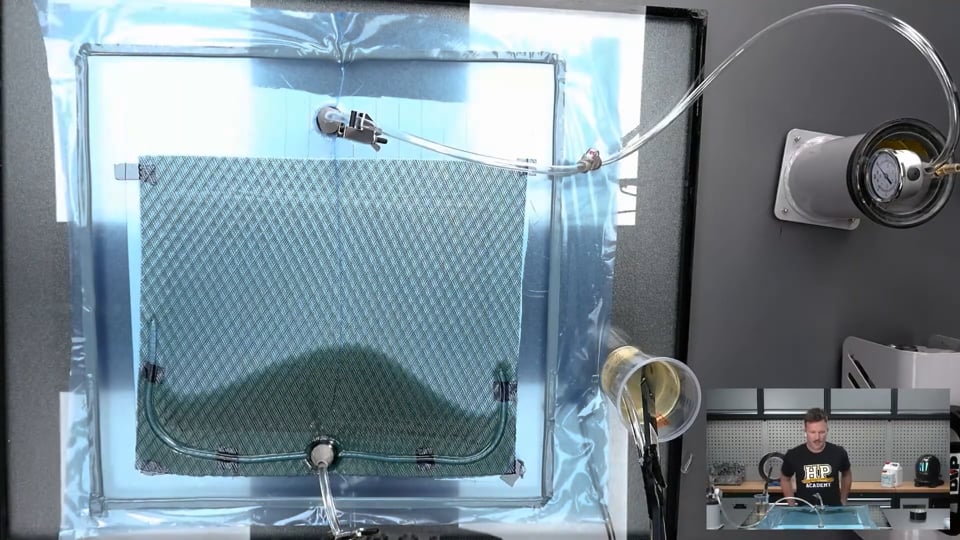
| 11:13 | So, we just have that placed on top of it on top of the reinforcement and we're going to leave a little section up here just clear of the infusion mesh and that's going to work as a bit of a resin break to make sure as we flow up we fully infuse all this before the flow actually gets to the vacuum port. |
| 11:34 | But that'll make a little bit more sense soon as we start to lay up the ports and so on. |
| 11:39 | So, infusion mesh is just to help speed up and facilitate the flow of the resin through the layout. |
| 11:48 | And then finally in our stack we have the actual vacuum bag itself and we're going to come back to this soon in a little bit more detail but it's a nylon-based bag that is relatively stiff and tough so it doesn't puncture but it also has a little bit of flexibility in it as well so it can kind of conform to shapes a little bit too. |
| 12:14 | But we'll come back to this shortly and for now we're just going to get started laying up a few other consumables that we'll need. |
| 12:24 | I'll just put this down here for now. |
| 12:28 | And that will be sealed to the mold surface, so a tool sealed bag in that case, using some tape. |
| 12:34 | But again we'll come back to that. |
| 12:36 | So, now we need to add a few consumables that will facilitate the resin flow through the layout. |
| 12:43 | Some of those are going to be these little ports here. |
| 12:46 | So, these are essentially just little silicon parts that have a port in the top here for the hose to go through and then they have some little channels down the bottom as well. |
| 12:59 | We'll be using one here for the resin feed and then we're going to use one over on the other side for the vacuum port. |
| 13:10 | So, it is possible to move these into different positions and infuse this way across the part. |
| 13:17 | We're just going to keep it very simple in this case and just go straight across. |
| 13:23 | And we just want to keep that off the surface of the reinforcement as well. |
| 13:27 | So, you see the reinforcement's about here and we're just going to keep that about here. |
| 13:32 | And then this is also accompanied on the resin feed side by what's called spiral. |
| 13:39 | So, spiral is just a hose that has been slit down its length in a spiral. |
| 13:46 | So, you might be able to see as I kind of pull that apart that basically creates even gaps all the way along it that the resin will be able to flow through the center of it but also seep out of it at the same time. |
| 13:59 | And I'm going to set up the spiral to kind of come along the bottom and then slightly up the edge of the part. |
| 14:07 | And once we start the infusion you'll be able to see a little bit better why we do that. |
| 14:11 | But basically the resin flow through the part or controlling how the resin flows through the part is really important because what we don't want to do is end up with parts of the layup that are missed and we get dry spots or essentially islands as well because if we for example started the infusion from out here and it started to flow this way and missed a section here, once it gets to the port, once the resin gets to the vacuum port, this whole area will just be left dry and there's basically nothing we can do about it. |
| 14:49 | And same thing as we come up the sides here, we don't want to get to a point where it comes into the port and misses areas here. |
| 14:56 | At the same time we want to make sure this all happens within the the pot life of our resin before it all cures. |
| 15:04 | So, what I'm going to do is just clip that port over the spiral like that and then I can just use little bits of tape. |
| 15:14 | Typically duct tape works good. |
| 15:16 | This is just a scotch kind of race tape just to kind of hold these consumables in place. |
| 15:25 | So, I'm just going to put a little bit onto the spiral there so I can keep it off the surface of the actual reinforcement. |
| 15:35 | And the reason we do that is because as the vacuum bag kind of clamps down on everything and it begins to cure, we would get this witness mark or line down our part where the infusion mesh, sorry, where the infusion spiral was laying on top of it. |
| 15:53 | So, we don't want that kind of witness mark on the the final part. |
| 15:57 | It is also possible to use little bits of this tape to just stick our peel ply and our mesh to the the mold surface as well. |
| 16:15 | So, we'll just do that in a few places just so it doesn't kind of move around on us as we start to pull vacuum on the bag and everything shifts a little bit. |
| 16:23 | For a part like this that is very easy, it shouldn't be too much of a problem but you never know. |
| 16:32 | It's better to be safe than sorry. |
| 16:36 | I'll just put a few more little bits up here and this shouldn't affect the actual resin flow too much. |
| 16:44 | We'll soon see. |
| 16:51 | Cool. |
| 16:53 | So, now we have our reinforcement, our peel ply, our mesh and our ports and our spiral all in place. |
| 17:02 | Now, the next step is going to be actually creating the bag. |
| 17:05 | So, as I mentioned before this will be what's called a tool sealed bag. |
| 17:09 | So, we're using the tool or the mold surface to seal the bag against. |
| 17:13 | The alternative to this would be an envelope bag which is where we basically make a big envelope and put the entire layout in that with the mold as well. |
| 17:22 | Usually, when we're doing infusions we're doing a tool sealed bag like this but it is possible to do it with an envelope bag but that's more kind of typical for a prepreg smaller part or a wet layout that's vacuum bagged as well. |
| 17:35 | Cool. |
| 17:35 | So, the next step is to get our tape. |
| 17:39 | So, this is a really gummy kind of sealant tape and we're going to use that to seal the bag off as well. |
| 17:49 | So,rry, seal the bag against the mold. |
| 17:52 | So, we just start by kind of going around the border here and at the ends here we can kind of tear it and then overlap or what we can do is just tear the backing paper slightly and then make a kind of 90 degree turn here. |
| 18:09 | Come along the sides nice and straight. |
| 18:14 | Tear that as well. |
| 18:17 | Come along the top. |
| 18:24 | Tear and then down the side. |
| 18:31 | Pull back the backing paper slightly on this bit if it lets me and then just overlap slightly and then you can tear it or I just find it easier to cut the tape like that. |
| 18:55 | So, now we've got the sealant tape on and it's really important that that creates a really really tight seal and we don't end up drawing any air into the infusion as we go but we will do a drop test which is basically like a leak test to ensure that we don't have any issues with that just shortly. |
| 19:16 | So, now the next step is going to be putting the bag material on top. |
| 19:22 | So, get our bagging film. |
| 19:29 | Yep, we'll get this all set up and then we will talk about the resin that we're actually going to use in just a moment as well. |
| 19:39 | So, just make sure the bag's going to fit over that sealant tape which it is and then we'll just peel back the sealant tape bit by bit and I like to just work from one of the corners across the part. |
| 19:58 | While we're doing this I will just mention that some of you might have kind of seen this process and seen what's called pleats and wondering might be wondering if we're going to use any pleats. |
| 20:09 | So, pleats are basically vertical sections of our sealant tape that create folds or pleats in the bag and basically that just allows you to have more bagging material for the kind of perimeter. |
| 20:23 | So, when we have if you think of a mold that has a curvature to it or kind of like a valley in it or something where the surface area is quite big relative to the perimeter that means that we get the bagging material can actually compress to the surface really well and we don't get the bagging material stretching over things and potentially breaking or the bagging material being too short to span into the mold and then get something called bridging where we basically have Unconsolidated areas, and we'll get big voids in the part. |
| 21:00 | In this part, just because it's perfectly flat, and although it kind of has to go over the spiral and everything here and the ports, there's enough kind of flexibility or stretch in the bag that we don't need those plates, but so in this case, we don't don't really need them, and I'll just keep them kind of, keep things simple, save us some time, and we'll just avoid that. |
| 21:25 | I might have just made a mistake there. |
| 21:28 | I kind of need to work along that smoothly, so we don't get any creases in the bag. |
| 21:33 | We get a nice seal. |
| 21:37 | So, you can kind of pull the tape back. |
| 21:44 | A bit of a crease there, but that's not too bad. |
| 21:47 | Like I said, the bag's got a little bit of stretch to it, so you can kind of stretch it out and get rid of any creases, and then this top bit's just going to be a little bit tricky, because I can't walk around to the other side. |
| 22:11 | I expect we're just going to get a bit of a crease here as we come along, but we'll work with it. |
| 22:19 | What we can do is kind of stretch things out a bit. |
| 22:27 | Lay that down, and then I'll just grab a tiny little bit of tape just to fix that little crease. |
| 22:33 | I could have just done a better job at getting the bag on there all square, and I wouldn't have to do this, but that's what it is. |
| 22:43 | I'm just going to make a little raised section there to get rid of that. |
| 22:50 | Press that all together. |
| 22:52 | That'll be fine, and that'll give us a little bit of extra bag there, like a mini pleat around the vacuum point there. |
| 22:59 | Cool. |
| 22:59 | So, again, we just run around the outside, make sure that's all laid down really well, and we don't have any areas where it's going to leak. |
| 23:09 | Oh, sorry. |
| 23:10 | Now, the next point is going to be connecting some vacuum line, or yeah, vacuum line for this case, or the resin feed line, into these ports. |
| 23:21 | And the way we do that is when we're using ports like this, is to just make a little pierced hole in the bag. |
| 23:32 | Like that. |
| 23:35 | And then, watch me struggle with this, because this vacuum line is slightly too big for these ports, but I'll just slash cut the end of this slightly to make it a little bit easier. |
| 23:52 | Get this off the bench, tidy things up. |
| 23:56 | And then now we just can push that through the bag, down into the port. |
| 24:04 | And it's usually not this easy, but like I said, not this difficult, sorry. |
| 24:10 | But like I said, it's just a little bit tricky with these. |
| 24:13 | This line that we've got is a little bit too big for these ports. |
| 24:18 | But once we've got that in there, then what we do is just cut a little bit of our tape again, peel the back off it, and then we can just kind of stretch that around the port, to seal it off. |
| 24:44 | And like I said, this side is going to be the vacuum, sorry, the resin feed port. |
| 24:54 | So, the resin is going to be fed through this one, and then the other side is going to be the vacuum port that connects up to our vacuum pump. |
| 25:04 | So, same thing on the other side. |
| 25:09 | Pierce through there a little bit, then grab our line from our catch pot and a vacuum pump here, and then same thing. |
| 25:23 | Struggle a bit to get that pierced through there. |
| 25:38 | Might need to make the end of the line a little bit nicer, and the hole in the bag a little bit bigger. |
| 26:06 | The great thing about doing all this stuff live... |
| 26:14 | We're going... |
| 26:21 | There we go. |
| 26:23 | Right, cool. |
| 26:24 | All right, and same thing there. |
| 26:26 | Just want to seal that off with some of our tape, so we don't have any vacuum leaks or resin leaks. |
| 26:40 | So, just kind of stretch the tape out around that, push it down, kind of try to get it to seal up nicely, but we will come back to it in just a moment. |
| 27:03 | So, the next step for now is just going to be clamping off these lines, so we can do what's called a drop test. |
| 27:11 | Check that we don't have any leaks. |
| 27:14 | So, I've just got these little clamps here, which just clamp the line, seal it off, I'll just rest that one on there for now, because I don't want to clamp it off obviously while I pull a vacuum. |
| 27:41 | That one's actually just going to stay there, so at the end I can clamp it off while the part cures. |
| 27:49 | So, now what we're going to do is perform the drop test. |
| 27:51 | So, I've got my vacuum pump here, which has a vacuum gauge on it, which you might be able to just see there, and I'm going to just draw down on the bag. |
| 28:10 | See, you can hear, I've just got some leaks here. |
| 28:14 | So,unds like the main one's kind of coming from this port, maybe this area here. |
| 28:26 | Try that again. |
| 28:33 | So,unding a bit better. |
| 28:42 | Yeah, and if we watch our vacuum gauge here, it's holding that vacuum pretty good. |
| 28:48 | Could be a little bit better if I'm honest. |
| 28:52 | But it's hardly moving. |
| 28:53 | So, typically what we'd want to do for a resin infusion, which we don't have time to do, is leave that for about 30 minutes or so, and this should only move. |
| 29:03 | Well, it shouldn't move anything ideally, but we do have a little leak somewhere. |
| 29:08 | It could also just be in our line here. |
| 29:11 | But these leak flow indicators that we have here, these would also spin if we had a leak. |
| 29:17 | So, it's looking pretty good. |
| 29:20 | So, basically the next step from here is going to be to prepare our resin and get ready for the infusion. |
| 29:27 | So, let's just discuss the resin a little bit. |
| 29:33 | So, resin systems for high-performance composite parts. |
| 29:38 | We could be talking about epoxy, which we're going to use today, and that's kind of best suited to carbon fiber parts for resin infusion anyway. |
| 29:48 | It does have its advantages, but also its downsides. |
| 29:52 | We could also be using polyester. |
| 29:54 | That's kind of more typically used with chopstrand matte fiberglass for mold making or kind of body kits and things like that. |
| 30:02 | And then the one that kind of sits in between is vinyl ester, which has some... |
| 30:07 | it's a bit of a step up from polyester, a little bit of a mix between that polyester and epoxy, and it has really good chemical and weathering resistance as well. |
| 30:16 | So, it does quite well in UV light if we're talking about infusing bonnets or body panels like that. |
| 30:23 | Our resins, so I'll grab this one that we've got here. |
| 30:28 | We'll just have a quick look at that. |
| 30:30 | So, they're typically kind of infusion specific. |
| 30:33 | So, this one here says on it, you might not be able to read that, laminating and infusion epoxy resin. |
| 30:42 | So, this one, it's kind of specific for infusion, and as such it's basically lower viscosity and that allows it to flow through everything a lot kind of easier. |
| 30:56 | A laminating only resin would typically be a bit thicker and have more thick satropy, which basically means it kind of clings to vertical surfaces better, and that just makes it a little bit easier when we're actually hand laminating. |
| 31:09 | So, infusion resin, typically a little bit less viscous, so it flows better. |
| 31:16 | And then also when we're working with an epoxy, we will have a hardener here as well, which goes with it that initiates the curing process. |
| 31:27 | And this one in particular is a slow cure hardener. |
| 31:31 | Again, it's just written small down there. |
| 31:33 | So, it cures quite slowly and that just allows us the ability to infuse quite large parts without it kind of being, going off while the infusion is happening. |
| 31:45 | So, I think this kind of gives us about a 60 -minute pot life or so, whereas a more typical one would be 30 minutes or so. |
| 31:54 | So, we're going to mix it up in just a moment. |
| 32:01 | One of the questions that you might have is how much resin do we need and how do we know how much we'll need? There are a few things we can kind of think about here. |
| 32:12 | One is if we're doing an infusion like this, typically we'll have 50-50 fiber to resin ratio or even 60-40, where we have 60% of the composite by weight will be the fiber and 40% by weight will be the resin if we do an infusion. |
| 32:31 | Pre-pregs might be even lower like 70-30 to really get the resin out of it because that's just really holding the fiber together and we get most of the mechanical properties from the fiber. |
| 32:43 | So, it is possible to say if I weighed out this reinforcement, which I did before coming over here and it was about 70 grams, then we're going to need 70 grams or maybe 60 or even a little bit less of resin in it. |
| 32:57 | But in saying that, there's going to be a whole lot of resin that's used up in our line, in the peel ply, in the mesh as well and just kind of in the empty parts of the bag too. |
| 33:10 | So, that's something to consider. |
| 33:11 | So, we kind of need to mix up a lot more than we think we need. |
| 33:16 | There are other techniques we can use, kind of like a vertical orientation. |
| 33:20 | So, we stand the mold surface up and then watch how it balloons in the bottom and kind of throttle with the clamp, the feed into it to control all of that. |
| 33:31 | We're going to keep it simple today. |
| 33:33 | That can get quite kind of complex. |
| 33:35 | We're just going to keep it simple and just do a standard infusion here and just make sure we have enough resin for the part. |
| 33:42 | The other thing that I need to talk about is naturally I'm doing this live with the microphone and everything on, so I can't really wear a respirator. |
| 33:50 | Typically, this is the respirator that I would wear and it's really comfortable and quite nice to wear, but I'm not going to use it today. |
| 34:00 | And the only reason that I'm comfortable doing it is in here we have quite good ventilation, but also epoxy resins are super low VOC. |
| 34:10 | So, the amount that they kind of gas off their fumes is quite low. |
| 34:16 | That is not to say it's not dangerous doing this and it is toxic, but just get it done quickly. |
| 34:23 | After we stop filming, I'll put that on while we tidy everything up, so it's not going to be too much of a problem. |
| 34:28 | If I was using a polyester resin, really high VOC, like 30% compared to 1% or so for the epoxy, I definitely want to be working with a respirator. |
| 34:38 | At the same time, I'm going to be using these gloves as well. |
| 34:42 | So, I've just got some nitrile gloves for epoxy work. |
| 34:46 | But again, typically for polyester or hand laminating, we'd use latex gloves because the epoxy ones tend to kind of fall apart a little bit as well. |
| 34:55 | So, we'll just get straight into it and start mixing up some epoxy and then get this infusion happening. |
| 35:03 | So, I've got my scales here, put that on and I'll just zero those with the cup on them. |
| 35:15 | Then what I'm going to do is mix up, try to do it with 300 grams, actually 400 grams maybe. |
| 35:28 | And then we'll be able to go 4 to 1 really easy. |
| 35:41 | So, 396, that's getting pretty close. |
| 35:45 | And yeah, we have to mix these at 4 to 1 in the case of these resins. |
| 35:49 | Not all resin systems are 4 to 1 like that. |
| 35:51 | The West system laminating resin that we use, epoxy, is 5 to 1 and most are kind of other ones that we use. |
| 36:06 | Polyester and vinylester resins, to be a bit more clear about that. |
| 36:13 | We mix them with a catalyst called MEKP and that's typically at about 2%, so a lot less. |
| 36:22 | So, it's quite hard to kind of mix this much resin in a small container like this. |
| 36:28 | If I bought another one I would have poured them in between the two, but this will get the job done. |
| 36:37 | And it'll be really important as well, after we finish the infusion, that the leftover resin is kind of dispersed and disposed of safely. |
| 36:45 | Because if we have, you know, quite a lot in this, it'll get really hot and it is actually a fire risk. |
| 36:52 | You can't just chuck it in a bin with a whole bunch of old rags that have kind of petrochemical products on them because you'd probably burn down your workshop. |
| 37:02 | So, that's definitely something to consider as well. |
| 37:06 | So, we're just mixing this up thoroughly, making sure I'm scraping down the sides and getting everything really good. |
| 37:13 | Do it a little bit longer and then we'll get this set up with the suction line in it and we'll start the infusion. |
| 37:23 | And then we'll work towards wrapping this up as that kind of happens. |
| 37:29 | Right, pretty happy with that. |
| 37:32 | One little thing that I like to do, can I do this with gloves? I'm not sure, is tape the feed line to the mixing stick and that just helps hold it in the bottom. |
| 37:48 | I don't think I'll need to do that in this case. |
| 37:51 | I should kind of get away with it as it is. |
| 37:53 | We're just going to put that there. |
| 37:55 | That should be held in the bottom there pretty good. |
| 37:57 | Remove these scales. |
| 38:02 | Okay, so we'll just pull that down a little bit more. |
| 38:12 | Make sure we're happy with how everything is. |
| 38:15 | Get rid of these gloves. |
| 38:20 | Now, what I'm going to do is I'm just going to flush out the air in the line here. |
| 38:24 | So, we've got this under vacuum. |
| 38:29 | And then what I want to do is just, maybe I do need to tape that, bear with me for a second. |
| 38:37 | Yeah, I just do not want that line to come out and suck air into the layout as we go. |
| 38:50 | Just going to kind of tape that to the mixing stick there to try to keep it at the bottom there. |
| 38:59 | Okay, I have a rag. |
| 39:02 | Cool. |
| 39:03 | So, like I said, if I open this now, I can just draw the resin through. |
| 39:13 | I'm just going to stop it slightly again. |
| 39:15 | And the point of this is to just give the air a little bit of time to just draw out of the bag. |
| 39:23 | One technique as well to get all the air out of the system is to actually degas the epoxy here, or degas the resin. |
| 39:29 | And that'll just make sure it kind of like leads to a bit of a better surface finish in the end. |
| 39:35 | But I'm just giving it a moment to just pull as much air out of the bag as possible. |
| 39:39 | But as we're working live, we've only got so much kind of time to do this. |
| 39:43 | So, now I'm happy that's sitting at the bottom there, that's all mixed up. |
| 39:48 | The bag's holding good and we're ready to go essentially, so we can get started. |
| 39:54 | So, I'm just opening the clamp here and away we go. |
| 40:02 | So, you can see straight away it's starting to wet this out and it's moving pretty quickly because we have that infusion mesh. |
| 40:09 | And it's also flowing along the spiral here and it'll work its way up and kind of propagate out of the spiral as it goes. |
| 40:17 | So, that should all happen pretty quickly. |
| 40:24 | I will keep the vacuum going while I do that, just to make sure everything looks good. |
| 40:31 | And you can see basically how I've done this, so we kind of even up the resin flow where if it was just done from the middle it would kind of come out here. |
| 40:40 | And we risk to some degree leaving these bits dry, but you can see just how quickly that works on quite a small part like that. |
| 40:49 | And with the infusion resin being so kind of low viscosity, the infusion mesh also aids it quite a bit. |
| 40:56 | We could probably... I wouldn't do this without the infusion mesh. |
| 40:59 | And you'll see as it comes to the end here that... |
| 41:05 | I have to watch out for that. |
| 41:07 | It'll slow right down now once it kind of hits our resin break at the end there. |
| 41:15 | So, what I'm going to do... is that's just getting to the vacuum port. |
| 41:20 | And I'm happy that the whole thing's infused, I just don't want this to fall over. |
| 41:25 | So, it'll make a real mess. |
| 41:27 | We obviously don't want to draw resin up into our vacuum pump. |
| 41:34 | We've got quite a while naturally as it comes up this and comes into our catch pot, that's the point, but this is all good here. |
| 41:41 | It's holding vacuum really well. |
| 41:43 | So, what I'm going to do is I'm just going to clamp down on the vacuum line here. |
| 41:53 | That's a really good clamp. |
| 41:55 | And then just a few moments later, as we kind of get a little bit of extra resin flowing into the part, we can then kind of clamp off our feed line here. |
| 42:07 | I don't want that to fall over. |
| 42:16 | And that little bit of extra time just helps, a little bit of extra resin flowing into the part which tends to really help with the surface finish. |
| 42:26 | Please don't fall over, I don't want to make a mess. |
| 42:32 | Okay, cool. |
| 42:38 | Right, now I have the feed clamped off and the line clamped off here and that's all good. |
| 42:45 | And then essentially it's all wet out. |
| 42:47 | It's used, I would say, a little bit more than half of that kind of 500 mils. |
| 42:53 | So, that just kind of shows you how much is in the line here and how much has been used up in the peel ply and the infusion mesh as well. |
| 43:01 | So, now it's just a matter of leaving this all to cure and in 24 hours or so I'll be able to pull everything off, demould it and then trim the outside of that part. |
| 43:12 | Naturally, we're not going to wait to do that here, so I'm just going to show you some kind of ones that I prepared earlier. |
| 43:20 | This is just a bigger flat panel with essentially the same laminate there. |
| 43:27 | A little bit different, rather than three layers of the twill, I have one layer of twill, two layers of a double bias and then another layer of twill on the back. |
| 43:38 | And we get this really nice glossy surface finish with my fingerprints on it. |
| 43:42 | On the glass side, those fingerprints can be cleaned off, they're not actually in the surface of the part. |
| 43:48 | And then on the back, that is our peel ply surface there, mucked up a little bit, but it's a nice kind of textured surface that works really good for bonding, gluing to the back of the part. |
| 43:59 | It is possible to get glossy surface on both sides if you kind of compressed it in a big press, for example, but this is how it's going to come out in this case. |
| 44:11 | So, that one there actually was infused. |
| 44:14 | And then I have another one here, which looks very similar, a little bit worse, but this one was done with a wet layout and then vacuum bagged. |
| 44:27 | And it just has, you probably can't see them, but a few more little kind of surface imperfections and pinholes in it. |
| 44:33 | It's a little bit thicker. |
| 44:35 | The backside has got a little bit more kind of ridges and stuff on it from the breather bunching up. |
| 44:42 | And then it is also about 10 to 15% heavier than the infused part as well. |
| 44:51 | So, that just all comes down to it's exactly the same layout, but it has more resin in it. |
| 44:55 | So, a little bit lower performance and arguably more stressful to make that one. |
| 45:02 | I wouldn't want to make that one live on camera just because you're working with wet resins. |
| 45:06 | You've got to have the respirator on and so on, where this is just a little bit kind of easier to do. |
| 45:11 | So, with that covered, I should have mentioned, if you have any questions about this, feel free to ask them in the chat and I'll do my best at the end to answer them. |
| 45:19 | We're at the end now, so I will just grab my laptop and see if we've got any questions that I can kind of answer. |
| 45:43 | Spectral Composites, do you guys have, I assume by your name that you know a lot about composites. |
| 45:47 | So, hopefully what I've done hasn't been anything you've noticed being wrong. |
| 45:53 | Do you guys have Gurrit Epoxy in your area? I'm not sure if I said that right. |
| 45:57 | Gurrit Epoxy has a blendable hardness system. |
| 46:01 | You can create a custom cure time. |
| 46:04 | Super important to do a 100 gram test batch to ensure you know when your cure will occur in your environment. |
| 46:12 | I actually haven't seen that or used that, but it's something that I will look out for. |
| 46:17 | I'd say we probably can get hold of it, but again, I haven't seen it before. |
| 46:23 | I just talked to the guys at Adhesive Technologies here in New Zealand about kind of the curing rate that we want, and then they kind of provide the parts from there. |
| 46:32 | But good to know about that, I'll look into it. |
| 46:38 | The ShotgunGuy3721, when these cure, do you have to bake them or something? No, not for these ones. |
| 46:45 | It is possible to do kind of a post-cure on parts depending on the resin system that you're using. |
| 46:50 | But in this case, it's not required for this one. |
| 46:55 | We typically take that approach a little bit more for like pre-preg parts. |
| 46:59 | You cure them at temperature, and then afterwards you do a post-cure as well, and that kind of gets the best mechanical properties and best temperature resistance and so on. |
| 47:09 | But I don't have to bake these ones. |
| 47:12 | Same guy, that ShotgunGuy3721. |
| 47:17 | For resins that require baking, do they have better qualities like in terms of heat and aside from hardness? So, yeah, I think generally they would. |
| 47:29 | If they are kind of baked at higher temperatures, then that is because they typically can then achieve those higher temperatures as well. |
| 47:37 | That's typically how that works. |
| 47:39 | It won't be the case in every instance. |
| 47:41 | There's a lot of different resins out there, all with kind of varying properties and so on, and it's changing all the time with technology as well. |
| 47:51 | But typically, generally, what you said there is true, yes. |
| 47:55 | ZeroDrift1, any chance of saving a partial infusion? It's tricky. |
| 48:01 | It kind of depends on the case. |
| 48:04 | I think you mean partial infusion, like you don't get the whole way through. |
| 48:09 | We've kind of had to do that before where you back off the vacuum and basically open up the bag slightly and then pull passageways into the bag to allow it to flow through a little bit better. |
| 48:24 | But generally speaking, you're going to end up with some pinholes and stuff in the part. |
| 48:28 | So, it's a bit tricky to do. |
| 48:30 | A lot of the time, it's just, it'll be what it'll be. |
| 48:34 | After the part's cured, you can try to wet it out again. |
| 48:38 | But unfortunately, it's kind of, you do all the prior work before and really plan everything out. |
| 48:44 | So, at the end, you make sure that it's going to all go to plan. |
| 48:52 | But yeah, unfortunately, there's only so much you can do once you actually start the infusion. |
| 48:57 | That's kind of, yeah, it'll be what it'll be. |
| 49:02 | Olorolo. |
| 49:03 | So, it's not really needed to get the air out of the epoxy before pouring it in. |
| 49:08 | No, it's not. |
| 49:09 | It's not really necessary. |
| 49:10 | Like you can wait and then now, like how it's gone because I haven't just mixed it up. |
| 49:14 | There's no air bubbles in there anymore. |
| 49:17 | There's no air bubbles in the line either. |
| 49:20 | So, just give it a little bit of time if you're doing this. |
| 49:23 | Obviously,, don't wait too long that it starts to cure. |
| 49:26 | Always be aware of your pot life. |
| 49:28 | But just give it a bit of time. |
| 49:31 | Degassing, if you're kind of doing it at a more professional level or doing casting resins, degassing is used to pull the air out of it. |
| 49:38 | But it's not always really required, I'd say. |
| 49:44 | Curing ovens necessary for DIY resin infusion projects. |
| 49:49 | If the project is too big for a small oven, what can you do to cure it? So, resin infusion, generally, you're not going to require a curing oven. |
| 49:56 | That's more for like pre-preg work. |
| 49:58 | Out of autoclave pre-pregs, you can use a curing oven. |
| 50:03 | Some resins, like we mentioned, need to kind of be post-baked or cured in an oven. |
| 50:12 | But yeah, it's not too important, I guess. |
| 50:17 | Resin infusions typically don't need to be baked in an oven. |
| 50:20 | So, like this part here, I'm just going to leave it to cure for 24 hours or so. |
| 50:24 | And then those two flat panels before I showed you, and we just made a bonnet as well. |
| 50:28 | No post-curing required. |
| 50:31 | All right. |
| 50:36 | That shotgun guy, 3721. |
| 50:38 | Is there a recommended type of resin for each type of body part or any part in general? So, it depends on the processor you're using. |
| 50:48 | Generally, speaking, epoxy resins theoretically lead to better mechanical properties for carbon fibre parts. |
| 50:56 | And they bond better to the carbon fibres. |
| 50:58 | If you're working with chop strand matte fibreglass, you cannot use an epoxy resin if the fibreglass matte is emulsion bound, which most of them are, because it won't dissolve the binder and you won't be able to wet out the matte. |
| 51:13 | So, you need to use a polyester or a vinylester resin. |
| 51:17 | Some chop strand mattes are powder bound, more like the non-woven carbon fibre stuff, so you can use epoxy resins in those cases. |
| 51:26 | Generally, when we're doing an effusion, epoxy is great, but in saying that, it doesn't have very good UV resistance. |
| 51:33 | So, if you're making a roof or a bonnet or something like that, and you want to leave it raw, then you're going to need to use a UV coating over it. |
| 51:43 | In practice, it can actually be better to use a polyester or vinylester resin, especially if you're hand laminating, because the epoxy resin will kind of usually go off a little bit quicker and it gets very hot as well. |
| 51:55 | So, actually hand laminating with epoxy can be quite difficult and you might, as a kind of someone getting started with composites, actually have better results, even though theoretically the mechanical properties might not be there. |
| 52:08 | Practically, you'll get a bit apart from using a polyester and epoxy. |
| 52:12 | Resin infusion, tend to use epoxy, unless it's like a bonnet or something like that, and we don't plan on coating it and we want to use a gel coat or something like that. |
| 52:22 | But hopefully that gives you a little bit of more kind of insight into that. |
| 52:28 | Anyway, it's a very deep rabbit hole of the resins. |
| 52:34 | Right, Spectral and the guys are saying I did great, so I appreciate that guys. |
| 52:40 | Will you be making a mould and then a part out of carbon fibre in the future live? Probably won't do it live, but we have got a composites course that should be coming out in the next two weeks or so. |
| 52:50 | A fundamental composite course where we're doing hand lamination, mould making, pattern making, and all the fundamental stuff you need to know about reinforcements, resins, consumables, tools and so on. |
| 53:02 | That will be coming out then, and then early next year sometime we will have our advanced one coming out with resin infusion, vacuum bagging and prepreg work in it as well. |
| 53:11 | So, if you're interested in learning more about this, keep an eye out for that. |
| 53:17 | Right, so... |
| 53:19 | Zero drift. |
| 53:20 | How much vacuum do you need to have a successful part? Is 25 inches mercury sufficient? So, on this I was pulling that to 30. |
| 53:31 | It's backed off slightly because I have a leak, so as soon as this is done I'm going to fix all that and make sure that vacuum's pulled down good while it cures. |
| 53:39 | Is it sufficient? I would say for resin infusion... |
| 53:43 | probably just. |
| 53:45 | But the more vacuum you can have, the better. |
| 53:49 | About 1 bar or your negative 30 inches of mercury is going to be a lot better generally for resin infusion and then curing out of autoclave prepregs for vacuum bagging as well. |
| 54:03 | You want close to 100%, above 99% vacuum. |
| 54:09 | If you're doing a low compaction bleed on a wet layout part, with a breather and so on, then 25 inches of mercury is going to be more than enough. |
| 54:22 | That should be quite good for that. |
| 54:24 | And actually can have some benefits being not too overly compacted as well. |
| 54:29 | That shotgun guy, could you use a squeegee to help move the resin during vacuum or is that not good? I just honestly, you can try. |
| 54:38 | I've tried to use our fingers and stuff before to do it when it is going wrong. |
| 54:44 | But honestly, when it's compacted that much, it doesn't do much. |
| 54:49 | But again, you can back off the bag a little bit and try to do that a bit. |
| 54:53 | But yeah, it's quite tricky. |
| 54:58 | How do you make complex tubes in infusion? We'll save that for another day. |
| 55:06 | Yeah, the vacuum bagging kind of approach to that is a lot more tricky, where you have to make an internal tube in the vacuum bag and so on. |
| 55:14 | It's just a little bit hard to explain the whole process without animations or an actual... |
| 55:21 | something to be able to visualize it. |
| 55:23 | Osgar Boutou... |
| 55:27 | Epoxy resin vacuum infusion is possible with PLA 3D prints repeatedly. |
| 55:35 | So, I'm guessing 3D printing the moulds with PLA, you definitely want to coat those with some type of coating resin on them, something like XTC 3D is an epoxy coating resin. |
| 55:53 | So,mething like that to kind of seal that surface. |
| 55:56 | I haven't tried it yet, so I'm just not going to comment too much on it. |
| 56:00 | I'm not sure if it's PLA or if there's a better material to use. |
| 56:05 | Yeah, I won't go too deep into that, sorry, at the moment. |
| 56:08 | But it is something that we're going to look at doing 3D printing moulds and patterns in the future for the content. |
| 56:14 | So, we'll get to that when we can and just watch out for it. |
| 56:18 | So, I'll end the questions there, that's everything we've got. |
| 56:23 | Hopefully that's given you guys some insight into the infusion process from an introductory view anyway and kind of the key things that's considered. |
| 56:31 | It is one of those things that's as complex as you want to make it with different moulds and different layouts and there are some other consumables you can use too. |
| 56:38 | Key things you need to consider are the resin flow through it, through the reinforcement and just controlling that and making sure it all goes to plan. |
| 56:48 | But we'll wrap up there, I'll get this all tidied up and sealed up really good and we'll be back next week with another webinar. |
| 56:55 | So, thanks for coming, we'll see you next week. |