Selecting an intercooler for a forced induction build might seem simple, but there are a number of factors that need to be considered if we want the best result for our specific car.
The two main options are air-to-air and water-to-air intercoolers. Both can work well, but each has its own advantages, compromises and packaging considerations. Since building an intercooler setup can be expensive, it's definitely worth understanding the differences before committing to one path.
In this article: Why We Need an Intercooler | Air to Air Intercoolers | Water to Air Intercoolers | Efficiency and Pressure Drop | Packaging and Installation | Summary
Why We Need an Intercooler
When we compress air with a turbocharger or supercharger, the temperature of that air increases. This is made worse if the compressor is being pushed outside its efficient operating range, where it'll add even more heat for the same boost pressure.
Hot air is less dense, which means there's less oxygen in the same volume of air. The mass of oxygen trapped in the cylinder is one of the key limits on how much fuel can be burned efficiently, so hotter, less dense charge air works against power. In simple terms, heat is the enemy of power.
The job of the intercooler is to reduce charge temperature before the air enters the engine. This increases air density and allows the engine to produce more power for the same manifold pressure.
Lower charge temperature also helps reduce the risk of detonation. If air temperature becomes too high and the compensation tables in the ECU aren't correctly dialled in, the engine may become more prone to knock, which can quickly cause damage.
Air-to-Air Intercoolers
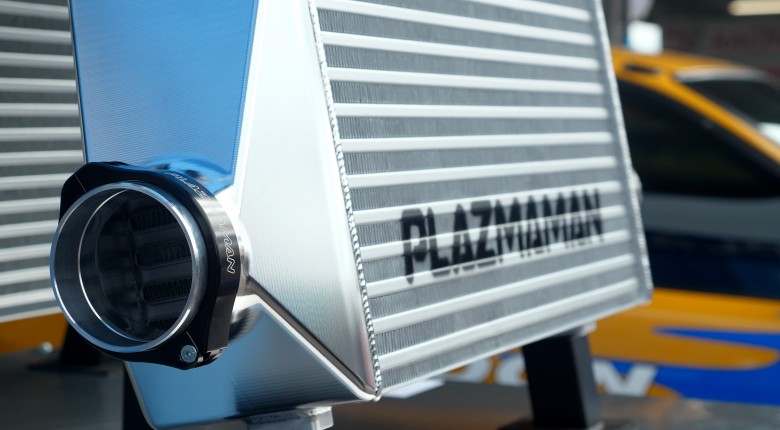
The most common intercooler style is the air-to-air intercooler. These are generally mounted at the front of the car where they're exposed to ambient airflow.
Charge air passes through the internal passages of the intercooler, while ambient air flows through the external side of the core. Heat transfers from the charge air into the aluminium, and then into the airflow passing through the core.
Air-to-air intercoolers are relatively simple, effective, and widely understood. In a conventional front-engine vehicle, fitting an air-to-air intercooler is usually straightforward, and there aren't many applications where one cannot be fitted.
Air-to-air intercoolers are commonly discussed as either bar and plate or tube and fin designs.
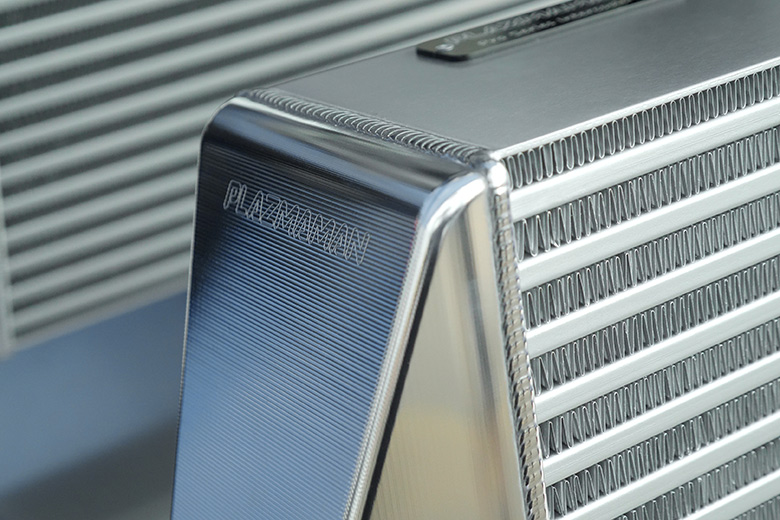
Bar and plate intercoolers, which are what we use on our builds here at High Performance Academy, are usually heavier because they contain more aluminium. This extra material adds thermal mass, which can help absorb short bursts of heat, although once heat-soaked it can also take longer to cool back down. Tube and fin intercoolers are generally lighter, but have less of this heat soak capability due to that comparative lack of thermal mass.
Both styles can work well, and neither is automatically the better choice. The internal construction of the core is often more important than whether it's bar and plate or tube and fin.
The internal fins are critical because they create surface area for the charge air to transfer heat into the core. Too little internal fin density reduces heat transfer. Too much can create a restriction and increase pressure drop.
A quality core needs the right balance. Not all intercoolers are created equal, and some cheaper cores may have very open internal passages with limited finning, which can lead to poor temperature control and reduced power.
Tube and fin cores can also be more prone to damage from debris because the passages are thinner. If pierced by a stone, they can be difficult or effectively impossible to repair properly.

Water to Air Intercoolers
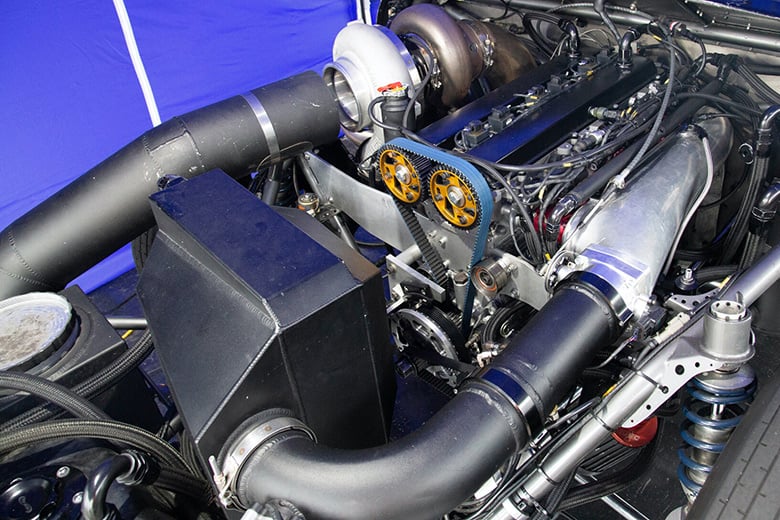
A water-to-air intercooler works on a similar principle, but instead of using ambient airflow directly as the cooling medium, it uses liquid flowing through the intercooler core.
In drag racing applications, this can be extremely effective. The system can start with ice water or an ice slurry, getting the cooling medium close to 0 degrees Celsius. Since the car only runs for a short period under high boost, the system doesn't necessarily need to remove heat from the water during the run.
An ice-only or reservoir-based water-to-air system without sufficient heat rejection is not suitable for sustained road, circuit, or time attack use. For those applications, a water-to-air system needs a properly sized pump, heat exchanger, reservoir, plumbing, and airflow path to reject heat continuously.
Water-to-air systems can make a lot of sense where packaging makes air-to-air intercooling difficult. This includes some mid-engine or rear-engine applications where airflow to an air-to-air core is hard to achieve, as well as V engine supercharger setups where the intercooler can sit in the valley below the supercharger.
The downside is added complexity, weight, cost, and simply more things to go wrong.
Intercooler Efficiency and Pressure Drop
Intercooler efficiency is measured by how well it can reduce charge temperature. In simple terms, we want to know how close the outlet air temperature can get to ambient temperature, or in the case of water to air, the temperature of the cooling medium.
For short-duration applications like drag racing, water-to-air intercoolers can be extremely effective. Water absorbs heat very efficiently, and when combined with an ice reservoir, charge temperatures can be reduced dramatically for a single pass.
For continuous operation like street driving, circuit racing, or time attack, a well-designed air-to-air intercooler will often provide lower and more stable intake temperatures over time.
This is because an air-to-air intercooler removes heat directly into ambient airflow in a single step. A water-to-air system has two stages of heat transfer: first from the charge air into the coolant, and then from the coolant into the atmosphere through a separate heat exchanger.
Since the coolant itself will eventually become hotter than ambient air during sustained operation, charge temperatures in a water-to-air system will generally stabilise higher than an equivalent air-to-air setup.
Pressure drop is also an important consideration regardless of intercooler type.
Pressure drop is the difference between the pressure entering the intercooler and the pressure leaving it. For example, if the turbocharger is feeding 20 psi into the intercooler but only 18 psi reaches the outlet, then the intercooler has a 2 psi pressure drop.
It's the pressure entering the engine that matters. A large pressure drop means the turbocharger is working harder than the manifold boost pressure alone suggests. As a rule of thumb, if pressure drop starts exceeding 2 to 3 psi, there may be a significant amount of performance being left on the table.

Intercooler Packaging and Installation
Packaging is one of the first considerations when choosing an intercooler type.
In many front-engine vehicles, a front-mount air-to-air intercooler is the obvious solution. In mid-engine and rear-engine vehicles, getting airflow to an air-to-air intercooler can be much more difficult, which is where water-to-air can become a better option.
For air-to-air installations, mounting style also matters. A front-mount intercooler is common, but a V-mount can be useful in cars with limited frontal space. A V mount can allow a larger core by leaning the intercooler back, but it requires careful ducting.
Air is lazy and will take the path of least resistance. Whether using a front mount or V mount, the airflow must be forced through the intercooler core using baffles, guide plates, and sealing. It's also important to provide a path for air to exit behind the core.

A large front-mount intercooler can also affect airflow to the radiator. If the engine cooling system is already marginal, placing a large intercooler directly in front of the radiator may create further problems. The entire cooling system needs to be considered, not just the intercooler.
There's also a common concern around intercooler volume, plumbing length, and throttle response. While it makes sense not to use larger or longer piping than needed, in practice, the increase in lag or throttle response loss isn't always as dramatic as some people suggest.
Did You Make The Biggest Intercooler Mistake?
The biggest intercooler mistake is assuming that one type, core design, or size is automatically the best choice.
Both air-to-air and water-to-air intercoolers can be effective, but the right choice depends on the vehicle, application, and packaging constraints.
Air-to-air intercoolers are simple, common, and usually the best fit for conventional front-engine vehicles. Water-to-air systems add complexity and cost, but can be a strong solution for drag cars, mid-engine layouts, or supercharged V engine applications where an air-to-air core is difficult to package.
Efficiency, pressure drop, core quality, ducting, and airflow management all matter. The best intercooler setup is the one that fits the car, controls charge temperature, minimises pressure drop, and supports the intended use of the vehicle.
Want to learn how to professionally plumb your vehicle, whether it's airflow, oil, or coolant? Start here.