PCMflash is a simple tuning tool used by tuners and calibrators to read and write data to a vehicle's engine control unit (ECU), and in some cases, the transmission control unit (TCU) too.

What Vehicles Does PCMflash Support?
Supported are a number of Ford, Mazda, Honda, Acura, Nissan, Infiniti, Subaru, Mitsubishi, Kia, Hyundai, Renault, Toyota, Lexus, Volkswagen (VW) and Audi ECUs. Coverage extends further to some Jaguar and Land Rover, Mercedes-Benz, Citroen, Peugeot, Jeep, Dodge, Lincoln, Aston Martin, Scania, and Volvo platforms. There's also some support for Chinese manufacturers including Great Wall, Haval, Geely, Chery, GAC, Changan, Dongfeng, SAIC, as well as Indian brands like Mahindra and Tata. Some Russian VAZ / UAZ ECUs are included too.
Beyond engine ECUs, PCMflash (aka PCM Flash) also covers some transmission tuning options. Transmission control units (TCU) tuning support generally covers many of the same brands as the ECU tuning options, including DSG, CVT, and automatic gearbox support for VAG, Ford, Mitsubishi, Subaru, Toyota, Kia, Hyundai, and others.
PCMflash Explained
It's important to understand that PCMflash is a flashing tool, not a full tuning platform itself. Its job is to manage the data side of the read/write process (essentially acting as the communication layer between your laptop and the ECU) rather than giving you a workspace to edit maps and tables.
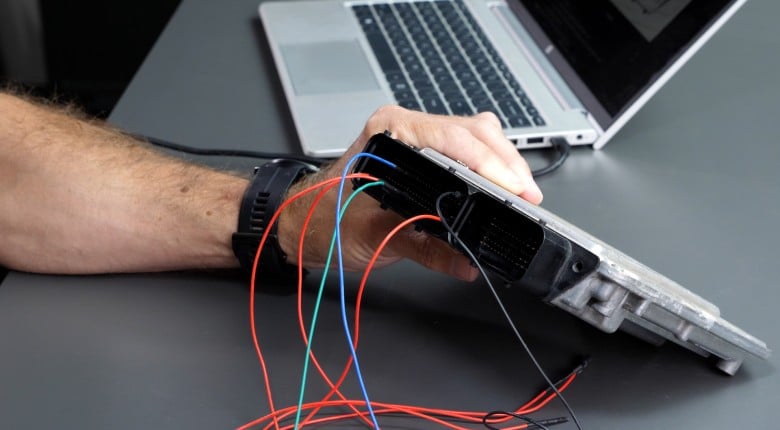
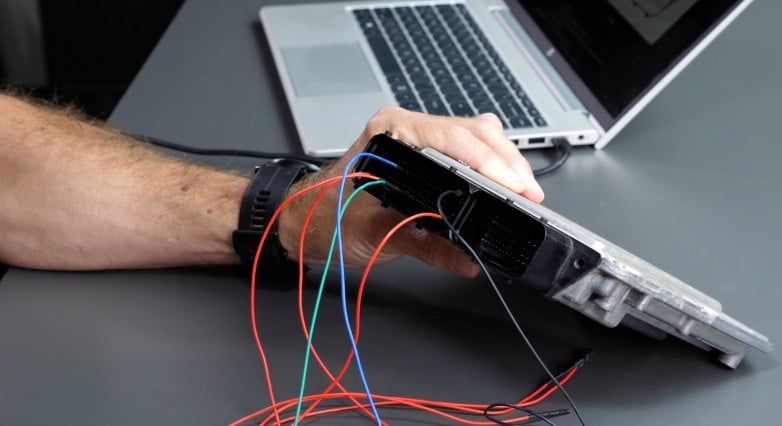
With the above in mind, PCMflash is made up of two parts. Firstly, it's a software interface that runs on your laptop, and second, a Guardant dongle that holds your license keys. Combined with a physical interface device (a Tactrix OpenPort 2.0 or similar J2534 OBD2 device, for example) or a direct bench read, you gain the ability to pull the factory calibration out of an ECU, flash a modified tune back onto it, or clone data from one unit to another.
It's worth noting that PCMflash uses a module-based licensing system, meaning you purchase the dongle first and then buy individual modules for the specific vehicles or ECU types you want to work with which are attached directly to that Guardant dongle, and like Bitcoin on a HDD, if you lose the dongle you lose the data/licenses forever (so keep it safe!)
If I Already Have WinOLS, Why Do I Need PCMflash?
If you're already running tuning software like WinOLS or ECM Titanium, why do you need a separate tool just to read and write the ECU? The short answer is that tuning software and flashing tools do fundamentally different jobs. WinOLS is designed for defining and editing calibration data. It gives you the workspace to open a file, locate maps, make changes, and save the result. What it doesn't do is handle the communication between your laptop and the ECU itself. That's where PCM Flash comes in.
Reading a file out of a live ECU, and writing a modified file back onto it, requires a tool that understands the specific communication protocols used by that ECU, and those protocols vary significantly across manufacturers and control unit types. PCM Flash handles all of that heavy lifting, acting as the bridge between your tuning software and the ECU. A common workflow would be using PCM Flash to read the stock file, opening and editing it in WinOLS, then using PCM Flash again to flash the modified file back onto the vehicle. It's a two-tool process, but each one does its job well.