391 | Make your own composite parts - The easy way
Summary
Composite parts offer great strength and stiffness at a low weight, making them a go-to choice for motorsport or performance applications. These materials are used at the pinnacles of motorsport, all the way down to the grass roots level. In this webinar we'll discuss some of the most accessible approaches to making your own fibre-glass or carbon fibre parts and starting your composites journey.
| 00:00 | Hey team, Connor here from HPA. |
| 00:01 | Welcome to today's webinar. |
| 00:03 | Today we're going to be looking at the easiest and most accessible approach to making composite parts for our car projects. |
| 00:10 | It's going to be wet lay-up, aka hand lamination techniques. |
| 00:14 | So, we'll just start off by talking about what hand lamination or wet lay-up is. |
| 00:20 | Basically, it's going to be wetting out our reinforcement with resin as we laminate it. |
| 00:26 | So, that's opposed to something like a resin infusion or something like that where we would lay up our reinforcement in the mould dry and then infuse the resin through it to wet it out after it's all laid up. |
| 00:39 | Or pre-preg where the material is, or the reinforcement like the carbon fibre is pre-impregnated with the resin before we lay it up and then after we lay it up through heat and pressure, the resin will flow. |
| 00:55 | And kind of wet out the reinforcement that way as well. |
| 00:58 | So, just to be clear there when we talk about laminating as well, we're essentially just talking about building up layers of reinforcement. |
| 01:07 | Be that our carbon fibre or our fibreglass, Kevlar, flax, whatever else we're using. |
| 01:13 | So, if that's all a little bit kind of rough and doesn't make too much sense yet, it'll make a little bit more sense as we progress through today's webinar as to how that process all works. |
| 01:25 | So, where is wet layups or hand lamination used? Where can we use them on our car parts? And essentially it would be making fibreglass parts. |
| 01:36 | So, I've got an example here. |
| 01:39 | This is a hand laminated or wet layup fibreglass fender for our Honda CRX. |
| 01:49 | We'll talk about this a little bit more as we go. |
| 01:51 | This is just using chopped strand matte fibreglass. |
| 01:55 | So, again, this is basically going to be the cheapest and most accessible type of parts that we can make. |
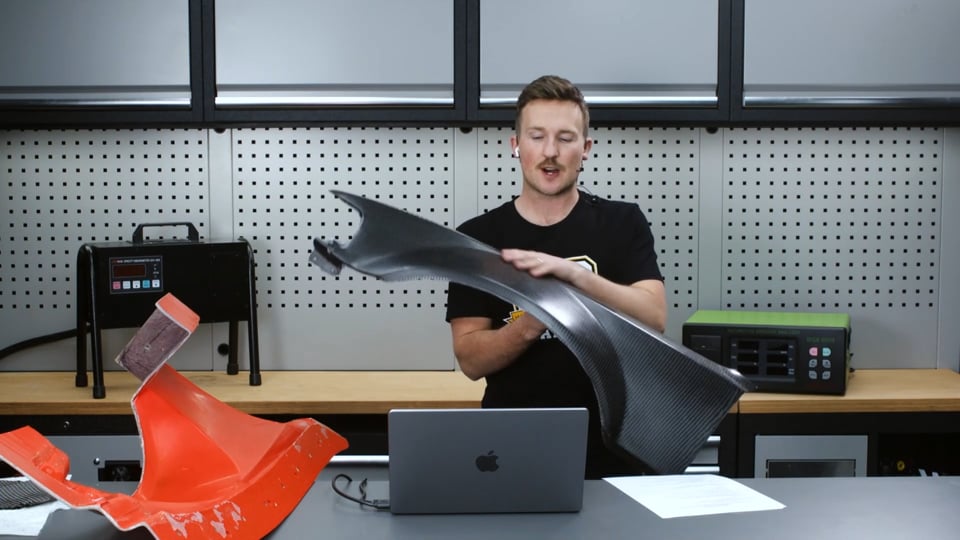
| 02:03 | The alternative or a little step up to that, I guess, would be a carbon fibre fender. |
| 02:09 | Again, this part here is just hand laminated wet lay carbon fibre. |
| 02:17 | So, we can do carbon fibre, fibreglass parts, Kevlar, other reinforcements as well. |
| 02:23 | And then also this here. |
| 02:25 | Is the mould for those two parts that we just saw. |
| 02:30 | Yep, the same side even. |
| 02:33 | And this part here, the mould itself is also made with hand lamination or wet layup. |
| 02:40 | With fibreglass, chopped strand matte as well. |
| 02:43 | So, even if you want to be doing resin infusion or prepreg work, a lot of the time the mould is going to still be made using a wet layup. |
| 02:56 | So, even if you're wanting to be working at the highest level, this most accessible technique is still something that you're going to have to probably have in your toolbox. |
| 03:06 | So, it's definitely worth learning. |
| 03:08 | But if you want to just do the most simple, cheapest and most accessible way to get into composites, this is probably going to be it as well. |
| 03:17 | Cool. |
| 03:17 | So, let's just talk about, dive a little bit deeper into what the process actually looks like of hand lamination. |
| 03:24 | And I'll just pull this mould back up here and put it on the bench just so we can kind of talk about it a little bit as we go. |
| 03:36 | So, essentially first, if we're assuming that we're starting with a mould like this. |
| 03:41 | And the mould for all intents and purposes is a cavity that kind of forms a negative of the parts that we're going to make. |
| 03:50 | And the mould surface being kind of the outside surface of the parts. |
| 03:54 | The backing surface would be inside the laminate. |
| 03:57 | And that's generally not going to be the important surface that we're worried about in most cases. |
| 04:04 | So, we're going to start off with our mould like this. |
| 04:07 | This is actually a two piece mould or from a two piece mould. |
| 04:10 | It's just one part of it. |
| 04:11 | We actually have another piece that bolts on here and has the flange for mounting under the bonnet or the hood. |
| 04:18 | But we're going to start off with our mould. |
| 04:20 | Before we start anything, we obviously want to make sure it's in good condition. |
| 04:24 | And it's nice and clean if that means using like a wax and grease remover or something like that. |
| 04:28 | The next step for preparing the mould surface is going to be applying release agents. |
| 04:35 | Assuming we're not working with a new mould which might need like a mould sealer or something like that the first time we use it as well. |
| 04:43 | But the release agent, the purpose of the release agent is to allow our cured part to release from the mould after it's all cured. |
| 04:53 | And we're finished and we want to demould it. |
| 04:55 | So, basically stopping the materials or the part from curing to the mould surface or sticking. |
| 05:03 | And it provides kind of like a nice slippery surface that won't bond to anything so we can release it. |
| 05:10 | There's a few different types of release agents. |
| 05:12 | The most traditional approach is something that I've got here. |
| 05:17 | And we can just look at under the overhead. |
| 05:20 | And this is Meguiar's Miracle Glow. |
| 05:23 | So, maximum mould release wax. |
| 05:25 | That's probably the most traditional approach and what we'd typically use for hand lamination. |
| 05:31 | This is just like car wax that you'd rub onto your car really. |
| 05:35 | Just put it on a clean rag. |
| 05:37 | Buff it onto the surface. |
| 05:39 | Allow it to haze up. |
| 05:40 | And then after it kind of hazes up we wipe it off and it leaves a really thin film on the surface. |
| 05:47 | And we typically build up like five to eight coats of something like this. |
| 05:52 | Allowing 20 minutes or so for it to cure. |
| 05:55 | And then after the final coat is applied probably another 30 minutes or so for it to cure after that. |
| 06:02 | The alternative to something like this would be a chemical release agent. |
| 06:06 | Like a semi-permanent release agent. |
| 06:10 | Which we'd often use if we're working with something like an epoxy resin or so on. |
| 06:15 | Which we'll get into all of this in a moment. |
| 06:17 | Where the surface temperature is going to be higher. |
| 06:20 | So,me of these mould release waxes will only work up to about 50 degrees surface temperature I think. |
| 06:28 | So, semi-permanent chemical release agent. |
| 06:32 | Or we might also use a PVA parting film. |
| 06:37 | If we jump onto my laptop screen here. |
| 06:40 | I have a photo of a bottle of PVA. |
| 06:45 | So, a parting film like that. |
| 06:47 | Which is... |
| 06:49 | A slightly different approach where we'd spray or brush that onto the surface. |
| 06:54 | And it gives a really... It's just a one time thing. |
| 06:57 | Where a semi-perm would stay on the surface or the mould release wax to some degree. |
| 07:02 | And we'd just top it up. |
| 07:04 | If we were continuously pulling parts out of the mould. |
| 07:07 | We'd top it up as the release got a little bit kind of sticky. |
| 07:10 | A parting film needs to be applied each time. |
| 07:13 | But it's going to give a really good chance of release. |
| 07:17 | If we're a little bit worried about it sticking in some areas. |
| 07:20 | A PVA parting film does a really good job of that. |
| 07:23 | So, those are the kind of release agents that we'd typically be using. |
| 07:29 | But for hand lamination and the most accessible side of things. |
| 07:33 | The traditional approach is that mould release wax. |
| 07:36 | So, once we've got the release agent on. |
| 07:40 | We've built up a few layers and it's all cured. |
| 07:42 | The next step is optional actually. |
| 07:45 | And that would be applying a... A gel coat. |
| 07:48 | So, what a gel coat is. |
| 07:49 | Is it's like an in mould coating. |
| 07:51 | That we apply to the mould surface. |
| 07:55 | Before we laminate the part into the mould. |
| 07:59 | And what we do is. |
| 08:00 | We could brush it in or spray it in. |
| 08:02 | I don't have a photo of a tooling gel coat here. |
| 08:08 | Well I thought I did. |
| 08:11 | Maybe not. |
| 08:11 | Didn't transfer it over. |
| 08:13 | Sorry about that. |
| 08:14 | But again. |
| 08:15 | It's just like a... |
| 08:17 | The gel coat is like a resin based coating. |
| 08:20 | It's usually based on the same chemistry. |
| 08:22 | That we'll use for our laminating resin. |
| 08:23 | Which we'll get to in a moment. |
| 08:26 | So, polyester, epoxy or vinyl ester. |
| 08:29 | And again. |
| 08:30 | We will lay that into our mould first. |
| 08:33 | Paint it in. |
| 08:34 | Spray it in. |
| 08:34 | And that will... Will allow that to cure. |
| 08:38 | It doesn't need to be fully cured. |
| 08:40 | And actually that's the point of the gel coat. |
| 08:42 | Is to just gel. |
| 08:43 | So, it cures. |
| 08:44 | But it's still kind of slightly soft and tacky to the touch. |
| 08:47 | And then as we laminate on top of that. |
| 08:51 | And the part cures. |
| 08:53 | It will all bond together. |
| 08:54 | And then as we remove the part from the mould. |
| 08:57 | That gel coat will be applied to the surface. |
| 08:59 | Again, this is an optional step. |
| 09:01 | So, actually on our fiberglass fender here. |
| 09:05 | We've taken a slightly unconventional approach. |
| 09:09 | And that was just for the purpose of the coarse material we were working on. |
| 09:12 | And we used a clear gel coat. |
| 09:14 | On a chop strand matte fiberglass body panel like this. |
| 09:19 | Usually, you'd see like a grey gel coat. |
| 09:22 | Used for a fiberglass part. |
| 09:25 | Just to hide the chop strand matte reinforcement underneath. |
| 09:29 | But we used a clear just so we could see through. |
| 09:32 | Just for the purposes of some of the footage that we were getting. |
| 09:35 | So, we could basically see into the part. |
| 09:38 | And look for any voids and stuff like that. |
| 09:43 | Again. |
| 09:44 | The gel coat isn't really necessary. |
| 09:47 | We can go without it. |
| 09:49 | Like this carbon fiber part here. |
| 09:51 | Has no gel coat on it. |
| 09:53 | So, we're just essentially laminating straight onto the mould surface. |
| 09:58 | The purpose of the gel coat. |
| 10:00 | If we are going to use one. |
| 10:02 | Is to do a few things. |
| 10:04 | Basically, it provides an outer coating. |
| 10:07 | That has a generally good surface finish out of the mould. |
| 10:11 | If our mould surface is good of course. |
| 10:12 | And that provides some material. |
| 10:15 | That we can cut and polish flat. |
| 10:17 | For a high gloss finish. |
| 10:19 | Or a nice smooth finish. |
| 10:21 | It also provides some protection for the part as well. |
| 10:25 | So, whether that's UV protection or weathering resistance. |
| 10:29 | It's really important for body panels of course. |
| 10:33 | So, that's the general kind of purpose of a gel coat. |
| 10:36 | The other thing I'll mention. |
| 10:38 | This kind of orange or red. |
| 10:41 | Coating that you see. |
| 10:42 | On the mould here. |
| 10:45 | Is exactly that. |
| 10:46 | But it's a tooling gel coat. |
| 10:48 | It's very similar. |
| 10:49 | Just a slightly different kind of formulation. |
| 10:51 | A little bit harder wearing. |
| 10:53 | Than the typical gel coat would use on a part. |
| 10:56 | And that's for our tooling surface. |
| 10:58 | Just to make sure the surface of the tool or the mould. |
| 11:01 | Stays in good condition. |
| 11:02 | And is really hard wearing to all the use that it would get. |
| 11:06 | Tooling gel coats are often bright colours like this. |
| 11:09 | Reds. |
| 11:10 | Greens. |
| 11:11 | Blues. |
| 11:12 | Things like that. |
| 11:12 | So, that's what's used on here. |
| 11:15 | And the tooling gel coat is just applied to the pattern. |
| 11:17 | Or the plug. |
| 11:18 | And then allowed to gel. |
| 11:21 | And then we laminate on top of that. |
| 11:22 | As we're making the mould. |
| 11:24 | And pulling it off. |
| 11:24 | So, it's all the same process. |
| 11:25 | Just one step before basically. |
| 11:28 | Cool. |
| 11:29 | So, following the gel coat. |
| 11:31 | Then we will mix up our resin. |
| 11:33 | And when we're mixing up. |
| 11:35 | We're basically catalyzing it. |
| 11:37 | With a catalyst like MEKP. |
| 11:39 | Which is very typical. |
| 11:40 | For polyester or vinyl ester. |
| 11:42 | Again, we're going to get into them in a bit more detail in a moment. |
| 11:45 | Or using a hardener. |
| 11:47 | In the case of epoxy resin. |
| 11:49 | Mixing it together. |
| 11:50 | And that is going to initiate the curing reaction. |
| 11:56 | Essentially. |
| 11:57 | So, our resin begins to cure. |
| 11:59 | And as it's curing. |
| 12:00 | We have a pot life then. |
| 12:02 | Could be anywhere between 10 minutes to 30 minutes. |
| 12:05 | Or even longer in some cases. |
| 12:07 | And that's our pot life. |
| 12:08 | So, our working time. |
| 12:09 | For our resin. |
| 12:10 | While we can laminate with it. |
| 12:12 | And pass that pot life. |
| 12:14 | It's going to basically cure too much in the pot. |
| 12:16 | Where it becomes impractical for us to hand laminate with it. |
| 12:21 | So, once we've got that mixed up. |
| 12:23 | We can brush it onto the mould surface. |
| 12:26 | So, we'd usually start by wetting out the entire mould surface. |
| 12:29 | And then assuming that we've got our reinforcement all prepared. |
| 12:33 | And cut into the right kind of sizes. |
| 12:36 | We can then lay up our reinforcement. |
| 12:38 | Into the mould. |
| 12:40 | And we can then wet it out with our resin. |
| 12:44 | Using brushes or application rollers. |
| 12:47 | And then essentially wet out the first layer of reinforcement. |
| 12:54 | And then we laminate from there. |
| 12:56 | So, we're building up those layers. |
| 12:58 | And continuously wetting them out. |
| 12:59 | Making sure that we don't have any dry spots. |
| 13:01 | And then consolidating it into the details. |
| 13:05 | The forms and all the curves of the mould. |
| 13:08 | As we work. |
| 13:09 | So, it holds that shape really well. |
| 13:13 | And we don't end up with voids on the surface of the part. |
| 13:17 | Against the mould surface. |
| 13:18 | Or voids in the laminate between the layers as well. |
| 13:22 | So, that's the basic kind of idea through the process. |
| 13:26 | And as we talk through the different materials. |
| 13:29 | And things that we use. |
| 13:31 | And tools that we use. |
| 13:32 | That'll make a little bit more sense as we go as well. |
| 13:35 | So, I'll just move this mould out of the way. |
| 13:38 | I think for now. |
| 13:40 | So, if we talk about the wet lay up or hand lamination process. |
| 13:46 | Kind of compared to the other construction techniques for composite parts. |
| 13:52 | That we talked about last week actually. |
| 13:54 | In last week's webinar. |
| 13:55 | Well the week before sorry. |
| 13:57 | We talked about wet lap hand lamination. |
| 14:01 | Compared to resin infusion. |
| 14:02 | And pre-preg work. |
| 14:04 | And also the kind of intermediate step of vacuum bagging. |
| 14:08 | Our wet lay ups. |
| 14:09 | The advantages of a wet lay up and hand lamination. |
| 14:13 | Is it's the cheapest. |
| 14:14 | In terms of the equipment and consumables that we'll use. |
| 14:18 | Generally, the materials and so on are going to be similar. |
| 14:22 | We're going to be using resins and reinforcement. |
| 14:25 | And that's going to kind of be the same across most our processes. |
| 14:31 | And just step up in cost once we get to like pre-pregs and so on. |
| 14:38 | So, it's going to be the cheapest in terms of the equipment and consumables. |
| 14:41 | It's also going to require the least amount of kind of specialist process knowledge required. |
| 14:47 | Because it is a relatively straightforward process that we just talked through before. |
| 14:52 | The other manufacturing or yeah. |
| 14:55 | Resin infusion and pre-preg require some kind of extra knowledge. |
| 14:59 | That just isn't required for hand lamination. |
| 15:02 | And you can still make some really good parts of it. |
| 15:05 | The downside is essentially the parts that you get out. |
| 15:09 | Aren't going to be considered generally as good as a resin infusion or a pre-preg part. |
| 15:17 | This comes down to a few things. |
| 15:19 | A lot of it is in the surface finish of the parts. |
| 15:22 | So, if I just pick up our carbon fiber fender again here. |
| 15:26 | And hold it under the overhead. |
| 15:29 | You might not be able to see. |
| 15:30 | Oh yeah, you can in the light there. |
| 15:32 | You can see some kind of pin-holing and stuff around here. |
| 15:35 | There's a little void on the surface here. |
| 15:38 | So, you kind of get that. |
| 15:40 | It's pretty common with hand lamination carbon parts like this anyway. |
| 15:45 | That don't have a gel coat on them. |
| 15:47 | It's pretty hard to get away from that. |
| 15:49 | Because we're not doing anything to kind of consolidate the part against the mold surface. |
| 15:56 | And hold it there while it cures. |
| 15:58 | Other than the general work that we do by hand. |
| 16:03 | If we used a vacuum. |
| 16:05 | For example to compress it. |
| 16:08 | And hold it against the mold surface. |
| 16:09 | Then that helps to drive out a lot of those voids and pinholes. |
| 16:14 | The other downside is a lot of it is in the resin to fiber ratio. |
| 16:19 | So, that's essentially how much fiber or reinforcement is in the part per weight. |
| 16:27 | Compared to the amount of resin in the part per weight. |
| 16:31 | Generally, we want to maximize the amount of fiber. |
| 16:35 | Because that's where our strength and stiffness comes from. |
| 16:38 | And minimize the amount of resin. |
| 16:40 | Because the resin is essentially just there to hold it all together. |
| 16:43 | And provide some kind of compressive strength and structure. |
| 16:47 | But it is heavy. |
| 16:49 | So, it comes down to the specific mechanical properties of the part. |
| 16:53 | Like the strength to weight ratio. |
| 16:55 | And the stiffness to weight ratio. |
| 16:57 | So, the resin to fiber ratio that we typically see for a hand laminated part. |
| 17:02 | Is going to be about 60 to 40. |
| 17:04 | Or something like that. |
| 17:05 | So, we have 60% resin for 40% fiber by volume. |
| 17:13 | Vacuum bagging allows us to kind of squeeze some of that excess resin out of it. |
| 17:18 | Into a kind of sacrificial bleeder layer that we've put in. |
| 17:22 | Just a material to absorb that resin. |
| 17:24 | We can usually lower that to about 50-50. |
| 17:29 | Infusion we could probably get this a little bit lower. |
| 17:31 | Like 40-60 or 50-50. |
| 17:34 | In that kind of range. |
| 17:35 | And then prepreg stuff. |
| 17:37 | Especially the autoclave stuff. |
| 17:38 | They can lower that even further. |
| 17:40 | Under 40-60 to in some cases really pushing it for aerospace parts. |
| 17:45 | It can be more like 30-70. |
| 17:47 | For the really really high end high level stuff. |
| 17:51 | So, again you're just going to end up with a lighter part for the same strength. |
| 17:57 | Or a weaker part for the same weight. |
| 18:02 | So,mething else that we will touch a little bit more on soon. |
| 18:05 | Another kind of disadvantage to this hand lamination technique. |
| 18:09 | Is when you are laminating with a carbon fiber weave for example. |
| 18:14 | Like this here. |
| 18:16 | Or a woven fiberglass like this. |
| 18:19 | When you're working with intricate kind of curves in the mold. |
| 18:25 | It's more difficult for that to be held down into the curves. |
| 18:29 | So, what you'll find. |
| 18:30 | Is that you'll put this in. |
| 18:32 | You'll lay it into the curves. |
| 18:33 | You'll wet it out. |
| 18:34 | And then slowly it will kind of like peel up off the curves. |
| 18:38 | There's nothing really to like continuously hold it down. |
| 18:41 | Other than the kind of stickiness of the resin. |
| 18:43 | Whereas if you have a vacuum bag or something like that. |
| 18:46 | It does a really good job of clamping it all down and holding it there. |
| 18:50 | So, it can just be a little bit tricky when you're working with woven fabrics. |
| 18:54 | Where working with a chop strand mat like this. |
| 18:58 | For the fiberglass. |
| 18:59 | Once we wet this out. |
| 19:00 | It becomes very very flexible. |
| 19:02 | Once it dissolves the binder in it. |
| 19:04 | And that'll lay down quite nicely. |
| 19:07 | It's a little bit easier to laminate with. |
| 19:09 | But we'll come back to those in just a minute. |
| 19:12 | The other downside that I wanted to talk about was the time pressure. |
| 19:16 | So, if we like we talked about at the start. |
| 19:19 | Once we catalyze or add hardener to our resin. |
| 19:23 | And that reaction starts. |
| 19:25 | Then we're working within the pot life of that resin. |
| 19:28 | And of course. |
| 19:29 | We can mix up other pots. |
| 19:31 | But while we're working on our mold. |
| 19:32 | The resin that we've laminated with is also starting to cure. |
| 19:37 | And to some degree we want to get the job done before that all cures. |
| 19:41 | So, we're kind of working in a time frame I guess. |
| 19:47 | Whereas sometimes with the dry lap techniques and resin infusion stuff. |
| 19:51 | There's a lot. |
| 19:52 | There's no time pressure when you're all laying it up. |
| 19:54 | And then you just shoot the resin through. |
| 19:56 | Or infuse it through. |
| 19:58 | At the end. |
| 19:59 | So, that time pressure means that you need to kind of have a plan in mind. |
| 20:05 | And work methodically and get it done in that time frame. |
| 20:09 | Cool. |
| 20:11 | So, if any questions come up during any of this discussion. |
| 20:16 | Relevant to today's topic. |
| 20:17 | Just feel free to ask them in the chat. |
| 20:20 | And I'll do my best to answer them at the end. |
| 20:23 | So, with that covered. |
| 20:24 | Let's move on and talk about resins. |
| 20:26 | I have a few photos here. |
| 20:28 | Hopefully. |
| 20:30 | Just of some of the products that we're using. |
| 20:33 | This is a polyester resin that we're using at the moment. |
| 20:37 | To actually make a mold of our CRX bonnet here. |
| 20:42 | For some more content that we're working on. |
| 20:45 | Course material that we're going to be bringing to you guys. |
| 20:48 | So, we're using this polyester resin here. |
| 20:53 | And you can see some other kind of details about the resin. |
| 20:56 | That we're going to talk about in just a moment. |
| 20:59 | So, polyester resin is really kind of the cheapest. |
| 21:03 | Easiest to work with. |
| 21:05 | It's quite a traditional approach to working with fiberglass parts. |
| 21:08 | Especially it doesn't have the best mechanical properties. |
| 21:13 | However, what people don't really talk about. |
| 21:16 | When they give polyester a hard time with this. |
| 21:20 | Is that in practice. |
| 21:21 | Because it's kind of so easy to work with. |
| 21:26 | It can actually result in the best parts. |
| 21:29 | In the end for beginners. |
| 21:31 | Who aren't really experienced with doing this work. |
| 21:33 | So, it's a little bit more forgiving. |
| 21:37 | Or beginner friendly. |
| 21:39 | So, what you'll find is that even though. |
| 21:41 | Theoretically it wouldn't give the best mechanical properties in the resin. |
| 21:46 | The parts that you get out of it are so much better. |
| 21:48 | That it doesn't really matter in the end. |
| 21:51 | Polyester resin also has really good weathering and UV resistance. |
| 21:55 | So, it's great for something like. |
| 21:58 | Fiberglass fenders or bonnet on a car for example. |
| 22:02 | Body kits parts like that. |
| 22:06 | But there is a few variations of polyester resin. |
| 22:10 | That aren't so immediately obvious. |
| 22:13 | When you're looking around for polyester resins. |
| 22:15 | That we need to talk about. |
| 22:17 | So, the first one is iso and ortho. |
| 22:21 | So, that means iso-thalic and ortho. |
| 22:25 | And that's essentially the acid used when making the resin. |
| 22:30 | This one here that we see on the screen is an iso resin. |
| 22:33 | And that is typically going to be the resin that we use. |
| 22:37 | For doing all our automotive projects. |
| 22:38 | Iso resins are generally going to be stronger. |
| 22:42 | And have better mechanical properties. |
| 22:44 | Where an ortho resin will generally be weaker. |
| 22:48 | So, if we're working on car parts. |
| 22:50 | Even making molds. |
| 22:51 | Iso resins typically the one that we want to use. |
| 22:53 | And saying that. |
| 22:54 | Ortho resins are a lot easier to work with. |
| 22:57 | And easy to get a full cure on. |
| 22:59 | And it's because of that. |
| 23:01 | That they're often used for like food grade products. |
| 23:04 | To ensure that they have a complete cure on the products. |
| 23:07 | And you know none of the chemicals are going to be seeping into food products. |
| 23:12 | Or anything like that. |
| 23:13 | So, ortho's are used there. |
| 23:15 | Really easy to work with. |
| 23:16 | Get a really good cure. |
| 23:18 | Iso still really easy to work with. |
| 23:21 | Just a little bit kind of. |
| 23:24 | You just need to do everything right to get a better cure. |
| 23:26 | Compared to ortho. |
| 23:27 | But still generally really good. |
| 23:29 | And better mechanical properties for iso. |
| 23:31 | So, typically car parts iso. |
| 23:33 | That's what we're going to be going with. |
| 23:34 | The next term here. |
| 23:35 | You'll see says unwaxed. |
| 23:37 | And the two variations. |
| 23:41 | It's obviously waxed or unwaxed. |
| 23:43 | And something that the suppliers don't often advertise. |
| 23:49 | I'd say. |
| 23:50 | Quite often most of the resins will see polyester laminating resins. |
| 23:54 | Will be waxed. |
| 23:55 | But a lot of the time we're going to want an unwaxed resin. |
| 23:59 | So, what the wax does in the resin is. |
| 24:02 | As it cures. |
| 24:03 | The wax rises to the surface. |
| 24:05 | And basically creates a layer on the surface. |
| 24:09 | Which seals off the resin from air. |
| 24:12 | And then that allows it to fully cure to a hard surface finish. |
| 24:17 | So, we talked about before our gel coat. |
| 24:20 | When we spray it or brush it into the mold. |
| 24:22 | It gels and it cures. |
| 24:24 | But it's still just tacky to the touch. |
| 24:27 | If we have an unwaxed resin. |
| 24:29 | This is essentially the cure that we'll get. |
| 24:32 | After a couple of days. |
| 24:34 | Or it's attracted enough dust. |
| 24:36 | That tack will go. |
| 24:37 | But generally it's not going to get a really hard surface cure on it. |
| 24:43 | So. |
| 24:44 | The reason this is important is. |
| 24:46 | In some cases we actually don't want this hard surface cure. |
| 24:49 | Because if we're laminating in stages. |
| 24:51 | Like applying our gel coat. |
| 24:52 | Letting it cure. |
| 24:53 | And then applying our resin over the top of that. |
| 24:58 | We want to get a really good bond between the resin and the gel coat. |
| 25:03 | Or our laminate and the gel coat. |
| 25:06 | But also if we're laminating in stages. |
| 25:08 | For example when we're making a mold. |
| 25:10 | We'll often apply the tooling gel coat. |
| 25:14 | Allow that to gel or cure. |
| 25:16 | And then we will laminate a thin skin over it. |
| 25:21 | So, really lightweight. |
| 25:23 | Fiberglass. |
| 25:24 | So, it conforms to all the details. |
| 25:28 | And we get reinforcement right up to the surface. |
| 25:31 | And we don't get so much print through. |
| 25:33 | Of like the really thick bony material. |
| 25:37 | Through to the mold surface. |
| 25:39 | So, we don't get a texture on the mold surface basically. |
| 25:42 | So, we'll do a thin skin. |
| 25:44 | We'll allow that to cure. |
| 25:45 | And then we'll come back. |
| 25:46 | And back that up with a lot of thickness. |
| 25:48 | To provide the structure for the mold. |
| 25:49 | And if we're going to allow those two to cure. |
| 25:53 | That thin skin to cure. |
| 25:55 | Before we back it up. |
| 25:56 | Basically, the unwaxed resin. |
| 26:00 | Will mean it'll cure. |
| 26:01 | But it'll still have that tacky back surface. |
| 26:04 | And then as we apply that next layer. |
| 26:06 | They'll bond together really nicely. |
| 26:08 | Whereas if it was wax. |
| 26:10 | That wax rises to the surface. |
| 26:11 | We get a really hard surface on it. |
| 26:13 | And then we won't get that kind of chemical bonding. |
| 26:15 | Between the two. |
| 26:16 | And we could get delamination essentially. |
| 26:18 | If we are going to be just laminating in a single stage. |
| 26:25 | Like just we've got our mold. |
| 26:27 | We've done our gel coat. |
| 26:29 | And then we're just going to laminate one time on the back of that. |
| 26:34 | Like we did for our fiberglass fenders. |
| 26:36 | Then we can use an unwaxed resin. |
| 26:38 | That wax will then rise to the surface. |
| 26:41 | Seal it off from the air. |
| 26:44 | And then it'll get a nice hard surface cure. |
| 26:46 | And all of this is because. |
| 26:47 | The cure of the resin is air inhibited. |
| 26:51 | So, if we think about the bottom layer of the laminate. |
| 26:55 | Again,st the mold surface. |
| 26:56 | That's sealed from air. |
| 26:57 | That's going to cure really hard. |
| 26:59 | But if it's open to the air. |
| 27:00 | The air essentially stops it from curing. |
| 27:02 | So, again the wax rises to the surface. |
| 27:05 | Seals it off. |
| 27:05 | And that's really good. |
| 27:09 | So, the alternative is to buy a waxed resin. |
| 27:14 | So, we get that nice hard surface cure. |
| 27:16 | On the back of our parts. |
| 27:18 | When we're finished. |
| 27:18 | Or we can just add a little bit of resin. |
| 27:21 | And then brush it. |
| 27:22 | So,rry. |
| 27:23 | Add a little bit of wax to our resin. |
| 27:25 | Which I actually have an example here. |
| 27:28 | Of styrene wax additive here. |
| 27:31 | We can add a little bit of that. |
| 27:33 | And brush a coat of that resin. |
| 27:35 | Over the back of our parts afterwards. |
| 27:37 | And get a nice hard surface cure as well. |
| 27:39 | So, there's a few ways to kind of achieve that. |
| 27:42 | If we do want to work in multiple stages. |
| 27:46 | And then I just want to. |
| 27:48 | The final kind of difference with the polyester resins. |
| 27:50 | And this goes for all resins. |
| 27:52 | As we have laminating resins. |
| 27:55 | Which will be different to infusion resins. |
| 27:58 | So, our laminating resin will be formulated specifically for hand lamination. |
| 28:05 | Where infusion resin would be formulated specifically for a resin infusion. |
| 28:10 | And the difference between the two is essentially. |
| 28:12 | The laminating resin is more viscous. |
| 28:14 | Or more accurately. |
| 28:15 | It's more thixotropic. |
| 28:17 | So, basically it means it clings to vertical surfaces. |
| 28:20 | A little bit better. |
| 28:22 | So, as we are laminating. |
| 28:24 | It will kind of stick in place a little bit better. |
| 28:27 | Where infusion resin will be a lot more runny. |
| 28:29 | Because it's designed to flow through the reinforcement. |
| 28:33 | And it will kind of just run off the vertical surfaces. |
| 28:36 | As we are laminating. |
| 28:37 | So, if we are hand laminating. |
| 28:39 | We want to work with a laminating resin. |
| 28:41 | Often times you will see a laminating resin. |
| 28:45 | And it might still not be advertised as waxed or unwaxed. |
| 28:49 | And usually in that case we can assume that it is waxed. |
| 28:52 | So, sometimes you have to ask specifically for an unwaxed resin. |
| 28:58 | So, we will just move on to vinylester. |
| 29:01 | From polyester. |
| 29:03 | And that's a little bit of a step up. |
| 29:06 | Generally, considered to be a better resin for car parts anyway. |
| 29:10 | It's a step up in mechanical properties. |
| 29:12 | It's still really easy to work with. |
| 29:15 | Very similar to work with as polyester. |
| 29:19 | Usually, a little bit more expensive. |
| 29:21 | But it also has really good chemical resistance as well. |
| 29:26 | So, they use it a lot around fuel tanks and things like that. |
| 29:31 | Where chemical resistance is needed. |
| 29:34 | And vinylester resins if you are wondering. |
| 29:36 | Are generally always as they come unwaxed. |
| 29:40 | So, if we are laminating with them. |
| 29:42 | Then we often need to add a little bit of wax additive to our final step. |
| 29:46 | Just to get that hard surface finish. |
| 29:51 | And then the last one is epoxy resin. |
| 29:54 | So, epoxy is often seen as the gold standard. |
| 29:58 | When it comes to composite parts. |
| 30:00 | Especially in the automotive industry. |
| 30:05 | Because theoretically it provides the best bond to carbon fibre as it's curing. |
| 30:11 | So, we get the best mechanical properties. |
| 30:13 | However, as we discussed before when we were talking about our polyester resins. |
| 30:17 | Sometimes in practice especially for beginners to composite works. |
| 30:22 | And when you are actually doing just like a basic technique like hand lamination. |
| 30:27 | This isn't exactly accurate in the results that you get. |
| 30:30 | Essentially with epoxy resins the pot life is usually going to be really quite short. |
| 30:36 | So, it can be within 15 minutes, 10 minutes. |
| 30:38 | So, it essentially starts going off while we are working with it. |
| 30:43 | The pot gets really hot if you have any experience with it. |
| 30:46 | Because it's an exothermic reaction. |
| 30:48 | Which we will talk about more at the end. |
| 30:51 | So, we also can't mix large quantities if we are working on really big parts of it. |
| 30:58 | So, basically all this means is that we've got more time pressure now. |
| 31:03 | And it's more kind of difficult to laminate with. |
| 31:06 | It is possible to get. |
| 31:08 | Slower pot life. |
| 31:10 | Using different hardeners and so on. |
| 31:13 | And it's obviously not going to be such a problem if we are just working with really small simple parts. |
| 31:19 | Epoxy is also more expensive. |
| 31:21 | And it has poor UV resistance. |
| 31:24 | So, if we are using it on the likes of bonnets and so on. |
| 31:28 | Then you've probably seen carbon fibre parts that are left raw. |
| 31:32 | And they will degrade and yellow and kind of become brittle and crack in the sun. |
| 31:37 | So, they are typically epoxy parts. |
| 31:39 | But it does provide a really good bond to carbon fibre. |
| 31:44 | I would just say if we are doing hand lamination. |
| 31:47 | I tend to work with like a polyester or vinyl ester. |
| 31:50 | And when it comes to infusions and so on. |
| 31:52 | That's when we usually step up to epoxy. |
| 31:54 | But you can do hand laminations with epoxy as well. |
| 31:59 | Alright. |
| 32:01 | Let's move on from there. |
| 32:03 | And we will talk about the reinforcement. |
| 32:06 | So, we've covered the resin. |
| 32:07 | The gel coats. |
| 32:09 | The release agents. |
| 32:10 | Now, we will talk about the reinforcement. |
| 32:12 | And we will just move under the overhead again here. |
| 32:15 | And we will start off by having a look at some chopped strand matte fibreglass. |
| 32:21 | So, most chopped strand matte like this is going to be emulsion bound. |
| 32:26 | So, basically we've got all these little fibres. |
| 32:31 | Or chopped sections of fibreglass. |
| 32:34 | And they are just basically bound together. |
| 32:36 | With somewhat of a kind of glue. |
| 32:38 | Or an emulsion binder. |
| 32:40 | And that's really important to know what binder is used in the CSM. |
| 32:46 | Because it determines what resin that we need to use with it. |
| 32:49 | Most of the time, like I said, it's an emulsion binder. |
| 32:53 | And that means that we need to use a polyester or a vinyl ester resin. |
| 32:57 | Because those will dissolve the binder. |
| 33:00 | Whereas an epoxy resin would not dissolve the binder. |
| 33:04 | So, basically we won't be able to fully wet the binder. |
| 33:06 | We will just wet out the fibreglass. |
| 33:08 | Whereas if we wet it out with polyester or vinyl ester. |
| 33:13 | It nicely dissolves it and then wets it out. |
| 33:16 | And it becomes very flexible as well. |
| 33:20 | So, that binder is just to hold it together when it's in the form like this. |
| 33:23 | Before we laminate with it. |
| 33:27 | The kind of issues with fibreglass like this. |
| 33:30 | Well I guess the advantage is it's really cheap. |
| 33:34 | And it's quite easy to work with. |
| 33:39 | The downside is because of the random orientations of the fibres in it. |
| 33:45 | Well it does provide reasonable properties in all directions. |
| 33:49 | But we don't have so much control over the direction of the properties. |
| 33:55 | If we're talking about like a woven material. |
| 33:58 | Which we'll get to in just a moment like this. |
| 34:01 | Where we know we have fibres running in this direction and this direction. |
| 34:05 | We know exactly what axes the properties are going to be best in. |
| 34:12 | So, we can lay this up in our mould. |
| 34:15 | Depending on how the part will be loaded. |
| 34:16 | And get the most control over our properties. |
| 34:21 | So, we have the most efficiency. |
| 34:22 | And basically all of this means in the end. |
| 34:24 | If we're smart about what we're doing. |
| 34:26 | We can have a lighter part for the same strength. |
| 34:31 | So, that's our fibreglass chopped strand mat anyway. |
| 34:34 | That's really great for working with body panels. |
| 34:37 | For cars that are possibly going to take impact. |
| 34:41 | Like our CRX fender here. |
| 34:45 | Fibreglass as well is really tough. |
| 34:48 | It's tougher than carbon fibre. |
| 34:50 | So, if it is going to take impact. |
| 34:51 | It deals with it pretty good. |
| 34:54 | This part here. |
| 34:55 | I think the original part was about four. |
| 34:58 | Four and a half kgs. |
| 35:00 | This part is only about two. |
| 35:02 | Or even slightly less. |
| 35:04 | I think this was about 40% of the original part. |
| 35:06 | The carbon fibre part was about half of that again. |
| 35:09 | So, it still can be used. |
| 35:11 | Chop strand mat to make some really lightweight parts. |
| 35:15 | And save a lot of weight. |
| 35:16 | And it is the cheapest. |
| 35:19 | So, then if we move on from our fibreglass. |
| 35:22 | To another fibreglass. |
| 35:25 | Still the same fibreglass. |
| 35:26 | But this is just in a woven format like this. |
| 35:30 | And we can hand laminate with this as well. |
| 35:34 | So, I will just look closely at that. |
| 35:35 | You won't be able to see because it is so small. |
| 35:37 | But this is just a plain weave. |
| 35:39 | So, it is essentially in each direction. |
| 35:42 | The toes are running under one and over one. |
| 35:45 | So, we just get a basic checker pattern. |
| 35:47 | So, that is a plain weave there. |
| 35:51 | It is going to look better. |
| 35:52 | Apart laminated with this generally. |
| 35:54 | If we have done a good job of it. |
| 35:56 | And like I talked about before. |
| 35:58 | We are going to have better control over the properties. |
| 36:03 | But like I mentioned earlier. |
| 36:04 | It does take a little bit more care. |
| 36:07 | When we are working with intricate curves in a mould. |
| 36:11 | To get these woven fabrics to kind of lay down. |
| 36:15 | Because once the binder is dissolved. |
| 36:18 | In something like this. |
| 36:19 | It lays down and becomes. |
| 36:22 | There is essentially nothing holding it together. |
| 36:24 | So, it will lay into the curves really easily. |
| 36:26 | Whereas this is still all being held together. |
| 36:29 | And there will be some kind of tension on it. |
| 36:30 | Trying to pull it off and lift it. |
| 36:32 | When it comes to hand lamination. |
| 36:34 | Anyway without a vacuum bag. |
| 36:37 | The other thing that I wanted to just mention. |
| 36:40 | About these woven fabrics. |
| 36:42 | And the direction of the fibres. |
| 36:45 | Is if we are talking about our fender for example. |
| 36:49 | And I will just pull this under the overhead. |
| 36:51 | This actually is mostly made of chopped strand mat. |
| 36:54 | But it has a little bit of this. |
| 36:56 | Woven fibre glass on the flange here. |
| 36:58 | Just so we can get it nice and thin. |
| 36:59 | So, we get the panel gaps really nice. |
| 37:01 | And we actually laid it up through the flange here. |
| 37:06 | On 45 degrees. |
| 37:08 | So, what that means is. |
| 37:12 | As the fibres are running over the flange. |
| 37:15 | They lap over this way. |
| 37:16 | And they lap over this way. |
| 37:18 | Rather than going over at 90 degrees. |
| 37:20 | And that does two things. |
| 37:21 | It essentially allows it to drape over that angle. |
| 37:25 | A little bit better. |
| 37:26 | Because we don't have fibres going straight up it. |
| 37:28 | They are kind of following a smoother path. |
| 37:31 | I guess. |
| 37:32 | And then the other thing it does. |
| 37:34 | Is it provides a little bit more strength over the flange there. |
| 37:40 | Because we have fibres going in this direction and this direction. |
| 37:43 | So, they are both kind of working together on the flange. |
| 37:47 | Whereas if we have them coming straight up over it. |
| 37:49 | Then these ones perpendicular to it are working really well. |
| 37:53 | But anything running straight along. |
| 37:54 | That's not really providing any strength or stiffness to the flange as well. |
| 37:58 | So, it just allows us to do things a little bit differently. |
| 38:01 | Like that. |
| 38:02 | When we are working with these woven fabrics. |
| 38:07 | Cool. |
| 38:08 | And then we will move on to our carbon fibre. |
| 38:12 | And bear with me. |
| 38:13 | These don't look great. |
| 38:14 | Because they are just little off cuts that I grabbed before coming over here. |
| 38:19 | But this here is carbon fibre. |
| 38:21 | And in this case it is not a plain weave. |
| 38:22 | This is a twill. |
| 38:24 | Two by two twill. |
| 38:26 | So, essentially like I mentioned before. |
| 38:28 | The plain weave goes under one and over one in each direction. |
| 38:31 | This goes under two and over two in each direction. |
| 38:34 | Just creates a little bit different pattern on the surface. |
| 38:37 | Generally, I think it looks a little bit better in some cases. |
| 38:41 | And it gives it a little bit more drape ability as well. |
| 38:44 | So, it is a little bit more flexible to work with. |
| 38:48 | Carbon fibre is also available as a non -woven mat. |
| 38:52 | Like we discussed with the CSM. |
| 38:55 | But more so it is going to be available in woven fabrics like this. |
| 38:59 | It has some undeniable acetic qualities. |
| 39:03 | This all depends on your taste of course. |
| 39:05 | You can always paint over your carbon fibre parts. |
| 39:08 | But some people obviously like to leave them visible. |
| 39:13 | Carbon fibre compared to fibre glass is stronger and stiffer for the same weight. |
| 39:19 | So, better strength and stiffness to weight ratio. |
| 39:22 | Especially the stiffness. |
| 39:26 | It is more brittle. |
| 39:28 | Than fibre glass. |
| 39:30 | So, not quite as good as taking a hit. |
| 39:33 | For body panels that are going to kind of get contact. |
| 39:36 | That is why we often see it woven with Kevlar. |
| 39:41 | Which is really good for that. |
| 39:43 | And again it can be just quite hard to lay up into those intricate curves. |
| 39:48 | Like on the flange of the fender for example. |
| 39:53 | In terms of the reinforcement. |
| 39:54 | Those are just kind of the main three. |
| 39:56 | That we would see in hand lamination. |
| 39:58 | But we can of course laminate with Kevlar. |
| 40:01 | Carbon Kevlar. |
| 40:02 | And other natural fibre fabrics. |
| 40:05 | Like flax and so on. |
| 40:09 | Again, if you have got any questions about any of this stuff. |
| 40:12 | Let me know. |
| 40:14 | But before we get to those. |
| 40:16 | I will just run through the kind of basic tools and consumables. |
| 40:20 | That you are going to need to do this hand lamination. |
| 40:24 | So, we talked about. |
| 40:25 | We will kind of work through this I guess in the stages. |
| 40:28 | That we would do it all in. |
| 40:30 | So, we will start with the mould. |
| 40:33 | First consumable being our release agent. |
| 40:36 | Mould release wax. |
| 40:37 | So,mething like this. |
| 40:39 | McGuire's one is relatively cheap. |
| 40:41 | And works really well. |
| 40:43 | And this tin would last quite a while as well. |
| 40:46 | So, we would basically just apply that with some clean cotton cloths. |
| 40:51 | We would have one for wiping it on. |
| 40:53 | And then another clean one for wiping it off. |
| 40:55 | You can use wax application pads as well. |
| 40:58 | And there are some waxes that you can spray onto the surface. |
| 41:02 | But a nice basic kind of most accessible approach. |
| 41:05 | Is just wiping it on with some cloths. |
| 41:08 | And then wiping it off as well. |
| 41:10 | So, start with the mould release wax. |
| 41:13 | And then we might be working with gel coats. |
| 41:16 | Or our resins from there. |
| 41:18 | Either way the gel coat is just like a resin essentially. |
| 41:22 | So, they are kind of prepared in the same way. |
| 41:26 | So, we are generally going to be just using some graduated mixing cups like this. |
| 41:32 | This is the approach we like to take anyway. |
| 41:34 | I think these are poly... |
| 41:36 | Yep. |
| 41:36 | PP. |
| 41:37 | Polypropylene. |
| 41:39 | So, it means that they are reusable. |
| 41:41 | If we let the resin cure inside them. |
| 41:43 | We can crack them and then pull it out. |
| 41:45 | And give them a clean up and use them again. |
| 41:48 | But they are cheap enough to be disposable as well. |
| 41:52 | So, they are graduated. |
| 41:53 | So, they just have the millilitres on the side. |
| 41:55 | And they have some other stuff. |
| 41:57 | If you are doing it in specific ratios as well. |
| 42:00 | Generally, for hand lamination. |
| 42:01 | When we are working with relatively large parts. |
| 42:04 | That don't need to be absolutely perfect. |
| 42:06 | Just basing all our measurements on volume. |
| 42:09 | Is going to be plenty accurate enough. |
| 42:12 | The alternative is to use measuring scales. |
| 42:15 | And do it all based on weight. |
| 42:18 | Which if you don't have graduated cups like this. |
| 42:20 | You are just working with kind of like a paper resin cup. |
| 42:23 | Then that's an all good approach as well. |
| 42:26 | But we are going to be essentially mixing this with a catalyst. |
| 42:32 | Which I have a photo of on my computer here. |
| 42:39 | So, this is actually a catalyst dispenser. |
| 42:42 | So,mething I would recommend. |
| 42:44 | And this is MEKP. |
| 42:48 | So, that's our catalyst. |
| 42:49 | I don't actually think I took a photo of a little bottle of it. |
| 42:53 | No I didn't. |
| 42:55 | But that's our MEKP catalyst. |
| 42:58 | So, methyl ethyl ketone peroxide. |
| 43:01 | And that's going to initiate the reaction. |
| 43:04 | So, for example we usually mix that at 2%. |
| 43:07 | So, we would fill up this cup. |
| 43:10 | Say with 400ml of our polyester laminating resin. |
| 43:14 | And then we would add 2%. |
| 43:18 | Which would be 8ml of our catalyst to this. |
| 43:22 | So, the way this works. |
| 43:23 | This dispenser here works. |
| 43:26 | Is we squeeze the bottle. |
| 43:27 | And then there is like the millilitre readings up the flute here. |
| 43:33 | Fill the bottle and it fills into this flute. |
| 43:36 | And then we can stop kind of squeezing. |
| 43:37 | And then just tip out what is only in the flute into this. |
| 43:41 | And then we would use, which I don't have here. |
| 43:43 | But just a very basic wooden mixing stick to mix it all up. |
| 43:48 | And we need to be really careful that we are fully mixing it. |
| 43:51 | And we don't end up with any uncatalyzed resin. |
| 43:53 | That we are laminating with. |
| 43:58 | So, that is our mixing cup. |
| 44:01 | And then if we talk about preparing our reinforcement. |
| 44:04 | Generally, we are going to be working with shears or scissors. |
| 44:07 | Just some big fabric scissors. |
| 44:10 | From your local kind of fabric store. |
| 44:14 | You can get some really nice composite shears. |
| 44:17 | They are great as well. |
| 44:19 | And it is always good to have maybe 2 pairs. |
| 44:21 | So, you can keep a pair nice and clean and sharp. |
| 44:25 | And then you can have some like these. |
| 44:28 | Which you are a little bit more okay getting resin and stuff on. |
| 44:31 | If you need to do any kind of emergency cuts while everything is wet. |
| 44:36 | And you have got gloves on or something like that. |
| 44:38 | So, a pair of scissors or shears is necessary for cutting the reinforcement. |
| 44:48 | What else? So, once we have got our resin mixed up. |
| 44:51 | We generally are just going to use a chip brush. |
| 44:54 | Again, basic cheap disposable chip brush like this. |
| 44:59 | This is just the small ones that we use. |
| 45:02 | But we also have some nice bigger ones as well. |
| 45:05 | For covering a lot more area with a little bit more efficiency. |
| 45:09 | What is important about these really. |
| 45:11 | Is that they are just not going to shed the bristles into our layup. |
| 45:16 | As we are... |
| 45:19 | Working. |
| 45:19 | So, it is just good that they are kind of chemically resistant. |
| 45:22 | But most cheap ones for painting chip brushes are going to be perfectly fine. |
| 45:28 | Cool. |
| 45:29 | Chip brush mixing sticks. |
| 45:31 | Mixing sticks I don't have a photo of. |
| 45:34 | But basic wooden mixing sticks. |
| 45:38 | Or a... |
| 45:40 | We even use the metal rulers in the workshop sometimes as well. |
| 45:44 | Not the nice ones. |
| 45:45 | Just the kind of left over ones. |
| 45:47 | They work great. |
| 45:49 | Just got to make sure that you work around and scrape down the inside of the mixing container. |
| 45:56 | Then it moves on to I guess the consolidation stage. |
| 46:00 | Where we are really trying to consolidate all the layers of our lamina. |
| 46:04 | And then consolidate it against the mould surface as well. |
| 46:08 | And typically for that we are going to use our rollers. |
| 46:13 | So, these are consolidation rollers rather than application rollers. |
| 46:17 | Which are... Application roller would be like... |
| 46:21 | We would use it at the same time as our brushes. |
| 46:25 | For wetting out the reinforcement. |
| 46:27 | But these are specifically just for consolidation. |
| 46:29 | So, these are both aluminium. |
| 46:33 | And this one here is paddled. |
| 46:37 | And this one here has some fins on it. |
| 46:40 | And as you would imagine you are just rolling that back and forth over the laminate. |
| 46:45 | Just to kind of drive out any air bubbles. |
| 46:47 | And make sure it is fully wet out. |
| 46:50 | Consolidated against the mould surface. |
| 46:54 | And then this one here is bristled essentially. |
| 46:58 | And these we have found work really really well for consolidating. |
| 47:03 | Chop strand matte fibreglass. |
| 47:05 | And kind of working into the reinforcement. |
| 47:09 | Where sometimes if you are using something like this on a woven fabric like carbon. |
| 47:14 | It will kind of pull the weave and distort the weave. |
| 47:17 | So, not so good for that. |
| 47:23 | Also in terms of consolidation. |
| 47:27 | If you are working with really small parts. |
| 47:29 | With lots of kind of like fine details in the mould. |
| 47:34 | Then just having a little dibber like this. |
| 47:37 | For just pushing it into the corners and so on. |
| 47:40 | Little tools like this are really good. |
| 47:41 | They are also handy for working with filleting wax and plaster. |
| 47:47 | As seen while you are doing mould making as well. |
| 47:49 | So, they are great. |
| 47:51 | On that note of filleting wax and plaster. |
| 47:54 | Seen just on my computer screen here. |
| 47:56 | I have just a photo of some composites. |
| 47:59 | Filleting wax that we have. |
| 48:01 | And some flash tape. |
| 48:02 | And essentially what that is used to do. |
| 48:04 | Is just as we are making our mould more specifically. |
| 48:07 | It just controls or blocks off parts of the pattern. |
| 48:12 | That we are trying to mould up against. |
| 48:14 | And ensures that resin doesn't flow into any gaps. |
| 48:17 | And so on. |
| 48:18 | Create flashing or create locking. |
| 48:20 | Things that will prevent release from the part. |
| 48:23 | And then the filleting wax is used to kind of like. |
| 48:25 | Fillet sharp internal corners and so on. |
| 48:28 | But plasticine works really well there as well. |
| 48:34 | And then lastly when it comes to demoulding the final part. |
| 48:39 | Just under the overhead here. |
| 48:40 | We just use things like this. |
| 48:42 | Which is just a little plastic demoulding wedge. |
| 48:45 | There is all sorts of different shapes. |
| 48:47 | And types of ones that you can get. |
| 48:49 | But you just jam them basically in between the flange. |
| 48:52 | And the part to demould it. |
| 48:54 | We try to use plastic ones like these. |
| 48:57 | Rather than you know screwdrivers and so on. |
| 48:59 | Because one slip of the screwdriver. |
| 49:01 | And you could drive it into the mould surface. |
| 49:03 | And have to do a big repair job. |
| 49:05 | Or break the part a little bit easier as well. |
| 49:08 | But it just depends kind of what you are working on. |
| 49:14 | That is the basic tools. |
| 49:16 | But it is really important of course. |
| 49:18 | That we touch on PPE as well. |
| 49:21 | Because obviously there are some dangers involved. |
| 49:23 | With exposure to a lot of the chemicals that we are using. |
| 49:27 | In terms of PPE. |
| 49:29 | Glasses or more ideally goggles. |
| 49:32 | To avoid any resins or anything. |
| 49:35 | Or catalyst splashing in your eyes. |
| 49:37 | The catalyst has peroxide in it. |
| 49:39 | So, it is pretty nasty stuff. |
| 49:41 | We use latex. |
| 49:44 | Latex gloves when we are laminating. |
| 49:46 | They work really good with polyester and vinyl ester resins. |
| 49:50 | And don't break down. |
| 49:51 | Where we find the nitrile ones tend to kind of break down. |
| 49:54 | And rip a lot more easily. |
| 49:55 | But if you are working with epoxy resins. |
| 49:58 | I think you need to be using nitrile gloves. |
| 49:59 | To avoid any of the chemicals seeping through into your hands. |
| 50:04 | And then what is really important is using a respirator. |
| 50:08 | Like this one I have got shown on my screen here. |
| 50:10 | You can use like an N95 valve. |
| 50:13 | And have really good ventilation where you are working. |
| 50:17 | But I definitely recommend investing in a respirator like this. |
| 50:23 | Because the fumes are pretty bad. |
| 50:26 | We have a ventilated room that we work in when we do all this stuff. |
| 50:29 | And then we all wear these at the same time as well. |
| 50:32 | Including the people filming. |
| 50:34 | The content too. |
| 50:35 | So, really important. |
| 50:37 | And then the rest of the basic protective equipment. |
| 50:40 | That we would usually use for any other workshop stuff. |
| 50:43 | Like be it overalls or steel toe boots. |
| 50:48 | Or air muffs if you are working with noisy tools and so on. |
| 50:54 | Is all really important. |
| 50:55 | The last thing that I wanted to make note of. |
| 50:59 | Is just winding back to the curing process of the resin. |
| 51:03 | And a safety note on that. |
| 51:04 | So, resin as it cures it is an exothermic reaction. |
| 51:09 | Which essentially means that it releases heat. |
| 51:12 | As part of that reaction. |
| 51:14 | And it releases a surprisingly a lot of heat basically. |
| 51:21 | So, for example yesterday I was doing a little bit of repair on some gel coat. |
| 51:26 | I mixed up only 100ml of gel coat. |
| 51:30 | Catalyzed at 2%. |
| 51:31 | Very basic. |
| 51:32 | Added some wax as well. |
| 51:34 | Finished the repair and it was sitting on the bench in front of me. |
| 51:37 | And as I was working after a while. |
| 51:39 | After an hour or so. |
| 51:40 | We kind of noticed that it was smoking or steaming. |
| 51:45 | And I grabbed the kind of infrared heat gun that we had. |
| 51:50 | And put it on it. |
| 51:51 | And it was at 140 degrees Celsius. |
| 51:53 | So, can't convert that to Fahrenheit for you guys. |
| 51:56 | Off the top of my head. |
| 51:58 | But it's pretty hot. |
| 51:59 | So, one of the kind of worse things that people do. |
| 52:02 | Is after they are finished with that exothermic resin. |
| 52:06 | They will just throw it in the bin. |
| 52:08 | And of course in workshop bins we have oily resin. |
| 52:10 | Rags, things with petrochemicals and so on on them. |
| 52:13 | That will be flammable. |
| 52:15 | Or we might have cardboard boxes and packaging stuff. |
| 52:18 | That's easily flammable or combustible. |
| 52:21 | And as you imagine that starts a fire inside the workshop. |
| 52:25 | Inside the bin. |
| 52:26 | And unfortunately that's been the loss of many workshops. |
| 52:30 | And even worse some of the people in them. |
| 52:32 | So, it is really important that once we finish with our resin in our container. |
| 52:38 | If we have just a small amount left in there. |
| 52:41 | Then placing it in the middle of a concrete floor. |
| 52:44 | And obviously be careful if you have pets or anything like that around. |
| 52:48 | Or up on a steel bench away from anything combustible. |
| 52:51 | That's super important. |
| 52:52 | If we have a lot left in there. |
| 52:54 | Then it's best to disperse it over a larger area. |
| 52:58 | If you have like a steel pan that you can put it in. |
| 53:01 | Or something like that. |
| 53:03 | And then after it has cured and gone hard. |
| 53:06 | It can just be broken out of this. |
| 53:07 | And then put in the bin. |
| 53:08 | Because it's just a plastic at that point. |
| 53:11 | But really important thing to keep in mind. |
| 53:14 | If you are just getting into composite work. |
| 53:16 | That curing exothermic resin is extremely dangerous. |
| 53:20 | And can cause fires in your workshop. |
| 53:22 | So, be careful of that one. |
| 53:24 | Alright, cool. |
| 53:25 | With that all covered. |
| 53:26 | I think that covers the most basic approach that you can take. |
| 53:30 | And the most basic amount of tools that you would need. |
| 53:34 | There is of course more tools that you can add. |
| 53:36 | To make it more complex. |
| 53:37 | And more complicated. |
| 53:37 | And more expensive. |
| 53:38 | But if you just have things like this. |
| 53:41 | Then I think you would be able to get by. |
| 53:43 | Making some basic composite parts for your cars. |
| 53:46 | So, with that covered. |
| 53:48 | I will just jump into the questions. |
| 53:49 | And see if we have any. |
| 54:01 | Alright, Andrew G. |
| 54:03 | Can you guys show how to make moulds out of something more durable. |
| 54:06 | Than just fibreglass coated with gelcoat. |
| 54:09 | Yep we absolutely could. |
| 54:11 | We are just showing kind of a more basic approach at the moment. |
| 54:15 | Obviously,. |
| 54:16 | There is a whole lot. |
| 54:18 | Kind of more you can do with moulds. |
| 54:21 | Up to the level of machining billet aluminium. |
| 54:24 | Or even steel for them. |
| 54:25 | So, something we can get into more in the future for sure. |
| 54:30 | Is the polyester resin a 50 to 1 mix? In terms of the catalyst. |
| 54:37 | Yeah, that is about 2% I guess. |
| 54:39 | So, yeah that is pretty much what we use every time. |
| 54:43 | 2% catalyst with the polyester resin. |
| 54:45 | So, I would usually. |
| 54:47 | If I was making a mould. |
| 54:49 | Mix up in these little containers. |
| 54:51 | 400ml or so. |
| 54:52 | And then catalyse with 8ml of MEKP. |
| 54:57 | I am going to butcher this. |
| 54:59 | But slusby. |
| 55:01 | Does the choice between wax and unwaxed resin. |
| 55:04 | Become irrelevant when vacuum bagging? Yeah, I think it does. |
| 55:09 | Like typically if you were vacuum bagging something. |
| 55:13 | You would just be laminating in one stage anyway. |
| 55:15 | So, using a waxed resin would be perfectly fine. |
| 55:17 | But as long as it is sealed off from the air. |
| 55:21 | Then it is going to cure essentially. |
| 55:23 | So, it wouldn't matter as much. |
| 55:27 | Alright, Andrew G. |
| 55:29 | What is the best way to make tubes? Out of composite I mean. |
| 55:32 | I need something that is seriously strong. |
| 55:34 | But I want a tube shape if I can. |
| 55:38 | Yeah, tubes are generally made in a two piece split mould. |
| 55:42 | You can infuse them. |
| 55:46 | But a lot of the time they are made with pre-preg as well. |
| 55:50 | By kind of overlapping the edges. |
| 55:52 | And then you need to make a vacuum bag. |
| 55:54 | That goes through the middle. |
| 55:55 | And has basically a channel or a tube in it. |
| 55:59 | So, as the vacuum bag pulls down on the outside. |
| 56:02 | It will also kind of pull up on the inside of the mould surface. |
| 56:06 | A little bit of a different approach. |
| 56:10 | So, that is the typical way that tubes are made. |
| 56:12 | Pre-preg. |
| 56:13 | Infusion is also possible. |
| 56:16 | Is the standard still a 2x2 twill? Yeah, I think that... |
| 56:21 | Well it really depends. |
| 56:23 | For the outer layer on carbon parts. |
| 56:26 | That is the acetic layer. |
| 56:27 | 2x2 twill is usually what is used. |
| 56:30 | But in saying that. |
| 56:32 | There is so many other forms of the carbon fibre reinforcement fabrics that we use. |
| 56:37 | We are making those bonnets at the moment. |
| 56:39 | I showed the photo of before. |
| 56:41 | And we are going to be using like a 2x2 twill. |
| 56:44 | On the mould surface and the backing surface. |
| 56:48 | But in between that. |
| 56:49 | I am going to be using a double bias. |
| 56:50 | Or like a biaxial non-woven fabric in there as well. |
| 56:56 | So, it really just depends what you are working on. |
| 56:58 | And what you want it to look like. |
| 57:00 | And the properties that you are after. |
| 57:03 | Angel Martinez. |
| 57:05 | Would this process also help with reinforcement? Like I have some broken jewellery. |
| 57:11 | Fenders. |
| 57:12 | That need to be filled and reinforced. |
| 57:14 | Yeah, like I am not sure if they would be fibre glass parts for example. |
| 57:19 | But yeah you could repair them. |
| 57:21 | Using fibre glass. |
| 57:24 | And then also kind of like add backing layers to it. |
| 57:28 | To add some more reinforcement. |
| 57:30 | And make them stronger as well from there. |
| 57:32 | It is just important when you are doing repairs like that. |
| 57:34 | To kind of grind out all the damaged area. |
| 57:38 | And get into the structure. |
| 57:39 | And then make sure that the new repair that you are doing. |
| 57:43 | Bonds nicely into the existing body. |
| 57:46 | And then any additional reinforcement you are doing as well. |
| 57:50 | Is doing exactly that. |
| 57:53 | If you are talking about bonding it onto like metal jewellery fenders or something. |
| 57:59 | Then probably not the best approach to be taking. |
| 58:02 | But it is possible. |
| 58:04 | Andrew G. |
| 58:05 | Can you repair carbon fibre with an undetectable edge around the edge? The repair area. |
| 58:11 | I would say it just depends on the part. |
| 58:13 | It is pretty difficult. |
| 58:19 | Yeah, to try and like match it into the weave of the part. |
| 58:23 | In a lot of cases it is going to be detectable. |
| 58:26 | But you can do a really good job. |
| 58:30 | But yeah. |
| 58:31 | No a little bit tricky. |
| 58:32 | It just depends on the part. |
| 58:34 | If you are working with something that has like nice edges close by. |
| 58:38 | Then trying to tie it into those edges. |
| 58:39 | Is probably the best way to go. |
| 58:41 | But if you are working on something with a big flat surface. |
| 58:45 | Trying to make it undetectable. |
| 58:48 | I don't know. |
| 58:49 | I haven't managed it anyway. |
| 58:52 | Cool. |
| 58:52 | That looks like the end of the questions. |
| 58:54 | So, hopefully that has given some insight into the most accessible approach. |
| 58:58 | For making composite parts. |
| 59:01 | And the most kind of basic tools and so on. |
| 59:03 | That you need to get set up to give that a go. |
| 59:05 | We have been working pretty hard on some composites work at the moment. |
| 59:09 | So,me coming composite courses. |
| 59:11 | And we have been leaning on some heavy hitters in the industry. |
| 59:15 | That are making composite parts. |
| 59:17 | To give us a hand with that as well. |
| 59:19 | So, something to keep an eye out for. |
| 59:22 | If you are interested in doing some more of that in the future. |
| 59:25 | We are going to be covering everything from this basic stuff. |
| 59:29 | All the way up to prepreg work as well. |
| 59:32 | So, yeah. |
| 59:33 | With that I will just end it there. |
| 59:35 | Thanks for watching. |
| 59:36 | And we will be back next week with another webinar. |
| 59:39 | Cheers. |
00:00 - Introduction to Hand Lamination for Composite Car Parts
01:30 - Examples of Parts Made Using Wet Layup
04:07 - Preparing the Mould: Cleaning & Release Agents
07:45 - Optional Step: Applying Gel Coat
11:33 - Mixing Resin: Catalyzing & Pot Life
14:13 - Advantages & Disadvantages of Hand Lamination
20:24 - Overview of Resin Types
32:12 - Types of Reinforcement Materials
40:24 - Essential Tools & Consumables