409 | Pattern & Mould Considerations for Dry Carbon Parts
Summary
Pre-preg carbon (aka dry carbon) is seen as the pinnacle of high performance for automotive composites. Curing pre-preg materials typically needs elevated temperatures in an autoclave (pressure cooker) or a curing oven. In this webinar, we'll discuss how the elevated temperature brings about a range of considerations for pattern and mould designs, as well as the considerations around the materials and consumables.
| 00:00 | Hey team, Connor here from HPA. |
| 00:01 | Welcome back to another one of our webinars. |
| 00:03 | Today we're going to be talking about making patterns and moulds for pre-preg construction or carbon parts, also known as dry carbon. |
| 00:13 | So, we're going to start off with a quick discussion of what patterns, moulds and pre-preg is, or are, and then we're going to talk about some of the key considerations specifically around the materials that we have to use for the elevated temperature when curing pre-preg materials and the thermal expansion considerations that go along with that. |
| 00:35 | So, in the end you guys can get a little bit more idea about how you could perhaps do this and use a curing oven to make some carbon parts for your project cars. |
| 00:44 | So, the first thing I just want to touch on is moulds and patterns. |
| 00:49 | So, if you're not familiar with that, pattern will start with pattern. |
| 00:53 | A pattern, a plug, a buck or an original, there's lots of different names for it, is essentially a rigid and dimensionally accurate representation of the final part that we're trying to make that we can use to make a composite mould. |
| 01:09 | By composite mould I mean a mould made of composite material like fiberglass or carbon fiber or something like that as well that we use to make our composite part in the end. |
| 01:20 | And then the mould of course is the negative of the part that we're trying to make and we use that to make the actual component itself. |
| 01:30 | So, I'll draw a few pictures in just a moment that kind of illustrate that a little bit more as well. |
| 01:35 | Pre-preg, if you're not familiar with what that term means, it's essentially pre-impregnated carbon fiber. |
| 01:43 | So, we have our reinforcement being our carbon fiber weave or fabric and that's pre-impregnated with the near ideal resin content. |
| 01:52 | So, we get a really good resin to fiber ratio for a lightweight and high performing part. |
| 02:00 | I say near ideal because there's lots of different variations of these pre-preg materials on the market. |
| 02:07 | And it's kind of impossible to get perfect, but some of them come with compromises with a little bit of extra weight for extra resin that might be cheaper or they're just more for aesthetic purposes and, so on. |
| 02:21 | But near ideal resin content anyway. |
| 02:25 | When you have the resin pre-impregnated into the fabric, we can't obviously add a catalyst to it or a hardener to start the curing process. |
| 02:38 | So, it's initiated by heat typically. |
| 02:42 | We'll initiate the curing process. |
| 02:45 | The alternative to that in some cases might be something like a UV light will initiate the curing process as well. |
| 02:53 | But typically in most high performance applications, it's going to be heat. |
| 02:57 | So, we need an oven or an autoclave. |
| 03:00 | If you're not familiar with an autoclave, it's essentially a pressure cooker like a pressure vessel that functions as an oven as well. |
| 03:10 | And, so if we're cooking it at a higher temperature, everything that goes into the oven or the autoclave needs to be able to handle that elevated temperature as well. |
| 03:20 | So, this comes down to a couple of things. |
| 03:24 | If we need to cure the mould at higher temperatures, then maybe the pattern needs to withstand it and all the consumables that go along with it. |
| 03:34 | And also the mould is obviously going to be used to construct the part. |
| 03:39 | So, that needs to handle the higher temperature. |
| 03:41 | And this is usually going to be higher than the mould making process. |
| 03:45 | Not only do they need to hold up to it, so not degrade and deform and break down with the higher temperature, but they also need to remain dimensionally accurate. |
| 03:56 | So, the parts that we get out are actually the correct size and fit well. |
| 04:00 | And that all comes down to thermal expansion. |
| 04:03 | So, as things heat up, they expand. |
| 04:07 | We're going to get into the considerations in just a moment, but if you have any questions that come up during any of this, then feel free to ask and I'll do my best to answer at the end. |
| 04:18 | All right, so key considerations, as we just mentioned, thermal expansion. |
| 04:25 | CTE stands for coefficient of thermal expansion, and it's basically just a coefficient, a number that we can apply to different materials to understand how much they change size with heat. |
| 04:37 | The thermal expansion of plastics is generally pretty high. |
| 04:43 | And plastics, obviously our composite parts to some degree are plastics because they use, you know, epoxy or something like that, which is a polymer, but that is reinforced by carbon fiber and carbon has actually got a really low CTE, so it doesn't expand much. |
| 05:05 | In the end, with carbon fiber parts, they don't expand much, is the kind of key point I'm trying to get to there. |
| 05:11 | But plastics, if something is just purely a plastic, it will expand quite a lot. |
| 05:17 | And also most metals will expand with heat quite a lot as well. |
| 05:25 | So, this is something that we need to keep in mind. |
| 05:28 | If the carbon fiber part is only expanding a very small amount of temperature, but the pattern or the tool that we're using to make it is changing a lot, then what we get is a lot of stresses in the part as it cures. |
| 05:42 | We could get delamination of the layers of the composite, we could get warpage in it, or we could get pre-release and sticking or sticking of the part into the mold. |
| 05:53 | So, I'm just going to draw a few basic kind of images here to get an idea of what we're talking about. |
| 06:01 | So, there's basically two kind of major different ways that we can make a mold. |
| 06:08 | It might be a female or a male mold, positive or negative. |
| 06:12 | So, we could draw out some really basic ideas here. |
| 06:18 | Let's say this is our mold here. |
| 06:23 | And in this case, this would be a female mold. |
| 06:27 | So, that's the mold material there. |
| 06:29 | And the part that we make inside this will come in like this and sit in there and it will release out that way. |
| 06:38 | The alternative to that would be a male mold. |
| 06:43 | So, basically something comes down like this and that becomes the mold. |
| 06:54 | That. |
| 06:56 | And then we have the part there that's going to release off that way. |
| 07:00 | And basically what that's changing is the side that the mold surface is on. |
| 07:04 | So, basically our A surface or generally the best, the smoothest, most aesthetic looking surface is going to be the one in contact with the mold. |
| 07:13 | So, in this case, you'd get it on this side of the part. |
| 07:15 | And in this case, it would be on that kind of upside of the part. |
| 07:18 | So, we basically do either of these depending on how we want to do that. |
| 07:22 | And there'll be draft on these and, so on, so it can release well. |
| 07:26 | Now, so what the point of what I'm trying to get to here is when we think about the CTE, as we heat the mold up and the part, it's going to expand. |
| 07:39 | So, if we think about a female mold like this, it's going to expand outwards as it's growing, as it's heated up. |
| 07:50 | So, as we cure the part, and then as it begins to cool and the part is already cured, it's going to shrink back down and it's going to be squeezing in on the part. |
| 07:59 | So, what that means is it's going to basically stress the part and maybe it will cause it to deform or something like that. |
| 08:07 | And then this part here would kind of be the opposite, where it heats up and the part cures or it's heated up as the part cures in the oven. |
| 08:16 | And then as it cools down, after we take it out of the oven and we go to demold the part, it's going to shrink away from it. |
| 08:23 | And what that's going to cause is kind of the part could actually just pop off at there. |
| 08:29 | And that's not going to be too much of a problem in this case. |
| 08:33 | But in this one here, if we think about the mold growing and growing as this cures and it's moving away from it, we could get pre-release where the part actually kind of peels away and releases from the mold before it's actually cured. |
| 08:48 | So, there's just a few kind of considerations there if you're with a male or a female mold as well. |
| 08:56 | And we'll talk about these a little bit more in just a moment too. |
| 09:01 | So, just back to, I wanted to just talk through kind of a typical approach of the materials that you'd use when making a pattern to a mold and, so on. |
| 09:11 | And this is kind of seen as somewhat of the gold standard approach, I guess, or the ideal approach. |
| 09:17 | And then we'll talk through a few alternatives as well. |
| 09:22 | So, I'm just going to pull open an image that I've got here. |
| 09:30 | So, this here, what you can see is this kind of blue material is being used as a pattern. |
| 09:36 | And what we can see here is the bottom of a bucket seat or a race seat. |
| 09:41 | And then that pattern is being used to make the mold out of a pre-preg, a tooling pre-preg. |
| 09:49 | So, you get a carbon fiber mold and then that carbon fiber mold can then be used to make a carbon fiber component. |
| 09:56 | And what you get is tooling carbon, tooling pre -preg mold and making a carbon part. |
| 10:03 | So, they're going to expand very little because they're carbon, but at that same rate. |
| 10:07 | So, we're not going to have any issue with differential between the tool and the pattern causing any warpage or pre-release or anything like that. |
| 10:18 | If we back up to the epoxy tooling board though, epoxy tooling board is essentially a polymer, so a plastic, and that's going to expand and that's going to be kind of relatively significant, that expansion. |
| 10:37 | So, we kind of want to limit the amount of heat because there's going to be a differential in that expansion between that part and then the tooling pre-preg as it cures for the mold. |
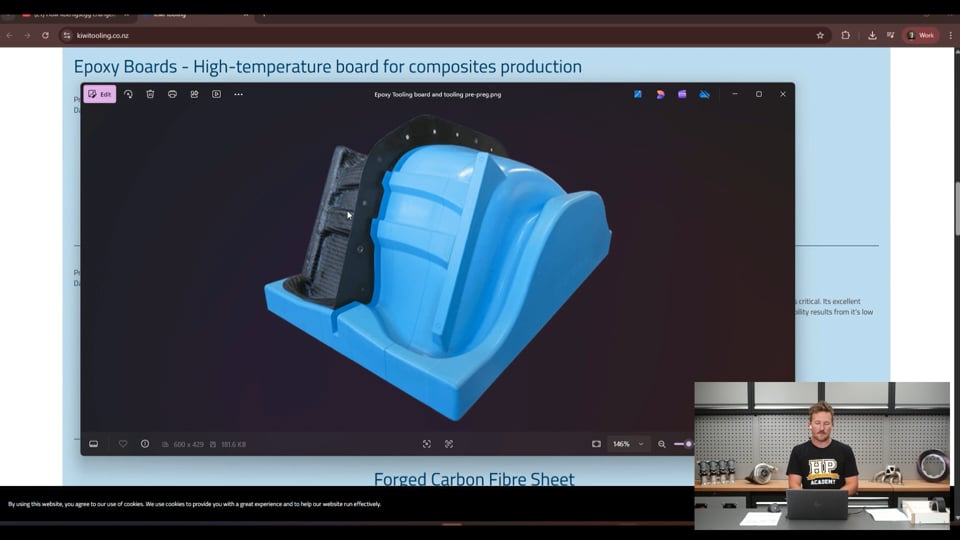
| 10:46 | So, I just want to come back to another little document that I've got open here because this is for Kiwi tooling, so it's just a New Zealand supplier for some of this tooling board. |
| 11:03 | And they're selling this epoxy tooling board here and they have noted here this value of a CTE of 40 plus or minus 5. |
| 11:14 | Now, that is pretty high, we'll come back to how all these values compare, but it's very common for these tooling board suppliers to kind of sell it like it's the best product for this because it's got a super low CTE and then they give you the CTE, but if you've got nothing to compare it to, you don't really kind of know I guess where that sits. |
| 11:37 | So, when we make the epoxy tooling board pattern, it's kind of layered up like this, a whole bunch of the blocks are glued together or dowed together and then use a machine to machine the mold and then as is shown here, machine that pattern and then use it to make the actual mold here. |
| 12:02 | So, if I just open another document I have here, I've got a few open here, I'll just have to find it. |
| 12:11 | We can see there's a supplier stated for that material, that epoxy tooling board, a CTE of 40 and then if we zoom in a little bit here on polymers, oh that's not CTE values down here, polymers here. |
| 12:32 | So, if we zoom in a little bit here, we can see that epoxy is actually around 80 to 120 and that unit is for, it's basically, you can see it a little bit up here, parts per million, so 10 to the negative 6, that's how much it will change per degrees Celsius. |
| 12:53 | So, it's a little bit of a strange value, but I will show you a little bit later how that can kind of come into consideration, you can use a equation to calculate all of that. |
| 13:05 | So, some epoxies could be as bad as 120 parts per million per degree Celsius, this tooling board supplier is saying theirs is down at 40 or so, so that all seems really great. |
| 13:17 | But if we compare that, coming back to some of these images here, I might not actually have it on here, might not be able to find it, but our composite materials, high modulus carbon fibre, so, we're down at the longitudinal direction, so that's basically along the fibres, it's saying negative 0.5, but you're essentially, compared to something like epoxy or a metal, carbon fibre just doesn't really change size that much. |
| 13:57 | So, something to consider there. |
| 13:59 | So, then if we come back and we're looking at this image of the epoxy tooling board being used to make this part, we obviously have that differential between the epoxy tooling board and the pre-preg mould here. |
| 14:15 | So, in this case we kind of need to take a slightly different approach, and that's when it comes down to the difference in the actual pre -preg itself. |
| 14:24 | So, as I mentioned there's tooling pre-preg, and then there's component pre-preg, and essentially tooling pre-preg doesn't need to be as light because it's not the final part, but it needs to be a lot more durable. |
| 14:38 | It will typically kind of have a higher resin content and the surface ply might have a tooling gel coat or something in it for a really durable surface finish to it, and we'd usually build up six plus millimetres thick of this mould, so it's not going to be very light, but it's going to be very strong and very rigid. |
| 15:00 | The other kind of difference between these tooling pre-pregs and the component pre-pregs is we have what's called LTC, MTC and HTC, standing for low temperature carbon, medium temperature carbon and high temperature carbon. |
| 15:16 | And typically a tooling pre-preg is going to be a lower temperature carbon, so basically what that means is it requires a lower temperature to actually cure it. |
| 15:26 | It might only be 60 degrees or something like that, where a component pre-preg might be using a high temperature carbon which requires 150, 120 or something like that plus. |
| 15:37 | So, by using a lower temperature carbon that we need for the tooling that's cured on the epoxy tooling board, we can limit the amount of temperature it's actually exposed to and therefore, limit the thermal expansion and that kind of differential to get around some of that. |
| 15:58 | But then what that also means is if it's cured at a lower temperature it's typically going to be less resistant, that's our carbon tool now, to going to those higher temperatures needed to be able to cure the actual component made from the high temperature carbon. |
| 16:16 | So, if we just draw another image here, what we actually end up doing is curing the tooling pre -preg on the pattern at say 60 degrees or something like that, removing it from the pattern, so it's just freestanding and then we can cure it at a higher temperature. |
| 16:37 | And basically what we're trying to do there with this post cure is chase up the, as we cure it and post cook it at a high temperature, we increase the Tg or the glass transition temperature which is basically a good indication of how much temperature the carbon will be able to withstand, so then we can use to make the component soon. |
| 17:03 | So, the important part though about that glass transition temperature and that curing process is that we do it gradually because basically if we have the temperature on this axis and time on this axis, as we increase the temperature that the part's curing at, the glass transition temperature will slowly kind of increase at the same time. |
| 17:34 | So, we're trying to bring these up and keep that curing temperature just underneath the glass transition temperature the whole time. |
| 17:44 | So, we've got to keep it at quite a steady or slow rate as we increase the temperature there. |
| 17:50 | If we end up trying to ramp the actual cure temperature up a lot and really quickly, the increase in the glass transition temperature won't be able to keep up with it and if we pass that glass transition temperature then we're essentially just going to degrade the material. |
| 18:08 | So, that's something to consider and that's a lot of the time why we can't use a domestic oven to do a lot of the stuff that's kind of got thermostatic control and no control of that ramp rate because we end up running over and just destroying the material essentially. |
| 18:28 | But if we can do this, slowly increase it, we might be able to bring this up to 120 degrees or something like that and cure it at that temperature and then we've raised the glass transition temperature a little bit higher than this and then our tooling prepreg mold will then be able to be used to make our component prepreg out of a high temperature carbon that needs to be cured at a higher temperature there. |
| 18:58 | So, that's a little bit about kind of the typical process there and then what we have is a carbon mold and we can use that to make our carbon parts and the CTE of both those parts is going to be exactly the same or very similar, so we're not going to run into any issues and that becomes really important when we're working on larger scale parts like this. |
| 19:22 | This is obviously a very kind of extreme example, but these are molds for wings of an airplane and these are made out of carbon fiber, so I wouldn't even want to know how much this costs to do but in something like this that is very long any kind of differential or change in the size of it is going to be really significant, so by doing it out of the same part if you consider that growth when you're designing the pattern to make these molds you should be able to get right on the money or very close to it if you're talking about tolerances in terms of manufacturing and so, on. |
| 20:05 | Moving back to something like the bucket seat here, this is obviously a really good approach because you're going to basically have no change in the size, but as the part gets smaller and smaller it naturally doesn't matter quite, so much. |
| 20:21 | In the other part here, so we'll look at a few alternatives, one of them I want to talk about is billet aluminium because it's kind of often seen as the gold standard for prepreg or dry carbon fiber tooling and it's not, so much the case. |
| 20:39 | So, this is quite an old video by The Drive here 13 years ago touring around Koenigsegg and looking at the molds that they have for making their prepreg carbon fiber parts and I remember watching this and thinking it was really impressive. |
| 20:56 | He's talking about a billet aluminium part and they use that for all their different things so you've got intake manifolds there and, so on. |
| 21:04 | If you actually come back to some of these values here for CTE, if we can, which are just taken out of an engineering textbook in this case and we look at aluminium alloys here we can see that they all kind of range around 20 or so. |
| 21:26 | So, half that of the epoxy tooling board, but still it's significantly different to that of carbon fiber. |
| 21:35 | So, when we come back to those kind of issues where if we make a female mold it's going to be closing in on the part as it cools down on the cured part. |
| 21:47 | So, basically to be able to demold the part often with tools like that it needs to be done hot. |
| 21:54 | I'm not sure in this image he is using gloves I assume that's just for kind of cut resistance but yeah oftentimes you need to basically take the tool out of the autoclave or the oven and demold it while it's still hot with like welding gloves or something like that on. |
| 22:09 | So, just something else to kind of consider there. |
| 22:13 | So, now we will look at a much more cheaper approach, an alternative to that which maybe might not be, so good, but it does might be a lot more achievable as well. |
| 22:31 | Bear with me for a second here. |
| 22:33 | So, this is a project I'm working on at the moment and making these kind of GT3 RSR style prepreg wing mirrors for our GT86 race car with some metal 3d printed kind of bases on them and so, on. |
| 22:49 | So, I'm just going to talk about the mold for the actual shell, so the top of it because the stalk here is going to be a separate part just to kind of keep things a little bit more simple. |
| 23:05 | So, essentially I need to do the same thing and use a pattern to make a mold and then use that mold to make the carbon fiber part and these are just going to be made with out of autoclave prepreg material which can be cured in an oven and we are modifying a domestic oven with a PID controller to be able to do this and have this kind of gradual increase over the temperature ramp rates and, so on, so we don't end up running into any issues there. |
| 23:39 | So, if we look at the design for this I'm just going to hide that mirror and go to the shell here basically this is the plan or something I'm doing at the moment, so this is a pattern of the shell which rather than being machined out of epoxy tooling board is just going to be 3d printed on our resin printer and then I've also got another 3d printed part just for the flange here and we And we can actually see some of this stuff here. |
| 24:16 | So, um, and then that's going to be all boxed in, in this kind of just basic melamine box. |
| 24:22 | Um, and then I've got to do some filleting with some fillet wax on the corners here to fill in my, uh, poor woodworking skills. |
| 24:30 | But, it's not really important anyway. |
| 24:32 | I need to fillet the, um, bottom edges to do that. |
| 24:35 | So basically, the 3D printed mirror, the part you see in that kind of light blue colour on the screen, uh, will sit on this. |
| 24:43 | And then this flange, uh, 3D printed flange will go in there. |
| 24:49 | And this will allow me to lay up inside this and make a fibreglass mould in two pieces. |
| 24:56 | So, I'll basically do this side, remove this flange, there'll be another flange here that I've already made. |
| 25:01 | And then, um, I'll be able to lay up the other side. |
| 25:05 | And then basically just undo the screws on the melamine box here, take that all apart. |
| 25:11 | And then what I should end up with, if we look on the computer screen, is a split mould that looks somewhat like this. |
| 25:19 | Um, that I can use to make the actual carbon fibre mirrors. |
| 25:24 | The materials that I'm going to be using for that, uh, need to be able to obviously withstand curing the, um, component prepreg that I've got. |
| 25:37 | Which cures at about 120 degrees is the maximum temperature it gets up to. |
| 25:42 | Um, so I have some photos of some of that material here. |
| 25:48 | So, basically I've got a, oh, I don't actually have those photos. |
| 25:53 | Essentially I've got a high temperature epoxy tooling resin, um, and a high temperature epoxy tooling gel coat as well. |
| 26:01 | And I am just going to use chopstrand matte fibreglass to actually lay those up. |
| 26:07 | Something to consider there though, usually when we're working with chopstrand matte fibreglass, when we're making moulds, we use a emulsion bound CSM matte, um, or chopstrand matte. |
| 26:20 | And that needs a polyester or vinylester resin to break down that emulsion binder, um, to be able to actually wet it out properly. |
| 26:27 | So, when we're doing something like this with a high temperature epoxy resin, we need to actually, use a, um, powder bound CSM matte to be able to do that. |
| 26:39 | But basically in the end, what I'm going to end up with is a, um, fibreglass mould that I can use at high temperatures. |
| 26:49 | And fibreglass, although not being as low a CTE as carbon, is actually pretty good compared to, um, the likes of just a epoxy machined mould or something like that made out of just tooling board. |
| 27:05 | Um, so yeah, that's a little bit of an alternative look at a way to do it, um, that doesn't break the bank, so much. |
| 27:15 | Again, if you've got any questions about this, I'll do my best to answer them shortly. |
| 27:22 | Uh, and just to wrap up, the other thing that I wanted to talk about was those kind of equations that we can use if you're ever working on a long part like a wing or a side skirt or something like that. |
| 27:35 | And you want to be sure that you're considering that thermal expansion, there are a few formulas that you can use. |
| 27:41 | Um, so basically what you can do is you can undersize your pattern if you're going to get it machined out of epoxy tooling board. |
| 27:48 | So, as it grows in the oven or the autoclave and it'll grow to a certain size, that will be the target size we're trying to get. |
| 27:57 | And then the tooling prepreg that we might be using will cure at that size. |
| 28:03 | And then that will be an accurate size mould that we can use to make, um, our component. |
| 28:10 | So, basically the, if we look at these, the change in volume equals the CTE, uh, multiplied by the original volume, multiplied by the change in temperature. |
| 28:31 | And that's all very well if we're working, um, in volumes and the CTE value is what we looked at before, which is in parts per million, um, per degrees Celsius, or there's also degrees Fahrenheit, um, versions. |
| 28:47 | And we just need to be using the same unit there for the change in temperature. |
| 28:51 | Um, again, that's just for the volume. |
| 28:54 | So, if we're actually looking at a certain dimension, like the length of a part, for example, the span of a wing or something, uh, then we'd look at the change in length would be equal to the linear CTE. |
| 29:10 | I've just marked as alpha for now, we'll come back to that. |
| 29:13 | Um, multiplied by the original kind of size of that dimension, let's say it's, uh, 1500 millimetres, multiplied by the change in temperature again. |
| 29:24 | So, this is the linear, linear CTE, which isn't necessarily the same as those typical CTE values that we're looking at just before, uh, but you can find these dimensions online. |
| 29:37 | And I would say most of the time they are, so close to the actual CTE value, uh, that you can just use the CTE. |
| 29:43 | So, for example, if we're working with a poxy tool in board that had a CTE, um, of 40, uh, parts per million multiplied, uh, per degree Celsius, then we'd just put in, you know, 40 there times that 1500, uh, multiplied by the change in temperature, which let's say we're going from ambient up to 60 degrees might be, uh, 35 degrees change or something like that. |
| 30:13 | Um, and we can work from there to actually figure out those values. |
| 30:17 | Not sure this might need to be, uh, multiplied by 10 to the negative six. |
| 30:23 | And then maybe we get a couple of millimetres difference over that 1500 mils. |
| 30:28 | So, we need to downsize our mould slightly to account for that. |
| 30:33 | And that's kind of, yeah, how that all works when you're considering the CTE value and, so on. |
| 30:39 | Um, so yeah, I'll jump into the questions now and see if there's anything I can answer. |
| 30:50 | All right. |
| 30:50 | Initial DOI mods, uh, mods, sorry. |
| 30:53 | We always talk about prepreg as carbon fibre, but are there other fibres that could be prepreg or worth getting as prepreg? I'm thinking, um, boron fibre, Kevlar and, so on. |
| 31:07 | Yes, absolutely. |
| 31:08 | You can get flax as prepreg from the likes of BComp, a really good supplier for it, and that's being used, um, in GT3 racing over in Europe and everything. |
| 31:21 | Now, um, you can get fibreglass as prepreg. |
| 31:26 | Basically, everything. |
| 31:27 | There's nothing really specific that means it needs to be, um, carbon. |
| 31:31 | Um, yeah, fibreglass is a good one. |
| 31:36 | We were down, and we have a video of this on our YouTube channel, um, but someone quite local to us here called Fi Innovations is making, like, a fibreglass prepreg that is UV cured, um, rather than heat cured. |
| 31:52 | So, basically take off this kind of, um, UV shielding backing paper and cure it with UV light after you kind of lay it up, and that just cures like that, but that is fibreglass. |
| 32:04 | And essentially all they're doing is running a fibreglass weave through a kind of bath of this resin and then coating it with these protective films and, so on. |
| 32:15 | And that's essentially how any of it's made. |
| 32:17 | It's just impregnating, um, the reinforcement fiber or fabric, um, with this resin at the right, content and, so on. |
| 32:27 | Um, so yeah, that can be used on any form of reinforcement really. |
| 32:30 | I don't think there's kind of any limits to it. |
| 32:33 | Um, it's all just the typical stuff you'd see, but yeah, absolutely you can get Kevlar and so on like it as well. |
| 32:40 | It's not just carbon. |
| 32:41 | We just typically hear that term kind of dry carbon thrown around because, um, of that low resin to fiber ratio, I guess. |
| 32:52 | All right, that looks like that's all the questions anyway. |
| 32:55 | Hopefully, that's given some insight into somewhat of a more involved process when making carbon fiber parts, um, and some key considerations that potentially you can use to make prepreg or dry carbon parts for your car. |
| 33:09 | Um, our fundamental composite course is live and that covers, uh, wet lay and hand lamination and pattern and mold making techniques and our advanced composite course covering vacuum bagging, resin infusion, and also prepreg work like what we discussed today is all on its way as well. |
| 33:28 | Um, so again, thanks for watching and we'll be back next week with another webinar. |
00:00 - Introduction: Patterns & Moulds for Pre-Preg Carbon Parts
00:30 - What Are Patterns, Moulds & Pre-Preg?
01:35 - Pre-Preg Defined: Pre-Impregnated Carbon Fiber
02:42 - Heat Curing: Ovens & Autoclaves Explained
04:04 - Key Consideration: Thermal Expansion (CTE)
05:05 - CTE Explained: How Materials Expand with Heat
06:01 - Female vs. Male Moulds: Expansion Behavior
08:00 - Thermal Expansion Problems: Stresses & Delamination
10:00 - Material Options for Patterns: Epoxy Tooling Board
12:00 - Carbon Fiber Moulds: The Ideal Solution
14:21 - Tooling Pre-Preg vs. Component Pre-Preg
15:36 - LTC, MTC & HTC: Low, Medium & High Temperature Carbon
17:18 - Post-Curing Process: Raising Glass Transition Temperature (Tg)
19:18 - Large-Scale Applications: Aircraft Wing Moulds
20:59 - Billet Aluminum Moulds: Koenigsegg Example & CTE Issues
22:40 - Budget-Friendly Alternatives: MDF & Other Options