Pick the right MIG welder and your projects get easier with better results. Pick the wrong one, and every weld can become a battle.
In this article: Why You Need a MIG Welder | Power Supply and Amperage | Multi-Process and Gasless Machines | Wire Feed Systems and Spool Types | What Comes With a MIG Welder | Summary
Modern motorsport and automotive fabrication demands accuracy, repeatability, and a welder that gives you enough control to tackle everything from thin sheet metal to thicker plate work.
If you’re shopping for your first machine or finally retiring an old hand-me-down unit, this MIG welder buyer’s guide breaks down the key considerations so you can invest in a machine that actually suits your fabrication goals.
Why You Need a MIG Welder
MIG welding has remained one of the most versatile and accessible fabrication methods in motorsport thanks to recent advances in inverter technology. These modern machines are smaller, more powerful, and offer far more adjustability than older transformer units.
That adjustability is important because motorsport fabrication often requires joining extremely thin material without distortion while still having the headroom to weld thicker components when needed.
Before diving into specifications, take a moment to consider your goals.
Most enthusiasts want the best machine they can afford, reliable after-sales support, and access to a broad range of consumables. You’ll also want the flexibility to weld multiple metals, especially if your projects involve stainless steel or aluminium.
While MIG isn’t always the best choice for every material (that’s why TIG welding) is also a great skill to learn, having a machine capable of supporting these options keeps your garage setup future-proof.
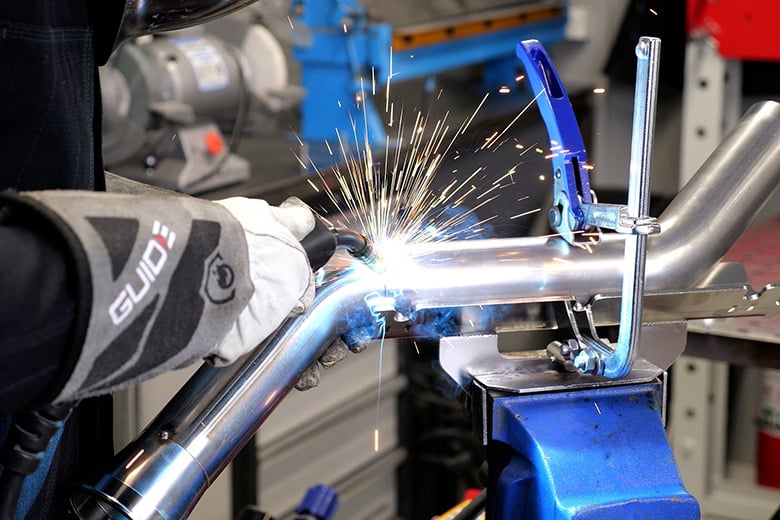
Here at HPA, the type of projects we use our trusty MIG for include exhaust and rust repair work, roll cages, general body work, and bash bars, which are all essential for any race or drift car.
Power Supply and Amperage
One of the most important early decisions is choosing a welder that matches the power you have available in your garage or workshop. There’s no point buying the perfect machine only to realise you can’t run it.
With that said, thanks to inverter technology reducing power consumption, many high-performing MIG welders can now operate from a standard household outlet, making them accessible to home fabricators.
When comparing machines, amperage is the main variable you’ll see listed in their specifications. Output heat is defined by amperage, so higher amp welders can weld thicker materials.
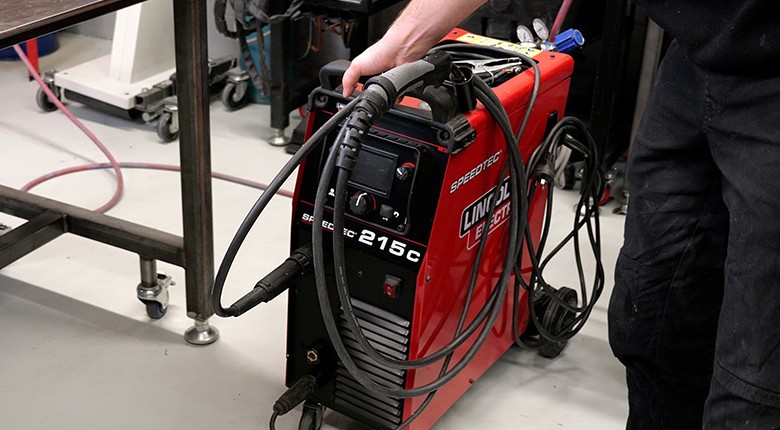
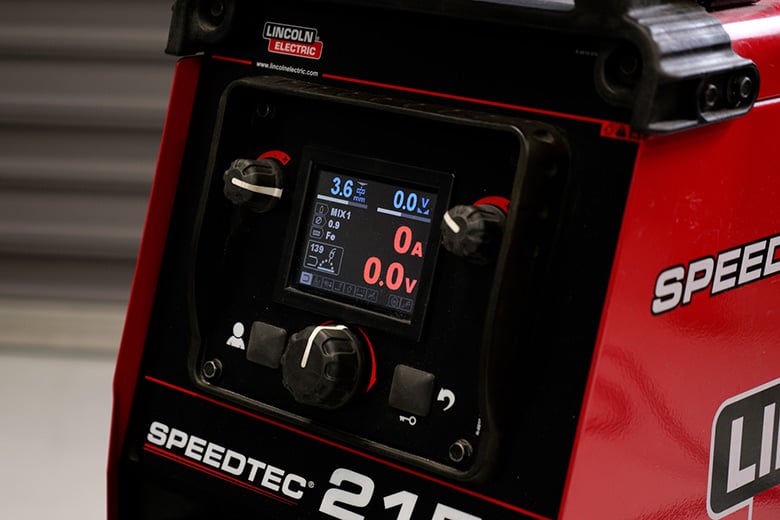
In motorsport fabrication, a 200 amp MIG welder is the sweet spot. In our case, we chose a Lincoln Speedtec 215c, which is a 200 amp machine that allows us to weld nearly everything we need it to, from 0.5 mm sheet metal all the way up to 9.5 mm plate.
If you’re unsure what you need, start by checking the power outlets in your space and match them to the machine’s requirements before you start comparing features.
Multi-Process and Gasless Machines
MIG welders often appear in “multi-process” configurations, combining MIG and TIG capabilities in a single unit. On paper, this sounds ideal, especially if your budget won’t stretch to two separate machines. However, switching between processes requires different inert gases and setup changes, which can be frustrating and time-consuming.
Most MIG welders that offer DC TIG support lack the precise control and parameter options required for motorsport TIG work. They're functional, but they aren't a substitute for a dedicated TIG welder.
"Gasless” MIG welders are also common. These machines don't distribute shielding gas and rely exclusively on flux core wire. Because flux core produces a dirtier weld and reduced control, gasless MIGs aren’t suitable for automotive fabrication.
We don’t recommend you get a gasless MIG even as a first welder, as it'll make the learning process slower and more expensive for you in the long run.
Wire Feed Systems and Spool Types
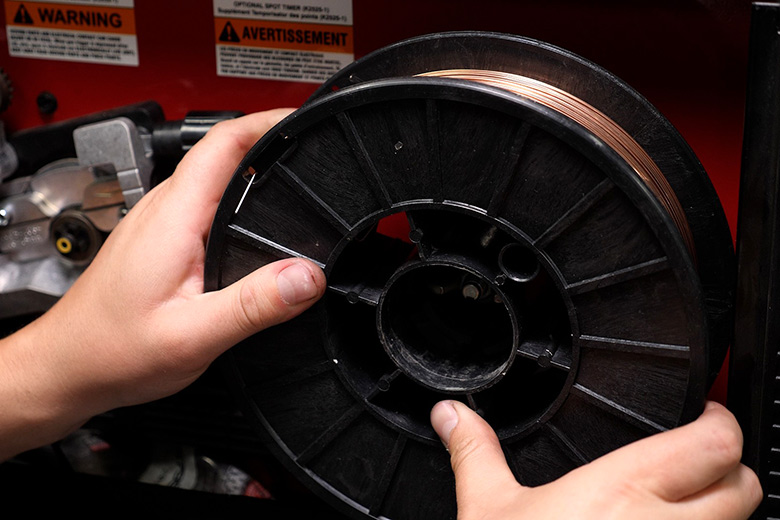
The wire feed system is one of the most critical components of any MIG welder. A poor-quality feed system results in inconsistent wire feeding, unstable arcs, and unpredictable welds. Look for a machine using a metal gear drive system with interchangeable rollers to match the wire diameter you plan to use.
Wire spools vary by weight and diameter, and welders are designed for specific spool sizes. While mild steel wire is the most common, many machines can also weld stainless steel and aluminium.
From a buying perspective, what matters most is that you ensure your welder is compatible with the wire types you want to use.
The majority of material used in motorsport fabrication here at HPA will suit either 0.8mm or 0.9mm diameter solid filler wire, which in imperial corresponds to approximately 1/32 inch (0.031 inch) or 35 thousandths of an inch (0.035 inch. If we need larger, it is often when we're working with aluminium.
What Comes With a MIG Welder?
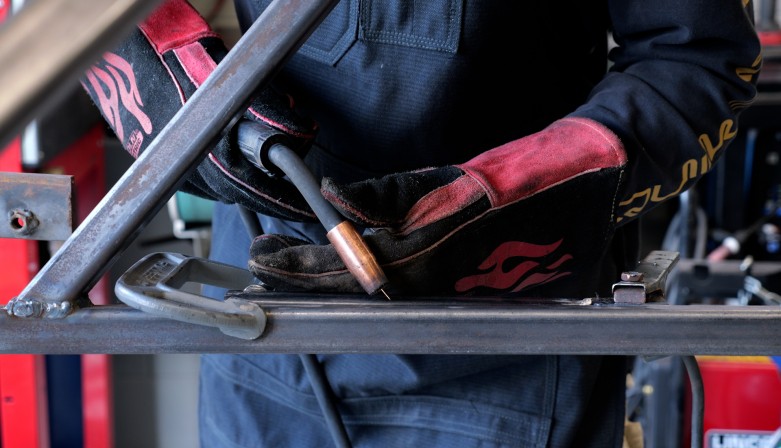
As you compare potential machines, check what is included in the box. Most welders come with the essentials: a gas regulator, earth lead, and MIG torch. These components will get you running, but you still need to budget for an Argon bottle, filler wire, and your personal protective equipment.
PPE is something we take seriously and it always pays to get the best helmet, gloves, and protective clothing you can afford.
Summary
Choosing the right MIG welder comes down to matching a machine to your workspace, fabrication goals, and budget.
Prioritise a welder that supports gas-shielded MIG, offers a strong wire feed system, and is designed with motorsport or automotive fabrication in mind.
A 200 amp inverter-based MIG welder covers the vast majority of motorsport applications and offers the flexibility needed to grow your skills.
If you want to continue developing confidence with your new welder, the Practical MIG Welding course is the most direct path to improving your technique on motorsport and automotive fabrication tasks.