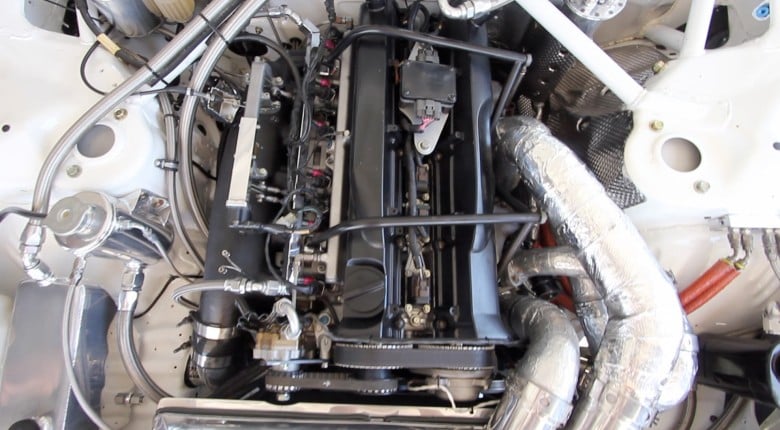
Before anyone else knew how to build an RB26 for endurance racing, Gibson Motorsport was already running them to 2,600km at around 700hp and developing their own turbochargers in-house.
Nissan’s ‘Godzilla’ built a formidable reputation on race tracks in the early 90’s, not least of all in the hands of Gibson Motorsport. With run away wins in the Australian Touring Car Championship, the R32 GTR was a force to be reckoned with and forced the rule makers to rethink the direction of the championship. In this video we get a unique and rare insight from Alan Heaphy, the man responsible for Gibson’s GTR development program.
https://vimeo.com/192071936
At World Time Attack 2016, Andre sits down with Alan from Gibson Motorsport alongside the original R32 Nissan GT-R that won Bathurst in 1991 with Australian V8 Supercar legends Mark Skaife and Jim Richards. This is the car that started the GT-R legend in Australia, and Alan was at the centre of developing it from the ground up under Group A regulations.
In this interview, Alan walks through what it actually took to build a competitive GT-R at a time when there was no prior knowledge of the platform and no one else to benchmark against. He covers the challenges of the all-wheel drive system, why they eliminated rear steer for race use, and how they built their own control module to give drivers real-time adjustment over front axle torque distribution.
On the engine side, Alan explains how the team reached close to 700hp from the RB26 on 1.8 bar of boost, the cylinder sealing and oil control issues they had to solve at those pressures, and how they determined engine rebuild intervals by simply running one to failure. When Group A regulations forced a boost reduction down to 1.3 bar, the team recovered nearly all of the lost power through individual cylinder tuning, using crankshaft rotation data and cylinder pressure transducers to optimise each cylinder at 250 RPM increments.
Everything on this car was developed in-house. No outside engineering support, no external development partners. Just the team on the floor working through the problems.
If you want to understand how the GT-R became what it is today, this is where it starts.
0:00 - Introduction: The 1991 Bathurst-Winning R32 GT-R
0:33 - Developing the GT-R Under Group A Regulations
1:03 - Managing Four-Wheel Drive and Removing Rear Steer
2:02 - Custom AWD Control Box and Driver Torque Adjustment
2:20 - How Drivers Used Four-Wheel Drive Adjustment on Track
2:56 - RB26 Power Output and Boost Pressure at Race Conditions
3:29 - Boost Control Setup and Driver Access in the Cabin
3:50 - Achieving RB26 Reliability for 1,000km Endurance Racing
4:17 - Cylinder Sealing, Oil Control and Ring Development
4:40 - Running an Engine to Failure to Establish Rebuild Intervals
5:01 - Engine Management Technology in 1990 to 1991
5:37 - In-House Turbocharger Development and Bearing Work
6:19 - Why Keeping Development Fully In-House Was an Advantage
6:38 - Boost Restrictions Imposed by Regulations
7:08 - Individual Cylinder Tuning to Recover Lost Power
7:54 - How Per-Cylinder Tuning Was Done: Sensors and Data Logging
8:35 - Results: 90hp Recovered Through Cylinder Optimisation
8:58 - Closing Remarks and the GT-R's Legacy in Motorsport







Comments
MackyRB, not currently mate, but the process and skills are all applicable.
- Ben.Silcock New Zealand
9 years ago
- adil United Arab Emirates
10 years ago
- mackyrb Trinidad and Tobago
10 years ago
No one has commented on this page yet.