405 | Twisted Pair Wiring Explained | CAN Bus
Summary
Modern vehicles are electrically noisy environments, yet data networks like CAN Bus remain reliable. This webinar explains how twisted pair wiring suppresses electrical noise, why it’s essential in automotive applications, and how small wiring decisions can have a big impact on system robustness.
| 00:00 | Hey everyone, welcome to another webinar. |
| 00:02 | I'm Caleb and this is High Performance Academy. |
| 00:05 | If you've done some wiring lately or in general, there's a good chance you've come across some wires that are twisted together like this, particularly in CAN bus, but also in some other circuits like speaker wiring or motor wiring. |
| 00:19 | And you might be thinking, why are these twisted? What's the go? Why are they not twisted with the rest of the wiring in a concentric twisted loom? It's all because of a thing called noise. |
| 00:29 | And if you've asked someone about that, they might say, well, cars are just a noisy environment, which might make you think, well, what does my straight pipe Civic have to do with the CAN bus? And I'll get into that a little bit more. |
| 00:41 | We're going to sort of delve in a bit deeper into what that noise does and how twisting our wires is actually going to remedy the effect from that. |
| 00:50 | So, before we get into that, though, welcome to the live webinar. |
| 00:54 | If you're not watching this live, it is recorded. |
| 00:57 | You can watch it at any time you like. |
| 00:59 | If you're live at the moment and you need to go pick up your kids, you can do that. |
| 01:02 | I do highly recommend it. |
| 01:04 | You can come back and watch it later. |
| 01:06 | But if you are watching later, if you have any questions, you'll have to send them through to our support at hpacademy.com or into our forums where there's heaps of people who are going to help, try to help. |
| 01:17 | And if you're watching live again, welcome. |
| 01:19 | And hopefully you can stick around and hopefully learn something out of this. |
| 01:24 | So, to quickly sum up CAN bus, I don't want to get into it too deep. |
| 01:29 | We've got a good course on that, the CAN bus decoded. |
| 01:33 | But in a simple form, it's a communication network. |
| 01:38 | The CAN stands for communication area network. |
| 01:41 | Bus is referring to a... bus is a... something of my words... a way of modules talking to each other, a communication area network. |
| 01:52 | That's the bus itself. |
| 01:53 | And it's basically just a way for modules to communicate. |
| 01:56 | Exactly that. |
| 01:57 | They send information to each other, signals, share information, tell each other what they're up to and request things, request PDMs to turn things on and off, stuff like that. |
| 02:10 | And without getting into it too deep, we'll go to our overhead cam here. |
| 02:14 | I've got a whiteboard and we can have a look at a few diagrams that I've drawn. |
| 02:19 | If I can get it to come over. |
| 02:22 | And we should be looking now at my beautiful graph. |
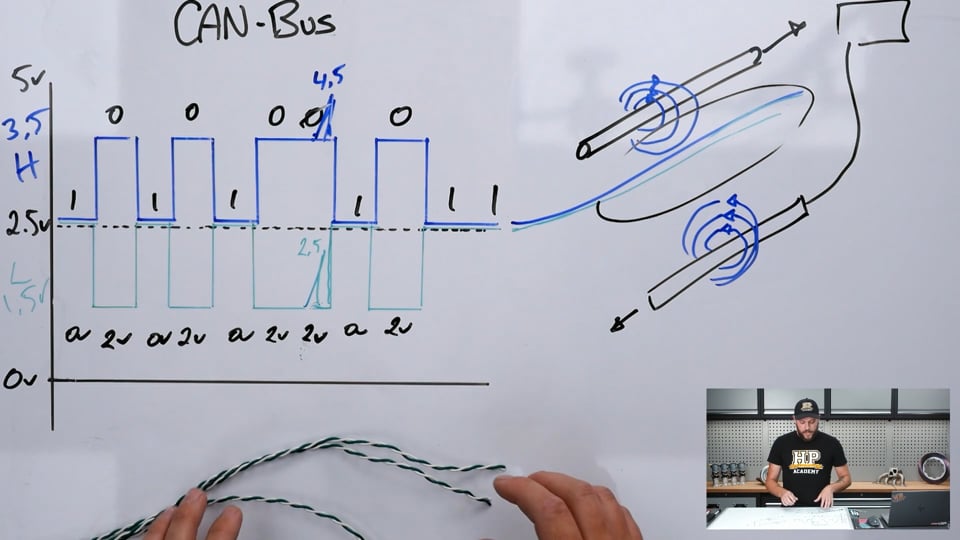
| 02:27 | So, CAN bus has two wires, which we've talked about, the twisted wires. |
| 02:32 | And the way that it works, it's sending signals on each of those wires. |
| 02:36 | We have the CAN high, which is the graph at the top, which is a square wave and CAN low at the bottom. |
| 02:43 | So, what's going on here is it's sending different voltages on this line. |
| 02:48 | We can see that the CAN high and CAN low both sit around the two and a half volt. |
| 02:53 | And then they go up or CAN high, sorry, it goes up to about three and a half volts. |
| 02:58 | And our CAN low will go down about one and a half volts. |
| 03:02 | And this varies back and forth to give information in binary. |
| 03:08 | So, they get, now if I remember this correctly, one is our low and zero is our high. |
| 03:17 | You'll get a binary signal similar to this. |
| 03:22 | And the modules that are receiving these CAN messages, they're interpreting these binary messages in a certain way. |
| 03:28 | That's something you will definitely learn about in the CAN bus courses. |
| 03:32 | For this though, we just need to understand that we're getting these different voltages on both lines. |
| 03:39 | And to get into this a bit more, we'll sort of take a step back from CAN bus itself and talk about cables and how we get that noise. |
| 03:48 | We're not talking about exhaust noise, we're talking about electromagnetic noise. |
| 03:52 | There's a few different types of noise, but this one is in particular bad for cars. |
| 03:57 | And if we think about a cable, I'm going to use black just so we can keep things different. |
| 04:04 | We run a cable and we want to pass a current through that. |
| 04:08 | Say that's going to a DC motor that is passing a current this way. |
| 04:13 | What happens when you pass a current through a conductor is you create a magnetic field around this and that presents itself as these waves that go around. |
| 04:23 | So, you get this kind of action, waves of magnetism coming out from that wire. |
| 04:31 | And they do actually flow in a certain direction. |
| 04:34 | There's a thing called the right hand rule, where if you take your right hand, point your thumb out, your thumb is the direction of current and the way your fingers curl is the way that magnetic force is going. |
| 04:44 | So, if we look at this, current going that way, fingers curling, we can see that that magnetic field is flowing in that direction. |
| 04:53 | And the whole reason we get noise is because this works both ways. |
| 04:58 | So, if we have a wire and an external magnetic force that's going over these wires back and forth, that's a point to really make. |
| 05:07 | For it to work this way, the magnetic force has to be going back and forth over the wire. |
| 05:12 | It can't just be a steady... you can't just put a magnet sitting there and expect something to happen. |
| 05:17 | When the magnetic force goes back and forth over your conductor or wire, it creates a voltage in that wire and sends its own current through. |
| 05:25 | So, you might already be seeing how this can create issues in wires around it. |
| 05:30 | And that's exactly why we use our twisted pairs. |
| 05:33 | And why do we use twisted pairs? So, when this happens, what it does is, this is your DC motor and you have... |
| 05:42 | continue this on and pretend that this is our CAN bus wiring going this way. |
| 05:47 | Our two wires and we're going to leave them untwisted for now. |
| 05:51 | Those magnetic field lines come across our CAN bus wiring and what they do is they induce more voltage into our nice neat setup here. |
| 06:02 | And that might happen say at a point here and we've got our lines together. |
| 06:08 | It will come and present itself like this, a spike in voltage. |
| 06:13 | And this is the secret behind the twisted pairs and how it actually works. |
| 06:19 | I don't want to get too far ahead of myself here, let me just see where I'm up to. |
| 06:25 | So, going back on CAN bus and how it actually works, it sees these two different voltages, the 3.5 at CAN high and the 1.5 at CAN low. |
| 06:37 | And it's not using that as its reference, well it's using that as a reference but it's not using that as its information. |
| 06:43 | What it does is it subtracts those two voltages from each other, uses a differential equation to work it out. |
| 06:51 | And what we end up with is, in this case we've got 3.5V minus 1.5V. |
| 06:57 | So, what it's seeing there is 2V. |
| 07:00 | And then obviously where we have our 2.5V in our one position it's seeing 0V. |
| 07:05 | So, all the way along here we're getting these 0V, 2V, 0V, 2V, 2V, so on. |
| 07:14 | And it's interpreting these as our binary messages. |
| 07:18 | So, you probably think here where we get this noise that's going to screw things up, it's going to shift the way it's reading and it's going to cause potential problems. |
| 07:27 | And that would be right if we had say just our CAN high wire going down here. |
| 07:32 | What that would do, we would get a spike of our voltage here, say that goes up to 4.5V. |
| 07:42 | When the module reading the CAN bus gets to this point it's not going to see that 2V anymore and we're actually going to see, what are we seeing, another hole, another volt more, 3V. |
| 07:53 | And that's going to cause issues in the CAN bus itself. |
| 07:56 | It's maybe going to skip that byte and continue on and you'll just maybe see an error or it could shut down the whole system completely. |
| 08:06 | It really depends on the severity of the errors, how long it's going to last for. |
| 08:09 | But the fact is that it is causing an error and we might wipe that byte out completely. |
| 08:14 | So, to avoid doing this, what we want to do is we are running our wires together parallel. |
| 08:21 | This allows that magnetic noise, it passes over evenly. |
| 08:26 | And because the way that the magnetic field works, the larger the loop, so if we have this coming out here, goes to our DC motor or something up here, and then passes down another way, current going that way, we get a magnetic loop, magnetic, a loop sorry, in that system. |
| 08:47 | This here, current's going the opposite way, magnetic fields are going this way, and it basically creates a really noisy environment, especially in between here. |
| 08:57 | So, if your CAN bus wires are passing through there, you're going to get a lot of noise and you're going to have situations like this, except if we pass both wires through, basically they're getting that same magnetic noise across those two wires. |
| 09:11 | So, we see same thing here. |
| 09:14 | And because the secret is here, because they're going in different directions, we get the positive reaction on the high and a negative reaction on the low. |
| 09:24 | But still with the SPLAC, it only goes in one direction, it's only going in that positive, and we get a extra volt on the CAN low. |
| 09:31 | So, this goes up to 2.5. |
| 09:34 | And the module is going to again do its differential equation, 4.5 minus 2.5, we are back to our two volts. |
| 09:43 | So, the fact that there's noise there, and we've got completely different voltage readings than the rest of the CAN bus, we're still getting that two volt differential. |
| 09:50 | And that is the key in how the CAN bus is seeing the noise, still getting a logical signal out of it and not creating a mess. |
| 10:03 | So, really going by that, we can see that running the lines together is going to give us the best situation with noise. |
| 10:12 | And that's why at the end of the day, we go to our twisted wires like this. |
| 10:16 | If we think about it, those wires are twisted together, it doesn't matter how you move them around, they're going to stay together, stay nice and parallel with each other all the way through your loom. |
| 10:24 | And there's no chance of us ending up in a situation where CAN high is going close to a magnetic field and CAN low is over here and not getting a bad signal. |
| 10:35 | And it's because of this, that's the whole reason we want to go for twisted wires. |
| 10:39 | There are other things that use twisted wires like speaker wiring, and that goes back to the whole magnetic field where it goes both ways. |
| 10:48 | If you actually pass these two wires close together, your DC power and negative, what happens is those magnetic fields essentially negate each other and they cause less of a loop. |
| 11:02 | So, when I'm talking about a loop, you've got a large area in here around between where those wires pass. |
| 11:08 | We bring those wires together, ideally twisting them so they've got as little room between them as possible. |
| 11:14 | We reduce this loop down to the absolute minimum, which also reduces our noise around those wires. |
| 11:22 | So, at the end of the day, you could twist all your motor wires together and everything and try and minimize the noise as much as possible, which is ideal. |
| 11:32 | And if you can do it, that can happen. |
| 11:34 | You'd really just need to keep your CAN bus wiring twisted because then no matter what noise is going on, because as I said, the automotive car industry, the cars are really noisy environments. |
| 11:45 | And it's because of this whole back and forth. |
| 11:47 | When it's going back and forth and switching quickly, that's what's creating these magnetic fields that are going back and forth, inducing voltage. |
| 11:55 | And you get things like your injectors, coils, DC motors that are being switched by PWM, they're pulsed back and forth really quick. |
| 12:04 | You're getting this current back and forth and that's creating those really noisy environments. |
| 12:08 | And obviously a lot of that stuff is happening in a car and we can't just simply go, hey, let's get rid of the injectors, run a diesel and get rid of the noise. |
| 12:16 | We need a way of making that noise irrelevant. |
| 12:20 | And that's what the CAN bus does. |
| 12:21 | It doesn't get rid of noise. |
| 12:24 | It doesn't make it disappear. |
| 12:27 | It actually uses the noise in its equations and how it sees the information. |
| 12:32 | And it actually incorporates it in a way that still makes the end information come out the same. |
| 12:40 | So, that's where our twisting is key. |
| 12:44 | Now, when it comes to twisting our wires, there are rules on how tightly you twist it or how loosely. |
| 12:55 | I think off the top of my head, one twist per inch is a general rule of thumb. |
| 13:00 | It kind of comes down to more, you don't want to twist it so tight that you begin creating mechanical strain on your wires and potentially breaking them. |
| 13:09 | And you also don't want it too loose where your wires may potentially run in different areas and have other wires running between them, that sort of thing. |
| 13:18 | You just want to keep it nice and neat and consistent is sort of the main thing. |
| 13:23 | If you keep your wire twist consistent through the whole loom, that's going to be more ideal than say, keeping to that one inch twist the whole way along. |
| 13:32 | If you've got two twists per inch, three twists per inch, half a twist, as long as it's the same all the way through, that's the key ingredient. |
| 13:43 | One of the caveats though is when you get to wiring to a connector, you can't keep those wires twisted obviously in the connector itself and twist our pins together, that's just not possible. |
| 13:54 | So, you are going to have to untwist a fraction of your wiring to connect it into terminals and position them into a connector. |
| 14:02 | The idea there is you really just want to untwist the bare minimum. |
| 14:07 | So, what I like to do is I untwist a fair way just to make it comfortable, it gives you plenty of area to terminate. |
| 14:14 | Once everything's terminated, re-twist your wires as much as possible up to your connector. |
| 14:19 | Again, you don't want to create strain, you don't want to create a mechanical problem where you're twisted right up to the terminals. |
| 14:27 | You want to go for more, not so much neat and tidy, try and keep it neat and tidy, but more just imagine the wires are comfortable and relaxed and still twisted as much as possible. |
| 14:38 | Also, if you're running twisted wires through say a consensually twisted loom, you run into situations where you might need to be running these twisted pairs on a layer outside of your core or further out or in the core with other wires. |
| 14:54 | And the key here is you always need to keep your twisted pair twisted together regardless. |
| 15:01 | So, as you can see here, I've got a couple of shielded cables and also a couple of twisted pairs in here. |
| 15:07 | We'll say that our green white here is our twisted pair. |
| 15:10 | They stay twisted together and then those twisted pairs actually create the concentric twisted loom around that. |
| 15:18 | And what I want to note here is you can see the lay of these twisted lines. |
| 15:23 | The CAN bus is laying, if we hold it this way, we got a left-hand lay going around. |
| 15:28 | We want our lay of the twisted pair to go around the other way. |
| 15:31 | If we have a couple of twisted pairs all going the same way that the pair themselves are twisted, then we have potential for those wires to mix in together and become essentially one big bundle of twisted wires. |
| 15:42 | Keeping them twisted opposite keeps it nice and neat like this. |
| 15:46 | They're all separate, they all stay in their own lane and that is going to be a perfectly good CAN bus. |
| 15:53 | Also staying in the same realm of untwisting for connectors, you will have situations where you need to join in and branch out your CAN bus. |
| 16:02 | Again, untwist the bare minimum and try and keep those nice and tight together. |
| 16:07 | Also I'll say when you're doing a connector, you don't try to avoid having the terminals of CAN HIGH and CAN LOW on completely different ends of the connector. |
| 16:17 | Again, keeping them as close as possible will keep that noise, or if there is any noise, basically even across those two terminals. |
| 16:29 | So, I've given a bit of an example. |
| 16:33 | That is also a worst-case scenario. |
| 16:35 | As I said, cars are inevitably a really noisy environment, but it doesn't always present itself this badly. |
| 16:41 | There are situations that make it worse where running along parallel with power wires and things like that, like I said, pulse width wires will give you more. |
| 16:52 | And there are other types of electrical noise that come into play. |
| 16:58 | That's where shielding has its benefits, but from what we're talking about at the moment, the magnetic induction, the twisting is the main defense against that. |
| 17:16 | Also, if you've got any questions, make sure you chuck them in the chat and we'll put them at the end. |
| 17:22 | I'll get to them and hopefully answer all the questions we get to. |
| 17:27 | Hopefully, as well, I touch on all the questions and we get to the end and everyone's quite happy. |
| 17:35 | Other important things with your CAN bus is just the general, you've got to keep your grounds and everything clean and optimal. |
| 17:43 | All these kinds of things play in how the CAN bus network works perfectly. |
| 17:50 | And it's just the whole twisting side of it is to do with our magnetic noise. |
| 17:55 | I think that's pretty much covers most of it, but let's have a quick look here. |
| 18:09 | Yeah,, so we just want to, at the end of the day, think about CAN bus as a full system. |
| 18:15 | It's not so much individual wires. |
| 18:17 | You've got both circuits being used together. |
| 18:20 | It's not, you know, you got one side that's positive, one side's ground. |
| 18:25 | These both work together at these consistent voltages to give us a good signal. |
| 18:30 | And it's that differential voltage that is using the noise from our electromagnetic force and works together to leave us with our proper signal. |
| 18:42 | And it's only when we separate those voltages, those noise onto each wire that we end up, you know, taking away one side and you get this differential that is out of sync, out of what the module is looking for. |
| 18:55 | That's when we start causing issues. |
| 18:57 | Sometimes that won't necessarily bring the CAN bus down or show as an error. |
| 19:02 | It could wipe out a byte and the CAN bus will retry the signal and it's happy days. |
| 19:08 | But worst case scenario, yeah, these things can cause big issues and are really annoying to try and diagnose in a car. |
| 19:15 | At the end of the day, just keeping your twisting nice and neat and consistent the whole way through. |
| 19:22 | It's a good preventative measure. |
| 19:24 | You're not expecting things to fail, but you're really just making sure everything is 100% perfect. |
| 19:31 | Because sometimes, I mean, you could run your CAN bus wiring in completely different directions and you may not have an issue, you might be lucky, but why do we really want to risk that? Let's just twist some wires together, have a bit of fun and everything's going to be hunky dory. |
| 19:44 | I'll have a quick look now, see if we've got any questions. |
| 19:51 | What's the worst thing that can happen if we twist wires that wouldn't normally need it? Like if we twist a couple of sensor wires together. |
| 19:59 | In these situations, it's not going to cause any issues. |
| 20:04 | Things like sensor wires, the way they work, they're referencing ground and generally a voltage or digital signal. |
| 20:14 | Twisting them together, the way the computer sees that information, it generally has its own filtering and that sort of thing that will get rid of that bit of noise and won't take it into account in its reading. |
| 20:25 | Most of the time when you're running wires for say an intake air temp sensor or just a sensor on itself, especially if you're doing a concentric twisted loom, you'll generally twist those two together anyway. |
| 20:38 | And like I said, things like DC motors, other things that are prone to creating noise, they're switching that current back and forth. |
| 20:46 | So, what's happening is that electromagnetic field is expanding and collapsing as that current passes through at different amounts. |
| 20:54 | I'll go back a little bit just to make that not as confusing. |
| 20:57 | The stronger the current that passes through your wire, the larger that magnetic field is going to be. |
| 21:03 | So, you can think if you're pulse widthing a DC motor, that current is going to be growing and shrinking, growing and shrinking, and so is that magnetic field. |
| 21:14 | Like I said at the beginning, it's the act of that magnetic field passing over other wires that induces voltage and current into another wire and that's where we get our electrical noise issues. |
| 21:24 | So, doing things like twisting a pair of DC motor wires can actually negate some of those effects because those magnetic fields are passing in opposite directions and they don't cancel each other out, but they create a field that isn't going to... it's even I guess what I should be saying. |
| 21:47 | What else we got here? Another question from Andrew. |
| 21:50 | Is there a certain gauge range for those that twist their own? So, I guess you're asking just like what gauge wire. |
| 21:58 | Generally, with CAN bus, sticking to 22 gauge is usually the optimum or 20 gauge. |
| 22:04 | There's no real reason to go any higher than that. |
| 22:06 | It's a low current system. |
| 22:08 | There's no high current going through any of this. |
| 22:12 | It's purely a digital signal to transmit information. |
| 22:15 | It's not actually dealing with any of the current from motors or switching anything like that. |
| 22:22 | Can we twist the high-low CAN wires with the ground and 12 volt power in the twists? So, in that situation I would do something similar to this where I've got my hand with the... |
| 22:35 | if you think that this red and white is the power in earth and our green and white is our CAN high, CAN low. |
| 22:43 | Keep them twisted separately. |
| 22:45 | You want to keep your CAN high, CAN low particularly twisted separately and then twist those separate twisted pairs together themselves. |
| 22:55 | This can sometimes lead to a bit of a ugly... I might see if I can do it with these. |
| 23:00 | So, yeah, so we got these and remember they're a left-hand lay so you want your twisted pair to go in a right-hand lay. |
| 23:08 | They will twist like this and essentially that's what you want to end up with. |
| 23:12 | You do get this kind of large... because if you think about it they're larger conductors now that are creating these big gaps between. |
| 23:21 | When I'm doing a concentric twisted loom if I want that to look neater a bit of filler wire running along those lines external to these twisted lines will kind of round that out a bit, play around with the different sizes. |
| 23:34 | I think there are some calculators online that will actually tell you what gauge of wire will work best in those situations. |
| 23:40 | They're purely filler wires to round it out otherwise just the two separate twisted pairs like this is how you want to do it. |
| 23:47 | You don't want to twist anything else in with those CAN HIGH and CAN LOW because if you think about it... if I draw... |
| 23:57 | CAN LOW and CAN HIGH and with colors also there are some conventional colors that are generally used. |
| 24:05 | GREEN for CAN LOW, things like YELLOW, BLUE, WHITE for CAN HIGH. |
| 24:09 | As long as you're consistent through your loom and you know what's going on and record it, there is no hard rule that says you have to do it that way. |
| 24:18 | Most manufacturers will have their own color scheme that they'll follow. |
| 24:22 | As I was saying, so you have your wires twisted like this. |
| 24:24 | If you then have a power wire twisted in with it that follows one of these and not the other one when you're twisting together sometimes these kind of things can happen. |
| 24:34 | If that's giving off an electromagnetic noise it's going to interfere with our CAN HIGH more than our CAN LOW and it's just going to create more issues. |
| 24:41 | So, try and stick to, as I showed you, a twisted pair for CAN HIGH and CAN LOW, other wires in their own twisted pair and then twisting those twisted pairs around. |
| 24:51 | A lot of twisting. |
| 24:54 | What else have we got here? We've got quite a few questions so I'm going to try and get through as many as I can. |
| 25:06 | Done that one. |
| 25:10 | Wayne, won't other wires near them cause noise? Also, yes that's 100%. |
| 25:15 | When you're running your loom together, things like your injector wires, power wires for electronic throttle body, all these things cause some sort of noise. |
| 25:25 | And at the end of the day we can't just go running all those different lines in completely different directions in our car to try and avoid the noise. |
| 25:32 | Like I said, it's just an inevitable thing with cars and that's why the CAN bus system has been so good and robust in that it actually takes that noise into account and works with it rather than trying to avoid it completely. |
| 25:47 | So, yeah, passing your wires through the loom with other noisy wires, it's all going to work fine as long as you stick to that twisted pair. |
| 25:55 | That is, I guess, at the end of the day for this webinar I'm trying to really nail in that we need to keep those CAN high and CAN low twisted together to allow the CAN bus to actually do what it does best and that is to use the differential equation to incorporate that noise and still get a perfect signal. |
| 26:23 | ECU voltage down to 5 volts. |
| 26:25 | What could potentially cause a voltage spike through low or high? So, it comes back to what I'm talking about here is our electromagnetic noise. |
| 26:36 | I will admit electromagnetism in electrical and everything is one of those harder subjects that you might need to take a complete other course just to fully understand it. |
| 26:47 | It's not an easy thing sometimes to imagine and that's probably one of the hardest things about electrical is a lot of it you do have to imagine and you can't see. |
| 26:55 | It's not like a suspension where you see your control arm smacking out into the fender wall because your tie rod end or something has completely lost it. |
| 27:04 | You need to kind of think about what's happening on an atomic level I guess because you've got all these electrons and things that are passing through the air. |
| 27:14 | Magnetic noise it's confusing sorry but try and bear with me as best you can. |
| 27:21 | What's causing a voltage in here is the fact that when a magnetic wave or magnetic what am I trying to say field passes over wiring. |
| 27:33 | So, if we look at the wire down say we're looking down straight into a wire this is our conductor as those magnetic fields come along like this as that happens it pushes the voltage through and creates a current. |
| 27:48 | And as I said at the very beginning in order for this to happen you have to have or for in order to be a problem you need this magnetic field to be passing back and forth and that's why things like injectors that are switching on and off constantly they're creating these collapsing and expanding fields and that's what's it's in it induces a voltage into that wire and that's how we're getting these little spikes. |
| 28:10 | There are other things hardwired into the electrical circuit that can cause noise as well but the whole point of the twisting is protecting against these radiated noise from otherwise other circuits that you know we're not talking about if you accidentally short can high to power it's not meant to deal with that sort of thing like full 12 volt 5 volt interference out straight wired to it this is the little tiny like if you were to oscilloscope this and actually try and look for it you might only see very minute little tiny It's a bit weird to see all these tiny millivolt changes in all the circuit. |
| 28:47 | But when it comes down to computers, they're seeing these at ridiculous speeds. |
| 28:51 | We're talking up to a megabyte per second, where each of these are bytes, and it's receiving thousands and thousands of these a second, or every few seconds. |
| 29:01 | And it's got to reference all these voltages so quickly that all these little tiny millivolt differences can cause issues. |
| 29:08 | And that's why we need a good robust system like the CAN bus that can differentiate these and cancel it out essentially. |
| 29:15 | Not cancel it out, sorry, but take it into interpretation to still get our good digital signal at the end of the day. |
| 29:23 | Now, I'm sorry if I'm glancing over some things, please put the questions in if I don't cover something because I know a lot of this can become confusing. |
| 29:32 | I'm going to go over terminations, node length, reflections, where does an automotive usually put the 120 ohm resistors. |
| 29:39 | So, it's not so much this is in about noise, but it is an important part of CAN bus is the 120 ohm resistors. |
| 29:46 | As stepped on in the question, it's to do with reflections in the CAN system. |
| 29:53 | So, if we think about... a basic way to think about it, you've got your CAN high and CAN low. |
| 29:59 | We'll get rid of our power wire here. |
| 30:03 | And these have the... each wire has its own waveform going along it, these waves of all your information. |
| 30:11 | And generally that node, say we'll have our ECU at one end and it will have another component at the other end, a dash. |
| 30:24 | If we've only got one, obviously we'll have other things in that, other nodes. |
| 30:28 | But in this situation, if you think about that, the waveform of this going along these wires, when it gets to the end here, it's like without the resistor, it's like it's hitting a brick wall. |
| 30:38 | And sometimes those signals can reflect back in the wire and basically muddle up with the rest of this information. |
| 30:45 | And the idea of putting the 120 ohm resistors now, as you said in the question about placement, you want to place them at the start and the end of your CAN bus main branch. |
| 30:57 | So, if we have other nodes in here stretching out in different directions, they will always have our main branch. |
| 31:05 | And at the end of these is where you want to keep your resistors. |
| 31:09 | And that is kind of like putting a nice pillow at the end there. |
| 31:12 | Once these waves get to the end, they go into the module, it gets red, gets sucked into that pillow, and it's nice and comfy and doesn't reflect back. |
| 31:21 | There's a lot of things that come into it, the impedance of impedance of wires and things like that, which can get a bit too complicated as far as what we're trying to just talk about the twisting of the wires and why it helps. |
| 31:34 | But it is good to know about the general CAN bus as well and why all this is so important. |
| 31:39 | Things like your node length is also important. |
| 31:44 | You'll find heaps of information, like I said, in our CAN decoding course that has some really good information on the things like how long your buses need to be, how long nodes can and making actual terminations and connections. |
| 31:59 | And another question, there's quite a lot of questions. |
| 32:04 | We still got heaps of time, so... |
| 32:10 | what else we got here? Node length, I'll just set that one. |
| 32:14 | Maybe I've gotten through the questions. |
| 32:24 | There is a question here about star grounding and understanding where to incorporate individual ground wires, the whole harness. |
| 32:32 | That, it's again, not really on this subject of the twisted wires for the CAN bus. |
| 32:37 | It is very important as far as the wiring of your CAN modules and things using the CAN. |
| 32:43 | But that is probably something that I can either go over in another webinar or I think we might even have a webinar that talks about it somewhere. |
| 32:51 | But it is quite an important thing, even when it comes to CAN bus. |
| 32:54 | I'm sorry, I won't go into that too much further. |
| 33:00 | I think that's pretty much all that. |
| 33:07 | Yeah,, I think that's going to cover our twisted pairs a bit more in depth. |
| 33:11 | Hopefully, this gives you a bit more of an idea why these wires are actually twisted together. |
| 33:18 | Just because someone said, hey, CAN bus, twist your wires together. |
| 33:22 | Now, you can know why you actually got to do that. |
| 33:24 | And it's not just someone being pedantic about how nicely their loom looks. |
| 33:28 | There is a reason behind it. |
| 33:30 | It's a very technical reason, but it's a reason nonetheless. |
| 33:34 | And it works really well, but it works when you twist your wires properly and consistently. |
| 33:39 | And yeah, that is hopefully in depth enough about CAN bus and twisting wires. |
| 33:46 | Also, again, I'll just quickly say this isn't limited to CAN bus. |
| 33:51 | The CAN bus protocol itself is designed around this to work with that twisted pair differential equation with your voltages. |
| 33:59 | Like I said, other things like speaker wires are often twisted to reduce the amount of noise they give off. |
| 34:04 | So, as I said, it works both ways with the magnetic induction. |
| 34:08 | You can pass current through a wire, this creates a magnetic field around it. |
| 34:13 | You pass a magnetic field over a wire, that creates current through it. |
| 34:17 | So, yeah, I think that's going to be pretty much it. |
| 34:20 | Hopefully, I've gotten to all the information that you need. |
| 34:23 | I'll take another quick look at the questions just to be sure. |
| 34:28 | I think that's pretty much it. |
| 34:30 | Resistors, yeah. |
| 34:32 | Again, if you have any further questions, you're watching this later and I haven't covered really what you wanted me to cover, jump on the forums. |
| 34:39 | There's heaps of people in there. |
| 34:41 | I jump on there occasionally to try and answer some questions. |
| 34:43 | And also you can email us directly at support at hpacademy.com. |
| 34:48 | Someone's going to try and get back to you as soon as possible. |
| 34:51 | We unfortunately have our own lives as well, so we might not get to it straight away. |
| 34:54 | But we really do enjoy helping you guys and help you with your issues and questions. |
| 34:58 | So more than happy to get out there and answer whatever questions you do have. |
| 35:02 | If you have any suggestions for webinars in the future, hit us up with those as well. |
| 35:07 | It can sometimes be a bit hard to try and think of what to do next, so your input is 100% welcome. |
| 35:14 | And finishing up on that, I hope you've had a good day. |
| 35:18 | I enjoyed my CAN bus talk and twisted wires. |
| 35:20 | Get out there and twist your own wires and set up your own CAN bus in your car, or fix someone else's, like I got to do this afternoon. |
| 35:27 | Catch you later. |
00:00 - Introduction: Why Are Wires Twisted in CAN Bus?
01:24 - CAN Bus Basics: Communication Area Network Overview
02:14 - How CAN Bus Works: CAN High & CAN Low Signals
03:39 - Electromagnetic Noise in Automotive Environments
04:08 - Magnetic Fields Around Current-Carrying Wires
04:58 - Magnetic Induction: How Noise Gets Into Wiring
06:22 - Differential Voltage Equation in CAN Bus
08:20 - How Twisted Pairs Cancel Electromagnetic Noise
11:00 - Demonstration: Twisting Wires with Drill Method
13:00 - Twist Consistency: Why It Matters
15:07 - Incorporating Twisted Pairs into Concentric Looms
16:02 - Connector Best Practices: Minimize Untwisted Sections
18:18 - Shielding vs. Twisting for Different Noise Types
19:21 - CAN Bus as a Complete System: Both Wires Working Together