407 | Injector Characterisation & Dead Time — Haltech NSP
Summary
Most tuners enter an injector flow number and move on, but there are 4 characterisation parameters that determine whether your ECU is accurately controlling fuel delivery or quietly introducing errors that can be difficult to chase, diagnose, and troubleshoot later on.
In this webinar, you will learn what injector characterisation is, why it matters, and how to source and apply real-world data from Injector Dynamics in the Haltech NSP platform. Demonstrated on a Mitsubishi EVO 9 (4G63) with an Elite 2500 ECU, the principles apply to any engine on any Haltech NSP-compatible ECU, including the NEXUS VCU.
Topics covered:
- Injector dead time (latency / battery offset)
- Flow rate vs. fuel pressure
- Returnless fuel system compensation
- Short pulse width adder
Most importantly, you will understand why each parameter exists, what goes wrong without it, and how to apply manufacturer data correctly in the NSP software.
| 00:00 | Hey team, Andre from High Performance Academy, welcome to another one of our webinars. |
| 00:03 | And in this webinar we're going to dive into the world of injector characterisation and find out what that term even means. |
| 00:10 | And then we'll have a look at how we can apply some injector characterisation data from Injector Dynamics in our Haltech NSP software using our Elite 2500 ECU that we've got fitted to our Mitsubishi Evo 9. |
| 00:24 | Now, let's just rewind and talk about injector characterisation, what this means and why we need to know about it. |
| 00:29 | And this is something that I think has probably only become mainstream knowledge in the aftermarket tuning industry for maybe the last 10 to 15 years, maybe 10 to 12 years. |
| 00:40 | And it was really all driven by Paul Yaw from Injector Dynamics when he started diving into what injectors actually do and how they operate. |
| 00:51 | And there's an assumption I think that the flow out of an injector is just a linear relationship to the pulse width that we provide it. |
| 00:59 | And that's, as we'll find out through the course of this webinar, not always the case. |
| 01:04 | I should mention this is going to be a reasonably short webinar so if you've got any questions I would suggest that you get those in quick so that we don't miss those out. |
| 01:15 | Now, if I look back at some of the first ECUs that I was tuning, and this would be the early link ECUs, those were pretty prevalent here in New Zealand given that it is a New Zealand company, they did nothing at all in terms of adjusting for or compensating for the injector characterisation data. |
| 01:38 | So, by this there's two terms that I usually use here, or three terms I should say. |
| 01:42 | One is the flow rate versus pressure. |
| 01:45 | This is much more important now that most ECUs use a volumetric efficiency based fuel model. |
| 01:52 | As part of this we need to know a couple of parameters, we need to know the engine capacity and we need to know the injector flow. |
| 02:00 | And basically what we're trying to work out here is what pulse width does the ECU need to provide in order to provide the correct mass of fuel out of the injector in order to meet our air fuel ratio target. |
| 02:13 | So, as part of this, the fuel pressure and the flow at that pressure do become quite important parameters. |
| 02:21 | Prior to this on injector time based fuel models where volumetric efficiency wasn't taken into account, we literally have a table of numbers where we are asking the injector to open for a specific amount of time. |
| 02:34 | Flow and fuel pressure really didn't actually factor into the tuning at all. |
| 02:38 | Obviously, still important parameters but essentially all we're doing is asking the injector to be open for a given pulse width. |
| 02:44 | So, that's the first aspect with these ECUs, less important the characterisation data. |
| 02:49 | But the early ECUs from Link that I was dealing with, and this was not just Link, there were a lot of ECUs that did exactly the same, completely ignored the other aspect of injector operation which is their dead time, also referred to as injector latency, also referred to as battery offset. |
| 03:08 | All terms that basically mean the same thing. |
| 03:10 | So, we're just going to jump over to my laptop screen for a moment and this is a graph that we're going to come back to a fair few times here. |
| 03:16 | This is worth reading post this webinar because it's going to dive a little bit deeper than I am going into it today. |
| 03:23 | But this is a blog article from Injector Dynamics on low pulse tech. |
| 03:30 | I know it's not exactly a riveting sounding topic but bear with me because it makes up the basis of today's webinar. |
| 03:37 | So, this is essentially a graph of what the injector does given the pulse width and the volumetric flow rate through the injector. |
| 03:47 | OK and the first part I want to talk about here is what happens between this point here where we're providing zero millisecond pulse width and this point here just below one millisecond. |
| 04:00 | And what's happening is absolutely nothing, the injector physically is not opening. |
| 04:05 | So, the reason behind this, and this is something that's really easy to overlook, is the injector is a mechanical device. |
| 04:11 | So, there is essentially a valve inside of it that has a mass and in order to open, there is a bit of a mass and an inertia behind that. |
| 04:20 | So, as soon as the ECU provides a pulse to the injector and basically provides 12 volts to it, the injector doesn't instantly open and start flowing fuel. |
| 04:30 | And in this graph here we can see that until we get out to almost one millisecond of pulse width, the injector is actually supplying completely zero fuel. |
| 04:40 | It's just physically not opening. |
| 04:42 | So, this is the dead time or injector latency. |
| 04:46 | And it's going to vary based on the injector, it's also going to vary based on the fuel pressure and it's going to vary based on our battery voltage. |
| 04:54 | So, we need to compensate for this. |
| 04:56 | Why does it vary based on our fuel pressure? Well the higher the fuel pressure, this is what the injector is opening against. |
| 05:03 | So, the higher the fuel pressure, the harder it is for the injector to open. |
| 05:07 | So, as we increase the fuel pressure, we see the injector latency increase. |
| 05:13 | Likewise, with the battery voltage, if we have higher voltage, we've got more electrical energy for want of a better term to open that injector, get the valve off the seat and get fuel flowing. |
| 05:23 | As the battery voltage reduces, it's going to take longer for the injector to open, we can get to a point where we physically don't have enough energy to open the injector. |
| 05:33 | And I am going to use Injector Dynamics for a bunch of this because I think they were pioneers in this field, they do a great job and now a bunch of other injector suppliers have sort of jumped on the bandwagon as well. |
| 05:46 | So, I think the work that Paul Yor did here has really driven the whole industry forward and now other injector manufacturers are offering this data as well. |
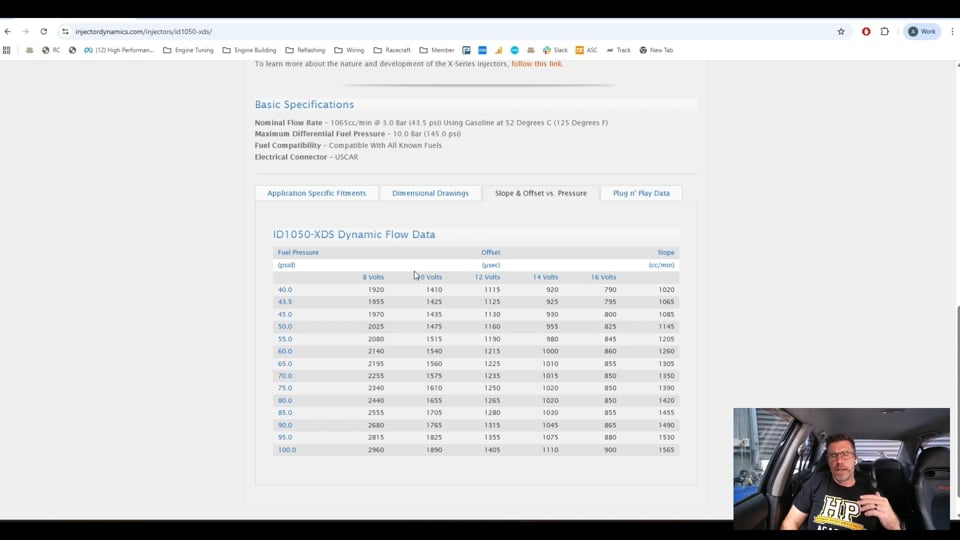
| 05:56 | But this is what we can see here with our injector data for an ID1050XDS. |
| 06:02 | This is the dynamic flow data and I'll just explain what we're seeing here. |
| 06:06 | So, in Injector Dynamics lingo, this is referred to as injector offset but again, latency, battery compensation, it doesn't matter, it's the same thing. |
| 06:16 | And this is in microseconds. |
| 06:18 | So, what we can see, as I mentioned, the fuel pressure is important. |
| 06:23 | So, this is the differential fuel pressure and there's a subtle but important aspect. |
| 06:28 | If we are running a manifold pressure referenced fuel pressure regulator, the aim or the job of that regulator is to maintain a fixed or consistent fuel pressure across our injector or differential pressure across our injector. |
| 06:43 | So, on one side of the injector we have fuel pressure acting on the top of it, on the other side we have the injector normally entering the inlet manifold where we have inlet manifold pressure acting on it. |
| 06:54 | Obviously, when we're just cruising around or we're sitting at idle, we have a vacuum in the inlet manifold. |
| 06:59 | If we've got a turbocharged car, as we move into boost, we've got positive pressure on the tip side of the injector. |
| 07:05 | So, the fuel pressure regulator's job is always to move that fuel pressure up and down in concert with the manifold pressure so that the differential pressure across that injector is always fixed. |
| 07:18 | So, if we've got a system like that, and it's not always to say that we're going to be running 43 .5 psi or 3 bar of fuel pressure but this was pretty common with most factory fuel pressure regulators in the older era of cars, now everything's sort of moved to a returnless system. |
| 07:35 | So, what we can do there is look across this table and we can see our battery offset or compensation. |
| 07:41 | So, at 14 volts which is typically where we would be running with the alternator charging, basically we are 925 microseconds before the injector is actually going to be open and flowing. |
| 07:52 | And as I mentioned, as we drop that battery voltage down, we can see at 8 volts, it's 1.9 milliseconds, 1.955 milliseconds in order to actually get the injector open and flowing. |
| 08:04 | So, injector dead time data was probably one of the first characterisation data points that was or became well known for injectors. |
| 08:13 | Why does this matter? Well it does matter but probably not as much as most people would try and have you believe these days and I'll just justify that comment because it might sound a little bit weird. |
| 08:25 | Coming back to the early link ECU that I mentioned, no compensation for dead time at all. |
| 08:30 | We were just sending a pulse width out to the injector and we got what we got. |
| 08:35 | Now, the downside of this is that some of the compensations that the ECU is making to the fueling didn't work quite right. |
| 08:45 | So, for example the ECU will typically have a background compensation for, sorry I'm just going to get this car up and running, a background compensation for manifold absolute pressure. |
| 08:57 | And that background compensation looks a little bit like this. |
| 09:00 | As we double the manifold pressure, in the background the ECU is doubling the pulse width provided to the injector and the idea behind this is it sort of improves our resolution in the map because if we double manifold pressure and we double fuel deliver or fuel mass being delivered, then we should be achieving the same air fuel ratio. |
| 09:18 | Now, that takes an aspect out of this, of course if we double the manifold pressure, we might not want to maintain the same air fuel ratio but we can fix that in our fuel map but this is happening in the background so the numbers that jump in our table don't have to be so dramatic. |
| 09:36 | So, if we are not compensating for injector dead time, then this calculation doesn't quite work. |
| 09:43 | Let's say we're running, really simple numbers, let's say we're running 2 milliseconds of injector pulse width to deliver the fuel, we needed 100 kPa, and we've got an injector dead time of 1 millisecond. |
| 09:56 | Then if we double, so in this first example we are properly accounting for the injector dead time so if we've got an injector dead time of 1 millisecond and we need 2 milliseconds of fuel being delivered, the pulse width that's actually being delivered out to the injector of course is going to be 2 plus 1 or 3 milliseconds. |
| 10:14 | So, in order to then double our fuel delivery, the ECU is going to keep the dead time the same, 1 millisecond, and it's going to double the actual pulse width that's delivering the fuel to 4 milliseconds, total is going to be 5. |
| 10:28 | If on the other hand we didn't compensate like this, we're not compensating for our dead time, in order to get our air fuel ratio correct with no dead time compensation, we would physically need to get the ECU to ask for a 3 millisecond injector pulse width. |
| 10:42 | Of course, the same goes, 1 millisecond of that, the injector isn't actually open but as far as the ECU knows, that's not what's happening, it's just flowing fuel. |
| 10:51 | So, now if we double that, that 3 millisecond pulse width out to 6 milliseconds, you can see that we've gone from 2 milliseconds of fuel being delivered, to 5 milliseconds of fuel being delivered. |
| 11:02 | So, the calculational compensations don't work. |
| 11:06 | Now, admittedly we can tune the ECU without any dead time compensation at all. |
| 11:12 | As I've mentioned, I've done that before. |
| 11:14 | The ECU does some funny things and particularly around idle and light throttle cruise, we may find that the air fuel ratio control is not going to be perfectly accurate. |
| 11:24 | But we can get the engine running. |
| 11:27 | As ECUs got more advanced and we learned more about the way the injector works, dead time compensation tables became the norm and of course we do want to add this data if we have it available. |
| 11:38 | Where this does get a little tricky though is when we're dealing with a factory vehicle, maybe an older vehicle like the Mitsubishi Evo 9 that I'm in here, can be difficult to get accurate flow and dead time values or specifically dead time values for that style of factory injector. |
| 11:54 | So, it can be a little bit tricky. |
| 11:56 | Much easier once we start moving to the world of aftermarket injectors. |
| 12:00 | And here, as I've already mentioned, there are a number of manufacturers now that are supplying proper characterisation data with the injectors. |
| 12:07 | And I would always strongly advise that you make sure that you can get this data before you actually commit to your purchase. |
| 12:16 | Alright, so let's just have a quick look back into the Haltech NSP software here. |
| 12:19 | And we will look at our stage one fuel injection. |
| 12:24 | So, there's a few things that are going on here, actually we'll come back to our fuel system to start with. |
| 12:29 | And the next part that I'm going to be talking about is a short pulse width adder. |
| 12:34 | Bit of a mouthful but I'm going to explain why we would want that shortly. |
| 12:38 | So, you can enable or disable this, the default map here for our Mitsubishi Evo 9 base file had this disabled because we don't have short pulse width adder data for the factory injectors but easy enough to just click that little radio button and enable it. |
| 12:53 | Now, if we come down to fuel tuning here and open up our menu structure, we can see right down the bottom we've got our stage one injection. |
| 13:00 | So, let's just go through this. |
| 13:02 | The first option here is our injector impedance. |
| 13:05 | And these days most of the modern EV14 based Bosch injectors are going, or all of them are going to be high impedance injectors. |
| 13:14 | Back in the era of the Mitsubishi Evo 9, the injectors were actually a low impedance injector and this is what's called a peak and hold injector as opposed to a saturated drive. |
| 13:25 | This required a special injector driver from the ECU that could provide a high peak current which would be used to quickly, or as quickly as possible, open the injector. |
| 13:37 | And then once the injector was actually open and flowing fuel, it didn't require as much current to just hold the injector open so it would drop from its peak current down to a holding current and that might have been something like four amps peak and maybe one amp as a holding current. |
| 13:52 | So, these days that's not normally a big issue because all of our aftermarket injectors are high impedance. |
| 13:58 | You might be wondering why I've got this set to high for our Evo 9 when I just mentioned that it has low impedance injectors. |
| 14:05 | That is because despite having low impedance injectors, the ECU still didn't have peak and hold injector drives so instead a ballast resistor pack was added in the engine bay which essentially brings the impedance up so it can be run off a saturated drive in the ECU. |
| 14:22 | A little bit probably beyond the scope of our actual webinar topic but worth mentioning. |
| 14:27 | So, we can see that under this drop down menu we've got options for 1 to 3 ohm injector, 3 to 8 ohm high which we're on, or we can have custom peak and hold currents. |
| 14:36 | We're obviously just leaving that as it is. |
| 14:37 | Next, we come down to our dead time table. |
| 14:41 | So, this is what we've just looked at in the injector dynamics data and we can see we've got breakpoints at 8, 10, 12, 14 and 16 milliseconds and if we head back to the injector dynamics data, we can see that's exactly what we've got. |
| 14:56 | So, we can just copy this data across. |
| 14:59 | The data here doesn't suit our actual injectors so I'm sort of making this up as I go along but 0.925 milliseconds, so we head back to our Haltech and 0.925, that will give us the correct result if we're running ID 1050s. |
| 15:20 | Now, if I'd entered all of this data, we should have a nice consistent shape to that curve. |
| 15:27 | Obviously, I'm not going to do that but you sort of probably get the idea at this stage how this works. |
| 15:33 | Now, the next part is our flow rate and we can see we've got a single value here obviously for our Evo injectors 550cc but again if we come back to the injector dynamics data, at 43.5 psi we can see that we're actually flowing 1065cc so we come in here and change that to 1065. |
| 15:56 | Before we get into short pulse width adder, I will just mention that if we are running a return style system then this is all we need to do. |
| 16:05 | If we are running returnless, the difference with a returnless system is that instead of the fuel pressure moving up and down in relation to manifold absolute pressure, it stays fixed. |
| 16:16 | Normally at four bar or 58 psi but again that's not set in stone, we can adjust that. |
| 16:22 | The problem with this is that now our flow rate is not fixed. |
| 16:27 | Our flow rate is now going to depend on the manifold absolute pressure because now instead of the differential pressure across the injector being consistent, the pressure of the fuel at the top of the injector is the same but the manifold pressure is constantly varying depending on our throttle position. |
| 16:43 | So, in this instance what we can do here is set up an axis here and we can set up an axis with our manifold pressure. |
| 16:52 | Let's just add that in. |
| 16:58 | And we can, let me just make up a wizard here. |
| 17:04 | We'll probably make this up to suit the breakpoints of our actual table. |
| 17:09 | But now if we come back to the injector dynamics data, we can now look, obviously this is in imperial units and what I've just done in the ECU is currently displaying in metrics so there's a bit of an inconsistency there, we could easily change our units to match. |
| 17:24 | But what I would do is basically make the table up with the same breakpoints that we've got in this table here and then once we've done that, we've got the data right here that we can drop in. |
| 17:33 | And that's going to allow the ECU to accurately track the amount of fuel flow that we're going to get as our differential pressure across the injector changes. |
| 17:44 | So, just something a little bit more complex to take into account if you are tuning a car that has a returnless fuel system. |
| 17:52 | Right let's head back to our Haltech and the next table we've got here is our short pulse width adder which as I've mentioned already, by default was turned off and we've enabled it. |
| 18:01 | What on earth is a short pulse width adder table? Well this all comes back to our Low Pulse Tech blog post. |
| 18:09 | So, this as I mentioned is the flow, volumetric flow rate through the injector versus the pulse width being delivered to it. |
| 18:18 | Now, the problem with this is it looks kind of like a straight line and it kind of is but if we actually run a straight line through this, and that is not a straight line, let's try that again. |
| 18:29 | I'm going to do this just above it, oh no that won't work. |
| 18:32 | Let's just try here, OK. |
| 18:36 | So, if I draw that line, so it basically touches our green line, what we can see is that once we're above about this point here, about 1.5 milliseconds, all the way to the end of our graph here at four milliseconds, the flow versus pulse width is linear, it's a straight line relationship. |
| 18:56 | So, as we double the injector pulse width, we're going to double the flow. |
| 19:00 | So, in this operating region, the operation of the injector is really really easy for the ECU to understand and when we want to double the fuel, all we need to do is double the injector pulse width. |
| 19:11 | However, we see that below 1.5 milliseconds, I shouldn't have actually taken that away, I'll just put it back in. |
| 19:18 | We can see that the flow deviates quite dramatically from that theoretically ideal line. |
| 19:24 | And if we are accounting for short pulse width area, then we're going to end up with baked in errors in our map because essentially we are going to be providing less fuel for a given pulse width than what the ECU would calculate. |
| 19:46 | So, what we do instead is we account for this with our short pulse width at a table. |
| 19:51 | So, this area down here is called the lower nonlinear operating area. |
| 19:56 | Bit of a mouthful again. |
| 19:58 | We do have a nonlinear upper operating area as well but I'm not going to deal with that in this webinar. |
| 20:05 | And we've got two sort of distinct areas. |
| 20:07 | We've got this particular point here which is known as the knee. |
| 20:11 | And where that drops off, that point there below that, which is happening at about 1 millisecond, so between 1 millisecond and the point where the injector first starts flowing fuel, essentially the injector is not fully opening. |
| 20:24 | So, there's not enough time, enough pulse width being provided to the injector to get it fully off its seat and that's why we've got this distinct knee and a very nonlinear operating area. |
| 20:34 | Then between this point and let's call it 1.5 milliseconds, we're kind of approximating a straight line but as you could already see, we're not on that same relationship, that same line that we saw for the linear operating area of the injector. |
| 20:50 | So, the idea behind a short pulse width at a table is to essentially model what's actually happening with the injector and what the ECU will need to provide in order to get back to that linear relationship that it's expecting. |
| 21:06 | And the benefit of doing this is that we should get more consistent fueling. |
| 21:10 | This is only an area that we're going to probably be accessing at idle and perhaps very light throttle cruise, it's obviously going to depend on the size of the injector specifically and the pulse width that you're using. |
| 21:23 | Obviously, as soon as you understand what's happening here, you can look at the pulse width that the ECU is commanding and understand where abouts on this sort of graph we're going to be operating. |
| 21:32 | So, short pulse width data, where do we get this from? Well I did show you this particular table here which is generic, you can put this into just about anything but this is only flow and injector dead time or offset data. |
| 21:46 | If we come over here, injector dynamics have been nice enough to provide plug and play data for a range of factory and aftermarket ECUs. |
| 21:54 | And we can click here, that will take us through to all of the different options that we've got and of course we can come through to Haltech here. |
| 22:03 | Now, I actually have found a bit of a problem with this. |
| 22:06 | I scroll down and basically you've got Haltech elite characterisation and platinum characterisation for the older ECUs listed here. |
| 22:14 | This is an elite ECU and I'm not sure if something's changed here with the way the NSP software works because the low pulse width compensation table, short pulse width adder as we can see here is actually listed in percent which is not correct. |
| 22:35 | So, what I've done is actually taken this data from a GM injector dynamics data page here which does provide short pulse width adder in milliseconds and I've just changed the breakpoints on my table to match in the Haltech. |
| 22:52 | Now, we're going to go into questions really shortly so this is another good time to remind you if you've got some questions, please ask those in the chat, we'll get into those in a second. |
| 23:01 | So, what I've done here is essentially just changed the breakpoints in the default table here to match the breakpoints in that GM data. |
| 23:10 | We can do this by simply opening our table axis setup and we can adjust these, we can use our wizard to create a table that goes from zero to four milliseconds with 0.125 millisecond breakpoints, already done that. |
| 23:24 | And from there it's just a case of copying and pasting that data in. |
| 23:29 | So, we can see that for example the point that I've got here, for a pulse width of 0.75 milliseconds, the ECU will actually add 0.07 to the pulse width delivered to the injector in order to get the fuel that it was expecting. |
| 23:46 | So, is this necessary? The short pulse width adder data definitely isn't essential, particularly in the aftermarket standalone ECU. |
| 23:55 | It's nice to have, if I've got that data I'm absolutely going to use it but if you're dealing with a set of injectors that are of unknown origin, you don't have the ability to get short pulse width adder data, don't think that you're never going to be able to tune the car, you're going to be able to get a perfectly acceptable result, it's just that you're going to end up with some baked in errors in your VE table, particularly in that cruise or light throttle cruise and idle area. |
| 24:26 | So, your table might look a little bit goofy, it might not kind of match the sort of trends that you'd expect to see but that's how you're essentially putting a bandaid on this particular problem. |
| 24:37 | Dead time data though, despite me saying that I have tuned ECUs that didn't account for dead time or battery offset at all, these days I would definitely not want to be doing that. |
| 24:48 | I definitely want some dead time data in there. |
| 24:50 | What do you do if you don't have data for your particular injectors, which I mentioned is a possibility? Well that's where we can come back to this table, I don't actually quite know what the number was but let's say 0.675 looks about right. |
| 25:05 | We're just looking at this table and that general shape is about what we'd expect to see. |
| 25:10 | So, I don't know specifically what the injector dead time data is going to be for a set of Mitsubishi Evo 9 injectors but typically if I didn't know at all, I would be expecting to see the dead time at 14 volts, which is the most important voltage, at around about 0.75 to maybe 0.85 milliseconds. |
| 25:32 | So, what we can do is essentially we want to keep the shape of that graph, which is really important. |
| 25:37 | What we can do here is just bring that up to that region and that's going to be about the best we can do unless we can find someone who is prepared to test your injectors and give you that particular data. |
| 25:50 | Why we want to keep the shape to this curve is that if the battery voltage does vary, and this is particularly important at idle where the dead time value makes up a much bigger percentage of the overall injector pulse width, we're going to find that if maybe the headlights get turned on or there's a lot of current draw from the battery, the alternator is working harder, we might see the battery voltage drop down. |
| 26:15 | So, if it drops from maybe 14 volts down to 13.2 or 13.0, if the relationship between the surrounding cells isn't pretty much where it should be, that's when we will also start to see our air fuel ratio move around, it won't track target as well. |
| 26:31 | We can also go some way towards estimating these numbers by disconnecting the alternator and that will obviously drop us down to probably more like 12.5 volts, then we can turn the headlights on, allow the battery voltage to drop down and that will allow us to access maybe the 12 volt and even the 10 volt area of this table and then we can make more specific changes. |
| 26:55 | Do need to account for the fact that at that low battery voltage as well, it's not just the injector performance that we are compensating for, it's also quite likely that the fuel pressure will drop because we don't have as much electrical energy going to the fuel pump. |
| 27:09 | Right so we'll jump into questions now and if you do have any more, please keep those coming, I just realised that I haven't actually loaded up my document with that so just give me one second while I find it. |
| 27:27 | Right, see what we've got in here. |
| 27:32 | Right, Dizzly has asked, can incorrect injector characterisation cause high VE numbers, could low voltage inflate duty cycle? Both of those situations are absolutely possible. |
| 27:44 | So, at low voltage for a start, we've got two problems, we're going to be operating with a much much higher dead time in the injector so if we're not compensating for that, then yeah we would need to increase the numbers in the VE table. |
| 27:59 | Now, that's a problem because then if the battery voltage comes back, obviously we can't sort of have two VE tables based on battery voltage, that's what the dead time table is there for. |
| 28:09 | But as I just mentioned as well, the other problem with low battery voltage we see is that the fuel pump can't work as hard, hence the fuel pressure can be lower than expected. |
| 28:18 | If we're not compensating for fuel pressure within the ECU, maybe we don't have a fuel pressure sensor, we don't know what's going on, we would need to increase our VE numbers again to basically put a bandaid on the fact that our fuel pressure is dropping away. |
| 28:31 | That's actually a really common situation we find when we're tuning a car and maybe the fuel system isn't quite up to the task. |
| 28:39 | And you'll sort of find that at higher RPM, particularly at higher boost levels, maybe the air fuel ratio's just starting to taper away lean. |
| 28:48 | So, you'll start adding some more numbers to our VE table around that area, do another ramp run and find it hasn't really improved. |
| 28:55 | And then you've got numbers in the VE table that are just sort of ramping up towards higher RPM. |
| 29:00 | And that's a bit of a red flag because our VE numbers should follow the torque curve of the engine. |
| 29:06 | So, if the torque curve's peaked at say 5000 RPM and is dropping away, it's a red flag if we're starting to increase our VE numbers at higher RPM irrespective of that. |
| 29:16 | So, keep that in mind, it's always something that's easy to fall into a trap of not really taking too much notice of the trends that are going on in your VE table. |
| 29:26 | Yeah, I think I've probably covered that question. |
| 29:29 | Ingeniums asked, I'm curious to know when upgrading the fuel pump for larger injectors, can I overwhelm the factory fuel regulator with additional flow? Will the factory fuel regulator do an adequate job of maintaining stable pressure? The answer unfortunately to that one is it depends. |
| 29:45 | Generally, you'll find that most factory fuel systems can cope with an upgraded fuel pump. |
| 29:51 | I mean these Evos have for the longest time been fitted with the old Walbro 255 pump and left on the factory regulator, I've never seen a problem with that. |
| 30:04 | But yeah if you're going to start feeding a huge amount of fuel into the factory fuel rail and regulator, yes you can get to a point where you've overwhelmed the factory fuel pressure regulator and it can't cope and can't maintain fuel pressure. |
| 30:17 | So, it really is important to keep your fuel system in mind in its entirety, and all of the parts of that system do need to be essentially specced and sized to suit each other. |
| 30:32 | Minotaur Blacks asks, is there any reason not to use a rising rate fuel pressure regulator greater than 1 to 1 to increase injector flow as boost rises to allow small injectors to be used for improved low speed control with required sensors? Yeah, look, I in my career have used a rising rate fuel pressure regulator where the fuel pressure is increased quicker than the manifold pressure increases. |
| 30:57 | I've used that about one or two times and probably not for about 25 years. |
| 31:01 | It was kind of a bit of a band aid fix when we didn't have proper ECUs and access to the quality injectors we've got now. |
| 31:11 | So, the idea behind this is basically give a little bit more headroom to the injectors. |
| 31:16 | These days, yeah, 1 to 1 fuel pressure regulators are the norm, I would see no reason to not use a 1 to 1 regulator and also if your ECU is not physically measuring the fuel pressure, it's going to be expecting a 1 to 1 relationship so it'll actually skew your tuning anyway and bake in some more errors which we don't want to do. |
| 31:36 | So, just simply choose a quality injector, these days we're spoilt for choice. |
| 31:40 | If you need to run a huge amount of fuel flow to handle the horsepower requirements of your vehicle, then the option there is to run staged injection with a smaller set of injectors that can be used for idle and cruise and then stage in your larger injectors as the fuel demands increase. |
| 31:59 | Alright, guys that takes us to the end of the questions. |
| 32:02 | Now, remember if you are watching this later in our webinar archive, then feel free to ask questions in the forum if you've got them and I'll answer them there. |
| 32:11 | Thanks for watching and we'll see you all next time. |
00:00 - Introduction: What is Injector Characterisation?
00:40 - Historical Context: Paul Yaw & Injector Dynamics Innovation
01:45 - Flow Rate vs. Pressure: Volumetric Efficiency Fuel Models
02:34 - Injection Time vs. VE-Based Fuel Models
03:00 - Dead Time, Latency & Battery Offset Explained
03:47 - Injector Flow Graph: Understanding the Curve
04:26 - Why Injectors Don't Flow Below 1ms: Mechanical Inertia
05:14 - How Fuel Pressure & Battery Voltage Affect Dead Time
06:02 - ID1050XDS Dynamic Flow Data: Injector Offset Table
07:03 - Differential Fuel Pressure: Manifold Referenced Regulators
10:10 - Haltech NSP Software: Accessing Injector Setup
12:38 - Peak & Hold vs. Saturated Drive: Impedance Settings
14:41 - Entering Dead Time Table Data from ID Spec Sheet
15:33 - Flow Rate Setup: Entering 1065cc at 43.5 PSI
16:04 - Returnless Fuel Systems: MAP-Based Flow Rate Table
17:57 - Short Pulse Width Adder: What It Is & Why It Matters
19:16 - Linear vs. Nonlinear Operating Regions
21:11 - The Knee: Lower Nonlinear Operating Area
23:02 - Benefits of Short Pulse Width Adder for Idle & Cruise