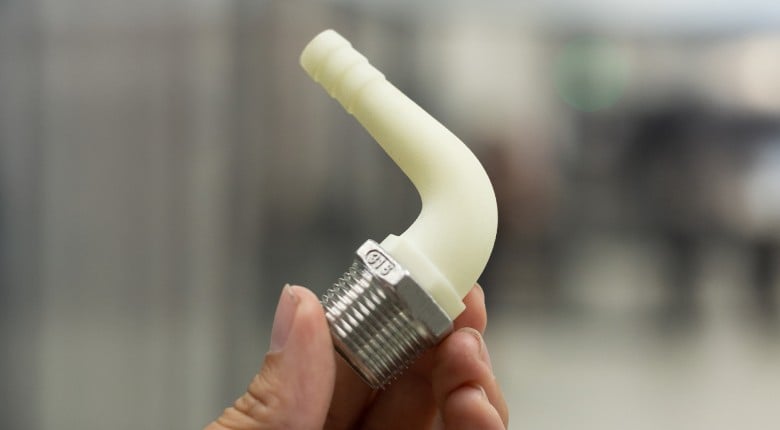
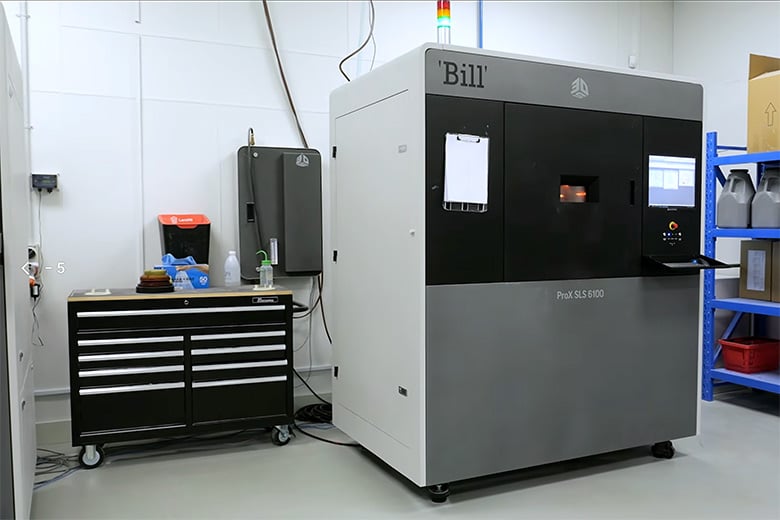
SLS machines cost roughly ten times what a decent FDM printer does, which sounds like a reason to ignore it entirely. It isn't. Third-party print services have made SLS accessible to anyone with a design file and a budget. For certain parts, nothing else comes close, and trying to make other methods work where they fundamentally can't is exactly how projects go wrong.
In this article: What Is SLS? | How SLS 3D Printing Works | Why Use SLS? | SLS vs FDM & SLA | What Is MJF? | SLS Materials Explained | Summary
What Is SLS?
SLS, or Selective Laser Sintering, is a form of additive manufacturing known as powder bed fusion.
Instead of extruding filament or curing liquid resin, SLS uses a fine thermoplastic powder that's fused together using a high-powered laser, a process known as sintering.
This term refers to applying heat to particles so they bond together into a solid mass, without fully melting into a liquid. This results in strong, durable parts with excellent mechanical properties.
How SLS 3D Printing Works
The SLS process begins with a thin layer of powder spread across a build platform.
A laser then traces the cross-section of the part, selectively fusing the powder in that layer. Once complete, the build platform lowers slightly, and a fresh layer of powder is spread across the surface. This process repeats layer by layer until the part is fully formed.
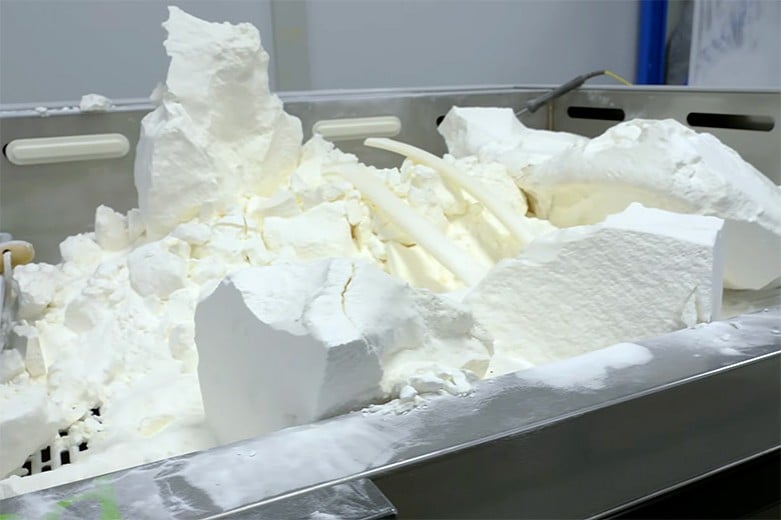
One of the key differences with SLS is that the surrounding unfused powder remains in place during printing, supporting the part as it's built.
After printing, the part is left to cool before being removed. Excess powder is then brushed or blown away and can often be reused in future prints.
Why Use SLS?
At first glance, SLS might seem unnecessary compared to more accessible technologies like FDM (Fused Deposition Modelling), but it does offer some significant advantages.
Firstly, SLS parts are more isotropic, meaning they have more consistent strength in all directions. This is because they don't suffer from the same layer adhesion weaknesses found in FDM prints.
Secondly, SLS doesn't require support structures. The surrounding powder naturally supports the part during printing, allowing for far greater design freedom and eliminating support-related surface imperfections.
This makes SLS ideal for producing strong, functional end-use parts, especially in demanding automotive and motorsport applications.
SLS vs FDM & SLA Parts
Compared to FDM, SLS parts are generally stronger and less prone to failure along layer lines. They also offer greater design flexibility due to the lack of required supports.
Compared to SLA (Stereolithography), SLS parts are typically tougher and more durable, as they use thermoplastics rather than brittle thermosetting resins.
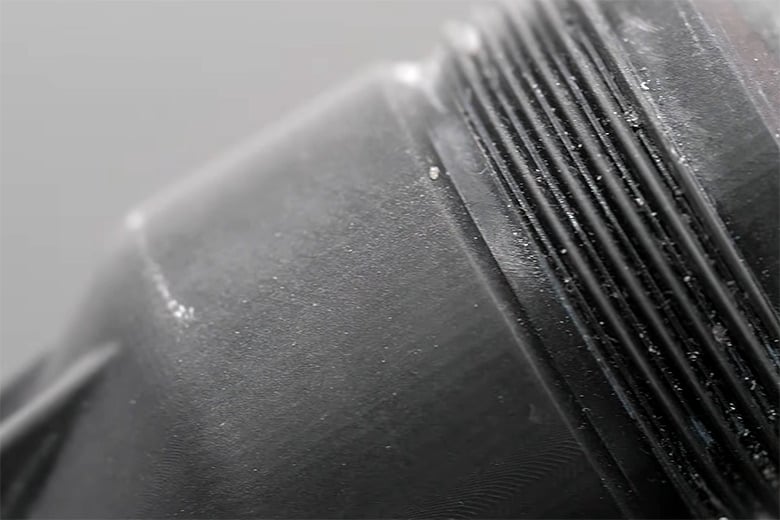
However, SLS parts usually have a slightly grainy or matte surface finish, which sits between FDM and SLA in terms of visual quality.
With that said, post-processing methods like media blasting or tumbling can be used to improve surface finish if required.
What Is MJF?
An alternative to SLS is Multi Jet Fusion (MJF), a technology developed by HP.
Instead of using a laser, MJF uses a fusing agent applied via inkjet nozzles, followed by heat and infrared light to fuse the powder.
MJF is typically faster than SLS and can often be more cost-effective, especially for production runs. It also allows for efficient recycling of unused material.
However, MJF is more limited in material selection compared to SLS, commonly using nylon 11 or 12. In fairness, though, these are great materials for the kind of work we'd be doing in motorsport.
SLS Materials Explained
While SLS material options are more limited than FDM, they still cover a wide range of high-performance applications.
- Nylon (Polyamide) is the most common SLS material. It offers excellent strength, durability, and resistance to heat, wear, and chemicals. Nylon 12 is the most widely used option, known for its stiffness and long-term durability. Nylon 11, on the other hand, provides greater flexibility and impact resistance, making it suitable for parts that need to deform without breaking.
- TPU (Thermoplastic Polyurethane) is another option, providing flexible, rubber-like properties ideal for vibration damping or soft-touch components.
- Polypropylene offers excellent chemical resistance and is lightweight and watertight, making it suitable for fluid-handling components like ducts and reservoirs.
Composite powders reinforced with carbon or glass fibres are a good option, increasing stiffness and heat resistance for more demanding applications. More advanced materials like PEEK (Polyether Ether Ketone) are also becoming available, offering extreme heat resistance and strength for high-performance motorsport applications.
Summary
SLS 3D printing is a powder-based additive manufacturing process that uses a laser to fuse thermoplastic material layer by layer.
While the machines themselves are less accessible than FDM or SLA, SLS offers significant advantages in strength, durability, and design flexibility, particularly due to its support-free printing process.
Materials like nylon, TPU, and polypropylene provide a wide range of properties suitable for functional automotive parts, while newer high-performance materials continue to expand the capabilities of the process.
With the availability of third-party printing services, SLS is becoming an increasingly viable option for producing high-quality, end-use components without the need to own specialised equipment.
Want to learn everything you need to know about 3D printing for motorsport and automotive uses? Check this out.