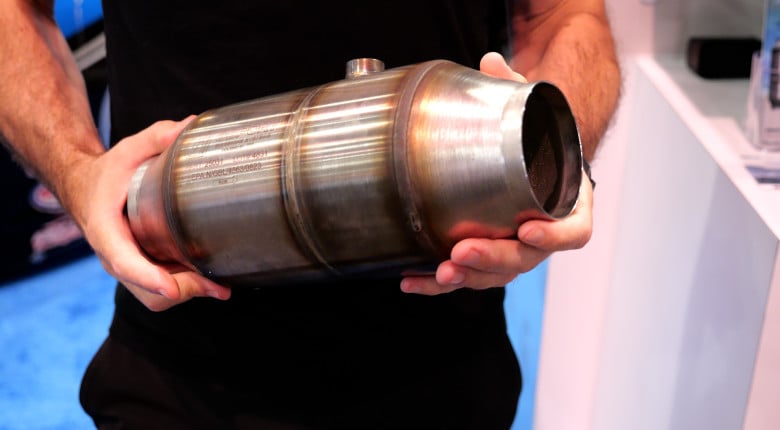
If catalytic converters are a performance bottleneck, how are OEMs making 1000+ hp with them?
When it comes to a street-legal performance vehicle, catalytic converters, often shortened to 'cats', are essential emissions-control devices, but for anyone modifying a performance car, they also raise an obvious question: how much do they restrict exhaust flow, and therefore horsepower?
Make no mistake, emissions devices are not here to make our cars go faster, and that is a fact. The answer to our question is more nuanced than simply saying catalytic converters are performance-thieving menaces because of that fact however. Their effect depends heavily on how the converter is designed, including its size, cell count, core material and placement in the exhaust system.
In this article: Do Catalytic Converters Restrict Horsepower? | High-Flow vs OEM Catalytic Converters | How Does a Catalytic Converter Work? | Are Catalytic Converters Bad for Performance?

Do Catalytic Converters Restrict Horsepower?
Yes, a catalytic converter creates some restriction to exhaust flow, but that does not automatically mean it will hugely restrict your engine's power output. Why?
Inside the converter is a core containing hundreds of small passages. The density of these passages is normally described as the 'cell count', measured in cells per square inch.
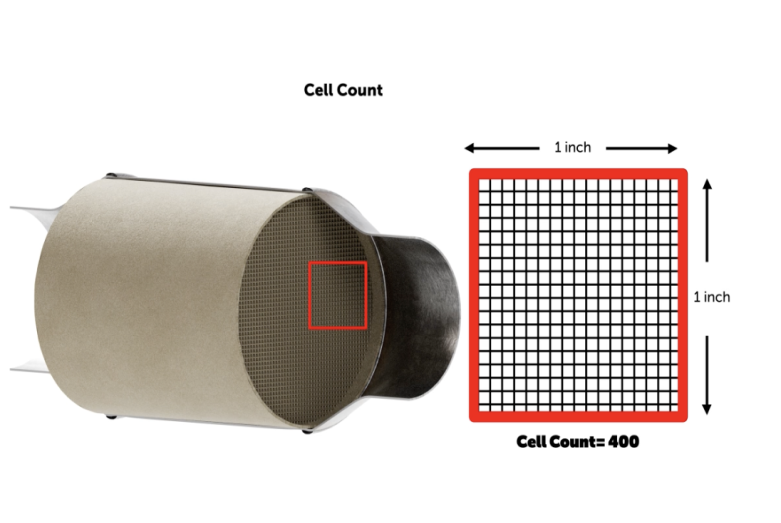
A higher cell count gives the catalyst more surface area to work with, helping it clean up emissions, but it also creates a greater obstruction to exhaust flow.
That restriction can be compensated for by increasing the overall size of the catalytic converter. A larger core provides more total flow area while still retaining the surface area needed for effective emissions control. This is why high-output engines will often use larger-diameter cats, or even multiple converters.
Modern OEM systems demonstrate just how much power a properly designed catalytic converter can support. The 2025 Chevrolet Corvette ZR1, for example, produces 1,064 hp while still retaining factory catalytic converters designed to operate reliably for years.
So while removing a restrictive catalytic converter can improve exhaust flow, simply having a cat does not inherently prevent a road-legal and road-driven performance car from making serious power, but sizing really does matter.
What's the Difference Between a High-Flow and OEM Catalytic Converter?
The biggest differences are generally found in cell count, core construction, catalyst loading and overall sizing, which we've already touched on.
Aftermarket performance catalytic converters commonly use around 100–400 cells per square inch, while OEM road-car catalysts are more commonly in the 400–900 cell range. Using the midpoint of those ranges as a simple comparison, that's around 160% higher cell density in the OEM example.
Reducing the cell count generally reduces the obstruction to exhaust flow, although the overall dimensions of the converter are equally important. A physically larger converter with a relatively high cell count can still provide considerable flow capacity. Core material also commonly differs.
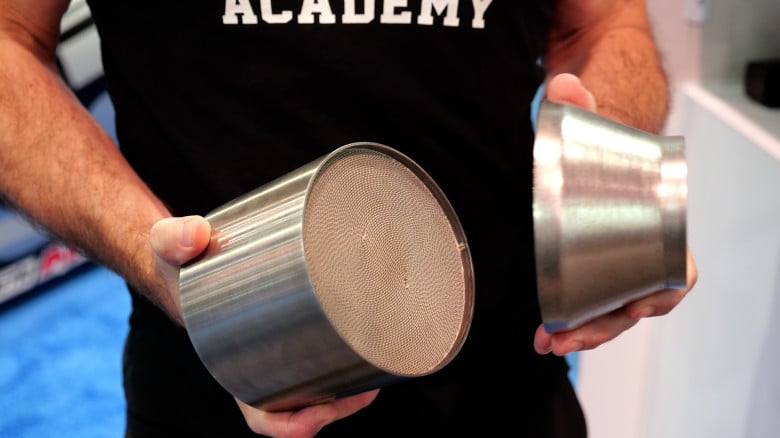
OEM catalytic converters typically use ceramic cores. Catalyst coatings adhere particularly well to ceramic, making it well suited to emissions-focused applications. Performance aftermarket converters more commonly use metallic cores, which can withstand violent exhaust pressure waves better than ceramic cores. However, catalyst coatings generally do not adhere to metal as effectively as they do to ceramic.
Another important difference is catalyst loading. The converter core is coated with materials that promote the chemical reactions responsible for emissions reduction. The wash coat contains precious metals, and both the type and quantity of these metals have a major influence on the converter's effectiveness and cost.
OEM converters typically use heavier precious-metal loading, while performance-oriented aftermarket converters may use fewer precious metals or, in some cases, none, much to the disappointment of some thieves.
This means the term "high-flow catalytic converter" shouldn't be treated as though it describes one specific construction.
A lower cell count can improve flow, but the converter's core diameter, length, material, catalyst loading and position in the exhaust all influence how it performs.
How Does a Catalytic Converter Work?
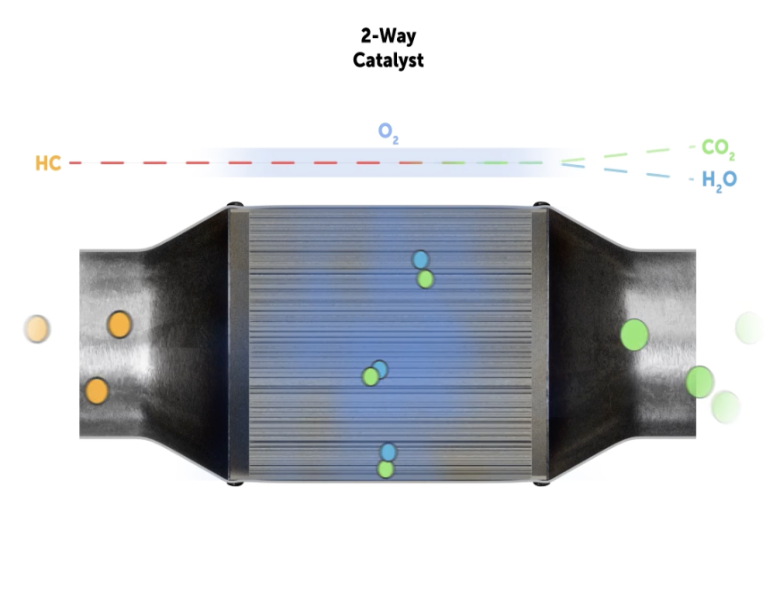
A catalytic converter promotes chemical reactions that turn harmful exhaust emissions into less harmful substances. The earliest two-way catalytic converters primarily addressed carbon monoxide and hydrocarbons.
They use oxygen to convert carbon monoxide into carbon dioxide, while partially burned and unburned hydrocarbons are oxidised into carbon dioxide and water. That oxidation process is effectively another stage of combustion, which is why exhaust temperature can actually be higher immediately after the catalytic converter than immediately before it.
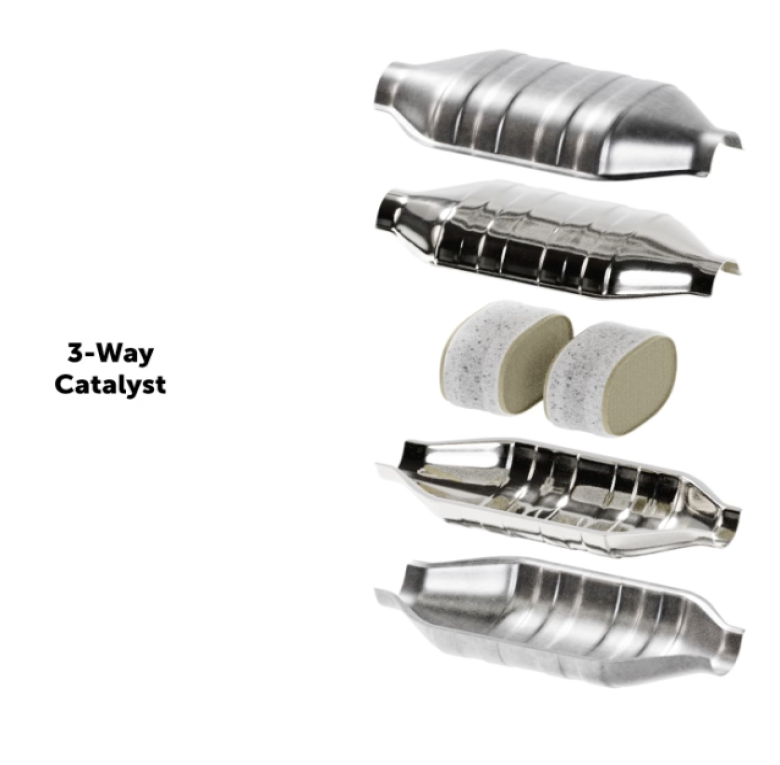
3 way cat breakdown
These days though, most petrol-powered vehicles built since around 1980 use three-way catalytic converters, which perform the same two functions while also reducing oxides of nitrogen, commonly referred to as NOx. Catalyst temperature is critical to this process. The converter needs sufficient heat to work effectively, which, fun fact, is one reason manufacturers often position a catalytic converter close to the engine.
The downside is that placing a converter close to the exhaust ports also exposes it to greater exhaust heat while increasing restriction and back pressure at high engine loads. Get a catalyst too hot, and it can permanently fail.
For this reason, some modern engines use multiple catalytic converters per bank. A less restrictive converter can be positioned close to the engine to begin working quickly after start-up, while another converter further downstream provides additional emissions clean-up in a cooler location.
Two-way catalytic converter
- Carbon monoxide (CO)
- Unburned hydrocarbons (HC)
Three-way catalytic converter
- Carbon monoxide (CO)
- Unburned hydrocarbons (HC)
- Oxides of nitrogen (NOx)
Four-way catalytic converter
- Carbon monoxide (CO)
- Unburned hydrocarbons (HC)
- Oxides of nitrogen (NOx)
- Particulate matter (PM)
For completeness, four-way catalytic converters have also been developed for gasoline engines, adding particulate matter (PM) control to the three functions of a conventional three-way catalyst. This type of integrated catalyst/filter technology was developed in response to tighter emissions standards, although it has not been as widely adopted as conventional three-way catalysts.

motorsport with catalytic converters
Are Catalytic Converters Bad for Performance?
While they're certainly not there to improve performance, cats are also not necessarily the massive bottleneck holding you back that you think either.
Any obstruction in the exhaust has the potential to increase restriction, and catalytic converters are no exception. But modern catalyst design shows that emissions compliance and high horsepower aren't mutually exclusive goals for a performance-oriented build you don't want to hassle with keeping street legal.
In summary, the important factors are these:
- converter size
- cell count
- loading
- core material and placement
As we covered, rather than assuming the lowest-cell-count converter is automatically the best choice, the goal should be to use a catalytic converter with enough flow capacity for the engine while still achieving the emissions performance and durability required for the application.
If you're working with modified vehicles and want to better understand how emissions systems affect performance, HPA's Emissions Tuning Fundamentals course goes much further than catalytic converters alone. You'll learn how emissions systems function, how to measure the emissions that matter, and how to develop parts and calibrations that balance performance, reliability and compliance.