If you haven't correctly calculated for this, you're going to have a bad time tuning your transmission...
One of the most common areas that trips people up when tuning a transmission is tyre size data. This is because it's very rare that you'll see a stock set of wheels and tyres on a modified performance vehicle, but people often don't know how to adjust their TCM tune to suit.
Along with final drive ratio (which we'll discuss in a separate article), if these values are wrong, all of the other hard work involved in calibrating the transmission properly can be put at risk. With that in mind, it's worth taking the time to confirm the values yourself rather than relying on assumptions or old tune data.
In this article: Why Accurate Measurements Matter | How to Measure Tire Circumference | Converting Circumference to Tire Diameter | Special Cases: Track and Drag Applications | Summary
Why Accurate Measurements Matter
When talking about measuring tyre size, we're not referring to retuning the car every time the tyre wears a little. What we want is an accurate starting point, which often differs from the specifications provided by the manufacturer.
Taking your own measurements can avoid errors and give you confidence that the data being entered into the tune reflects the real-world setup on the car.
This is especially important because tyre size can change not just with different tyres, but also with different wheel widths, operating pressures, load conditions, and in some cases, the way the tyre behaves at speed.
How to Measure Tire Circumference
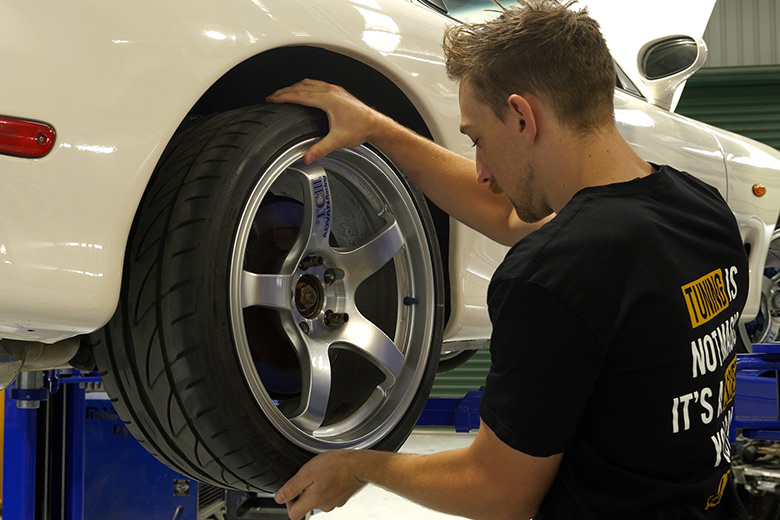
Here at High Performance Academy, we like to place the vehicle on a relatively smooth, flat paved surface that's free of debris. We inflate the tyres to the operating pressure we want to measure at, which is generally full operating pressure rather than the colder pressure found before the vehicle is used.
We then mark a tyre on an un-steered wheel on the driver's side, drawing a vertical mark down the sidewall where the tyre is nearest to the ground. Then, we line that mark up with a mark on the ground, or with the straight edge of an object that won't move, like a heavy book or box.
We like to use a driver-side tyre so the steering wheel can be held straight while pushing the car and watching the tyre mark to count tyre rotations as the vehicle moves forward.
At five tyre rotations, once the tyre mark lines up vertically with the ground again, we then mark the ground and measure the distance from that point back to the original start mark or object. We then record that first measurement.
Next, we move the car another five tyre rotations, mark the ground again, and measure from that end mark back to the middle mark made after the first five rotations, recording that second measurement as well.
The two measurements should be very similar. If they aren't, we'd need to start over and repeat the test until we get consistent results.
Once we have two measurements that are nearly identical, we add them together and divide by 10, which is the total number of tyre rotations measured. This gives us the distance travelled in one rotation of the tyre in real-world conditions and at the pressure we actually want to use.
Converting Circumference to Tire Diameter
To convert the measured circumference to diameter, which is also referred to as tyre height in gearing calculations, divide the circumference by pi. We use 3.14159 as a good enough pi value.
For example:
- If the first five rotations measure 440 inches and the second five rotations measure 440.4 inches, we'd add those together to get 880.4 inches for 10 rotations.
- Dividing 880.4 by 10 gives an 88.04 inch circumference.
- Then dividing 88.04 by 3.14159 gives a 28.02 inch tire diameter.
That 28.02-inch figure is the effective tyre height we can now use in our gearing and transmission calculations.
Special Cases: Track and Drag Applications
Measuring at operating pressure is especially important for road course applications, where the car may go out on track with lower air pressure and gain 10 psi or more as heat builds in the tyre.
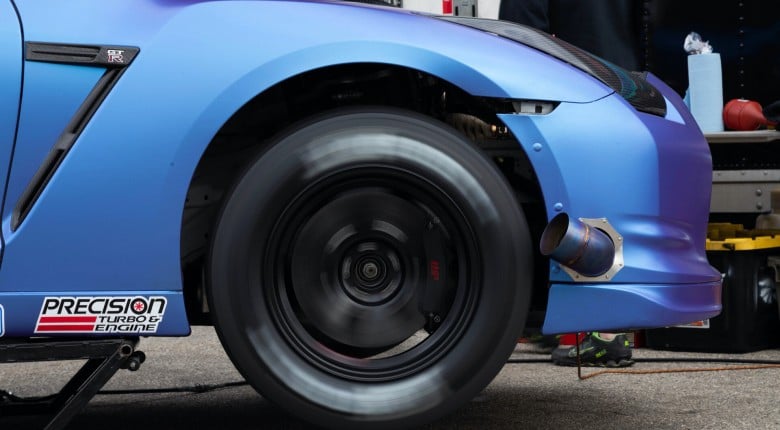
Drag cars introduce another challenge, especially when using tall sidewall slicks. Tyre growth in those situations can be extreme and less predictable until we have data from that specific tyre and application.
In that case, you can take a starting measurement with the tyre inflated more than usual to give the ground-facing portion of the tyre more support during measurement. So for example, if you normally run 6 psi, but on launch the tyre rapidly grows to resemble what it would look like statically at 20 psi, then measuring it at 20 psi can provide a more useful starting point.

This is only a starting point for drag racing applications, though. Testing and data logging remain essential, and GPS speed reference can also be very helpful in determining how much the tyre is growing as the vehicle travels down the track.
When gear and axle ratios are known, and if the torque converter clutch is locked for a test to remove slip from the equation, we can compare vehicle speed against GPS speed and get a better feel for tyre size change under real conditions.
Summary
Accurately measuring tyre size is crucial if we want to do a good job of tuning our transmission, as getting it wrong, or simply guessing, can have some very unfortunate consequences.
Any time you're measuring street tyres, it's best to do so at normal operating pressure. If you're working with a tyre whose size varies dramatically in operation, then some compromise is unavoidable because the circumference changes as the vehicle moves through the track.
Even if you keep the same tyre and only change wheel width, the shape of the contact patch and the resulting circumference can change, too.
Like most things in tuning, the less we assume and the more we know, the better our chances of success will be. With actual tyre size (as well as the final drive ratio) confirmed, you can move forward with much more confidence in the transmission calculations that follow.
Want to begin to learn everything you need to know about tuning your transmission? Start here instantly.