Sale ends todayGet 30% off any course (excluding packages)
Ends in --- --- ---
Talk about engine building here. New products, tricky questions or showcase your work - If it's engine building related it's welcome here.
It's quite surprising what you can get away with sometimes, however I wouldn't be very happy with the job you've paid for. Ultimately for a high performance engine you want everything in your favour, particularly in a Subaru engine where they are well known for potential bearing issues anyway.
Unfortunately having been through the task of line boring/line honing with two engines in quick succession, I can say that it isn't as easy and straight forward as it sounds, and it takes a talented machinist to get really great results. With the wrong operator on the boring or honing equipment it's very easy to destroy an expensive block so I would step carefully. Is there anyone around who has a good reputation for line boring / honing?
Did you measure the oil clearance in relation to the main journal diameters?
I do see alot of variances in your measurments ex. +.005 from horiztonal to vertical position(parting lines) in #1 which is alot imo. Not sure what your plans are for the engine but that is alot of out of round for a race spec.
I have done some more measuring on the engine.
Firstly, I dis-assembled the case halves, and cleaned everything. I then installed the ACL HX (+0.001) bearing shells to measure the protusion from the case halves. The measurements were done by putting the bearings in, then levelling one side of the shell, equal to the parting face surface. Then measuring the protusion above the parting face on the opposite side of the bearing shell. I used a deck bridge and dial indicator to do the measurements.
The left case half side all had more bearing protusion when compared to the right side. Meaning the tunnel center line is not the same as the parting face center line. (This is exacerbated by the way I measured them, as explained above).
And the right side #1 bearing actually sits recessed into the tunnel by 0.002. (Not protruding at all.)
Also, both #1 and #5 have less total/combined protusion (bearing crush) than the middle 3 bearings.
Bearing protusion from case parting surface.
------- Left Side Case -------- Right Side Case -------
1 --------- 0.014 -------------- NEGATIVE 0.002
2 --------- 0.015 ---------------------- 0.004
3 --------- 0.014 ---------------------- 0.005
4 --------- 0.015 ---------------------- 0.004
5 --------- 0.007 ---------------------- 0.005
I then assembled and torqued the case and measured the inside bearing dimensions. I measured at horizontal, 45°, and near vertical. This was done with a dial bore guage, set against a micrometer, at 25°c. (Keep in mind, this is with ACL HX bearings, with 0.001 extra clearance.)
--------- Horizantal ------------ 45° --------------- Vertical ----
1 --------- 2.3646 ----------- 2.3652 ------------- 2.3706 ----
2 --------- 2.3642 ----------- 2.3652 ------------- 2.3698 ----
3 --------- 2.3640 ----------- 2.3643 ------------- 2.3686 ----
4 --------- 2.3642 ----------- 2.3646 ------------- 2.3691 ----
5 --------- 2.3640 ----------- 2.3660 ------------- 2.3706 ----
Thanks for the reply.
I have flicked through the Subaru FSM and they do not list the main bearing bore measurements anywhere that I can see. They only list main bearing clearance tolerances, and crankshaft tolerances. Unless I am looking in the wrong area??? (Looking at SG Forester XT FSM, as that is what the car is originally)
The only tolerances I can find listed anywhere specific to the main bearing bore, is on the ACL and Kings bearings product info. And they both state a tolerance of 2.5197 to 2.5205. And they dont state a out of round or taper measurement allowance.
I have spoken with the original machine shop owner (NOT the guy who did the line hone) and he has said its not ideal. But it would probably work. He said, if it was his personal engine, he would probably run it as is. He said Subarus fail all the time, and the engine will need periodic refreshing regardless of those main tunnel measurements. He said, ideally, the line bore would be done to correct it, and that means oversize is needed. But he also said, it could end up worse. And if so, then there is probably no returning from that.
I have spoken with the shop who did the line hone, and he has already purchased a set of Kings oversize bearings. (I presume in anticipation of line BORING it to oversize.) He wants me to do some more measurements, including bore at 45°, aswell as bearing shell protusion from each case half. And also bearing clearances to crankshaft.
I think boring is the better way. But then i worry it will backfire and end up worse than it is now.
Such a dilemma.
@Bram, sorry for the very slow reply - For some reason I've missed this thread. I definitely wouldn't be happy about the variance you're seeing in the main tunnels. A good sanity check when you have a concern like this is to always reference the tolerances in the factory workshop manual. The manual will give you minimum and maximum measurements for the tunnel as well as a specification for allowable out of round. It's of course less of an issue if the measurement across the parting lines of the journal is larger than in the direction the bearing will be loaded since the bearing shells naturally have some eccentricity built into them and out of round like this will not impact the oil clearance where it counts. What it will do however is have some level of impact on the crush that will be achieved on the bearing shell.
I don't have an EJ20 manual in front of me but to give you some idea, the SR20 we've just finished building suggests a maximum out of round of 0.0002" on a main journal.
Honestly you should let your original machine shop look at it and tell you. I personally would not run the engine like that. They totally missed the housing tolerance by almost +.002 from the high. Thats alot and will effect your bearing crush.
You have one last option and that is having a good shop line hone for the next size +.002 or +.005. King bearings make an oversized bearing for bigger housings.
I would also appreciate Andres opinion on all of this. Please if your reading Andre, let me know if you think this is bad or not.
No one that I speak to is willing to say it it will be alright, except the shop that did the hone. I dont know if thats because no one knows for sure, or if its because no one is willing to put thier name to recommending running it like that, or if its because it is not ok to run it like that.
Hello. When i say "horizontal", I mean measuring horizontal as if looking at the engine normally. So inline with the direction the pistons move back and forth because its a horizontal subaru motor.
When i say "vertical", i mean inline with the parting line of the case. And not actually directly vertical. I measured maybe 5° away from directly vertical, So i didnt get any interference from the parting line itself.
I did 2 measurements for each bearing bore in horizontal, and 2 measurements for each bore near vertical. One measurement is forwards of the oil supply grooves, and the other measuremnt is rearward of the oil supply groove. I did this to try and determine any longitudal taper on each main bearing bore.
I havent done anything with the engine since i got it back from the 2nd line hone. But this weekend I plan on doing some more measuring. Including measuring the bore at 45° each way. And then putting some bearings in and measuring the protusion from each half. (The amount of crush on each bearing half.) And then assembling the case halves with bearing shells inside and measuring bearing clearance. Again, at horizontal, vertical and 45°.
I am interested to see the difference between the better bearing bore and the worse bore, with bearing inside. I know that bearings are made with a certain amount of eccentricity built into them. So that as the crank spins, oil is driven up a ramp and builds localised pressure where it is needed most. The additional out of round i have in the main bearing bores is going to add to this I would imagine. I would like to see how extreme it is comparing a realtively round bearing bore with the most out of spec (5th) main bearing bore.
Hey just catching up. I have been going through a very similar situation. My first engine build so I am also learning.
Is your horizontal measurements at/near the parting lines of the main housing??
Main #1 and 5 are outside of the main housing tolerance and very out of round. I think max out of round you would want to run on a 600whp setup would be
Just read through thread Bram - man that just plain sucks. I feel the same way as you when it comes to letting others handle my cars or engines, nobody will ever have the pride/duty of care you will have with your own property.
I feel if they just toruqed up your arp case bolts correctly then honed/bored it at the start - you would not be stressing over these clearance's!
I am assuming the shop is ok with the block leaving them the way you have it right now?
Did they check the block and are their measurements similar to yours?
Bump. Anyone got anything to add to my measurements on the previous page?
This one is for Andre with regards to my earlier question about whether to have the heads / torque plates bolted down during the line hone, and whether or not that will affect the main tunnel. Its only anecdotal evidence, but its something to think about.
I was speaking with a Subaru builder recently who told me he did a Subaru enhine with 14mm head studs, and as he was tightening the head studs on one side, the crank locked up on him. Because the distortion to the case from the studs was so massive.
He now does the head stud torquing equally on both heads at the same time. Instead of one head individually, then the other. Which he seams to think helps.
If the head studs can distort the main tunnel that much, then to me it would make absolute sense to get any line hone/boring performed with the heads or plates torqued down.
It is out of spec because the fist time they did the hone, they forgot to tighten tighten all the case bolts... so they re-did it, and it is now way out of spec in the vertical measurements.
This is because when line honing, they are attempting to remove material in the horizontal measurement only. The verticle measurement is already at size. And they keep skimming the parting face to give more material to remove from horizontal. But the skimming does not change the vertical size at all.
Then as the hone goes through, it just sands material away, removing it from where ever it touchs. So it ofcoarse removes more material from the vertical measurement, taking it out of spec, as they attempt to get the horizontal measuremnt in spec.
The reason there is taper on the bearings is probably because they would have had to attempt to individually loosen various main bolts as each bearing bore came to size, because of the botched first attempt. The Subaru blocks flex and distort when tightened, so as they loosen the bolts, and continue to hone, they would be honing the tunnel in the un-stressed state, and putting out of round, taper and probably even alignemnt faults into it. (Defeating the purpose of getting the hone in the first place)
After doing more research, and thinking about the process. I dont think line hone is the way to go with Subaru. If they got it right the first time it would probably be ok. But i think a line bore would probably have been the better choice. But you still have the problem of trying to find a machine shop capable of doing the work, without fucking it up.
Seems like a bad tool or setup because the issue is more pronounced on the first and last bore. If you have a set of bearings handy why not fit them in and check sometimes the bearing crush changes up things a bit, especially seeing it’s an aluminum block. You may have to try my style manipulate the torque to get what you want.
Bump. Anyone have any input on the main measurements i have put up????
All the other measurements do vary a bit here and there, but seam mostly within tolerance. #3 is on thight end of tolerance. #1 and #4 are on the loose edge of tolerance. There looks to be a small amount of out of round and taper on #2. But my big worry is the massive out of round on #1 and especially #5 which seams to also have some taper aswell.
#5 was the one they left the bolts loose on the previous go, and this is the one which has the most inconsistency.
Update.
I have picked the engine up after the 2nd attempt at the line hone. And I am worried that the work is been done poorly again. I would really appreciate some input from Andre or anyone else familiar with Subarus.
If it is foo-bar then it might mean the whole block is now a very expensive boat anchor? Or maybe have one more shot at it doing it, but do a line BORE not a hone. As I dont think a hone can fix out of round.??? Obviously there is only so many times you can skim the parting face before the block is too short. I have been told they took a further 0.001 off each face, meaning 0.003 off each face total. And a grand total of 0.006 closer together combined.
I have measured each main bearing bore front and rear of the oil groove, this is to try and see if there is taper on each bore. And i also measured in the vertical plane nearly perpendicular to the horizontal measurements to check for out of round. The out of round on #5 is like 0.0025. That seams MASSIVE to me.
The measurements I get are as follows. (Done at 22°c block temperature.)
................ horizontal ....................... vertical
#1 ...... 2.5204 / 2.5204 .......... 2.5221 / 2.5220
#2 ...... 2.5205 / 2.5202 .......... 2.5208 / 2.5208
#3 ...... 2.5197 / 2.5196 .......... 2.5202 / 2.5203
#4 ...... 2.5204 / 2.5204 .......... 2.5200 / 2.5205
#5 ...... 2.5200 / 2.5205 .......... 2.5212 / 2.5226
I have highlighted the measurements that worry me.
Update.
These are the main tunnel measurements as it currently sits. Measured at 20/21°c using a dial bore guage and micrometer. I have taken the engine back to the shop to re-work it today. He didnt say what he was going to do to get it right. Which worries me. I am concerned because the 3 middle journals are getting very close to the high tolerance. So i dont know how they will be able to get the 5th honed correctly without overshooting the already honed journals. I am not sure if they are going to re-cut the parting face. The parting face has apparently had 0.002 off each face from the first honing attempt. I did try fitting the front cover from the drysump kit, and it was able to fit on the front 2 oil pump dowels. At what point does the rear main oil seal and front oil pump cover become an issue after the parting cuts?
Im also concerned they may try and hone the block with the other bolts loose to try and bring it back or somthing like that. Which might make them tapered or out of round or whatever else. And also not in-line because of the uneven way the case bolts squeeze the case.
I would appreciate it if someone could give some insight as to thier opinion on what would be the best coarse of action from here forward. If you were tasked with job, would you try and re-hone it. Fly-cut the faces and re-hone it. Fly cut the faces then line bore it, then hone it. Bore the tunnel out for larger OD bearing shells. (Kings do make some I believe) Or stop and take it to another shop?
I cant find a Subaru main tunnel tolerance in the Subaru FSM. But Kings bearings have a tolerance listed as :
2.5197 to 2.5205.
My measurements :
#1 = 2.5200
#2 = 2.5202/3
#3 = 2.5202/3
#4 = 2.5203
#5 = 2.5188 / 2.5192 (0.0004 taper on #5)
Thanks. (I apologise for my bad language before, as uou can see, i was pretty angry when i discovered what had happened.
Thanks for the reply.
The shop is closed today, so no contact yet. But I did send them an email, with the photographic proof. And the measuremnts of the main tunnel once the bolts were correctly torqued. There is no doubt in my mind that they forgot to torque the bolts. They also wouldnt have followed the instructions, as the instructions clearly state to torque in 3 equal stages. And even give the correct sequence. Counting 1 thru 10. So even if they forgot the final torque of 60ftlb, they should have theoretically atleast made 40ftlb. I shouldnt be too hard on them. The average machinist only has 9 fingurs, so i can understand him not being able to count higher than 10 without taking his boots off. As we know, in todays age of OHS, you must always were your boots. (Unless you want to become a 9 toe'd machinist)
The #5 main bolts are kind of out the way on a subaru. There are 6 bolts going through the middle of the water jackets, coming from each side, and 2 in the front of the case. And the last 2 are in the rear of the case, which are very recessed and easily overlooked. As well as all the smaller bolts around the periphery.
I agree with you that mistakes happen, and its how they are handled whats important. We are all human, and Im probably guilty of forgetting to tighten a bolt as an auto electician. So hopefully, they will acknowledge the boo-boo. And make it right.
I would hope you have made your feelings felt regarding the "machinist" - you'll get the usual "Nah, mate, not our fault" BS, but they have lost customers now - note, I accept that sometimes mistakes are made, admitting and fixing them is the grown up thing to do! If they admit their mistake, and remedy it to YOUR satisfaction, that should also be made known.
With limited access, there are adaptors that are used with torque wrenches that should do the job, such as https://store.snapon.com/Torque-Adaptors-C800698.aspx - however, finding metric versions may be a little more difficult but, ultimately, worth it - don't forget the basic maths to correct for the added effective length of the 'wrench. There are also specialist torque wrenches that are socketed, rather than having a drive square, and some of these are available with 'ring spanner' inserts.
Properly fitted, Heli-coils are regarded as stronger than the parent material - in fact, it is not uncommon to find high end castings being supplied OEM with heli-coils fitted because of this greater strenght and reliability.
And to top my amazing day off. One of the small M8 outer case bolts pulled the threads. I was torquing it up as per the ARP instructions and just as I got to the specified torque of 25ft pound, there was a loud pop. Initially I thought i snapped the bolt, so I backed it out, and it was fine, so I re-installed it and it would not tighten up, instead just free spinning in the hole. So the threads in the case have been pulled. Fuck yeah, just what I need.
Now, interestingly. The 2 OEM locating dowels have been replaced by the shop. There are new dowels in the case. Which is very nice of them. (They possibly had trouble removing the old dowels when they went to cut the parting face. So this is understandable. )
BUT. They are longer than the OEM dowels. So, I suspect they had to drill the recieving bore a little bit deeper. IF this is the case, then it would explain why the threads might have pulled. They would have had to drill out some of the threads in order to install the longer dowel, so that would leave less threads behind, hence have a greater chance of pulling the threads when torqued. Guess what. The one that pulled is one that recieves the dowel... I dont have proof of this yet, and it was me that pulled the thread. But its a big coincidence that there are new dowels in my case, and the one that pulled was one that had the bigger dowel....
On a Subaru, the other dowel bolt is in the gearbox bell housing mating area. So, you cannot actually fit a torque wrench on it. You have to use a ring spanner. And as such, I didnt fully torque this bolt, as I fear over torquing it. Instead going to about 80% by feel. The subaru case dowel bolts are not the main bearing bolts, just smaller bolts that secure the outer periphery of the case together.
So now I have to get the case back to the shop to re-work. And figure out how to repair the case. Do I use a helicoil and only use partial torque. Or do I drill and tap to accept a larger bolt like a 3/8? Those ARP case bolts are like expensive. Not using one would be like not using a $50 note.
Imagine if they were building an engine instead of doing a line hone??? Imagine sending an engine out with loose main bolts or loose rod bolts even !!!
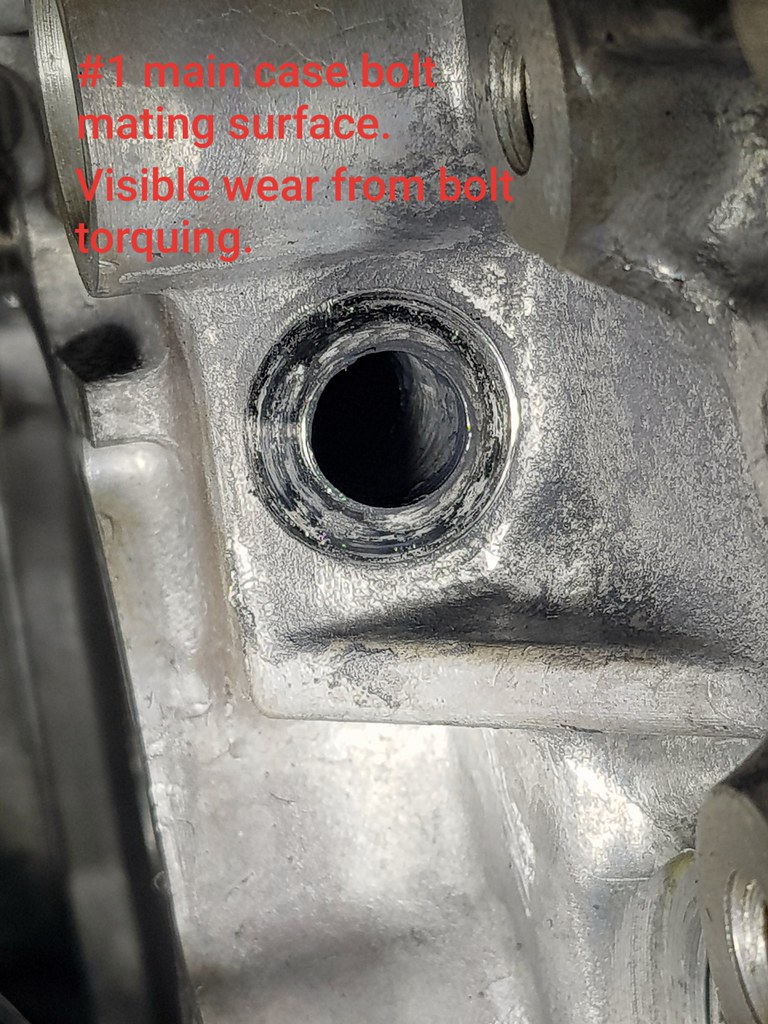
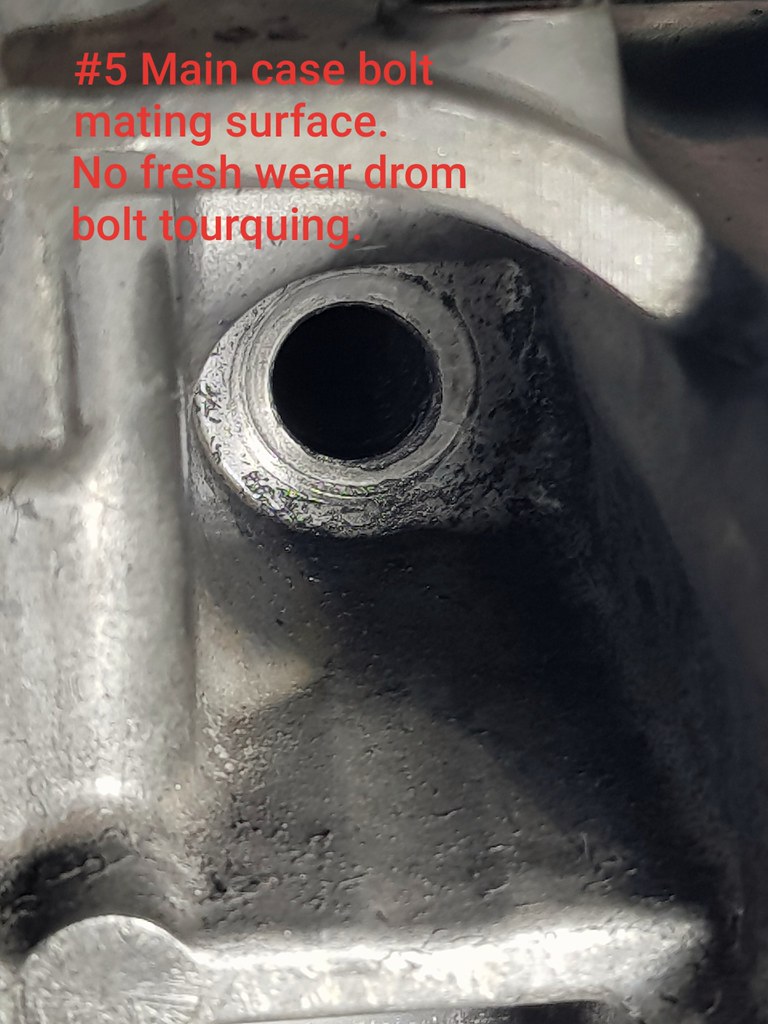
Confirmed that both the bolts on #5 main were only snugged up hand tight. Not torqued. The washers didnt have scuff marks from being torqued like all the other bolts. And the aluminium surface on the case where the bolt head/washer makes contact has a different pattern. Indicating the original torquing when the engine was first used, and no fresh torquing.
Measurements on the mains (after properly torquing all bolts) show the #5 main about 0.001 or so tighter than the rest.
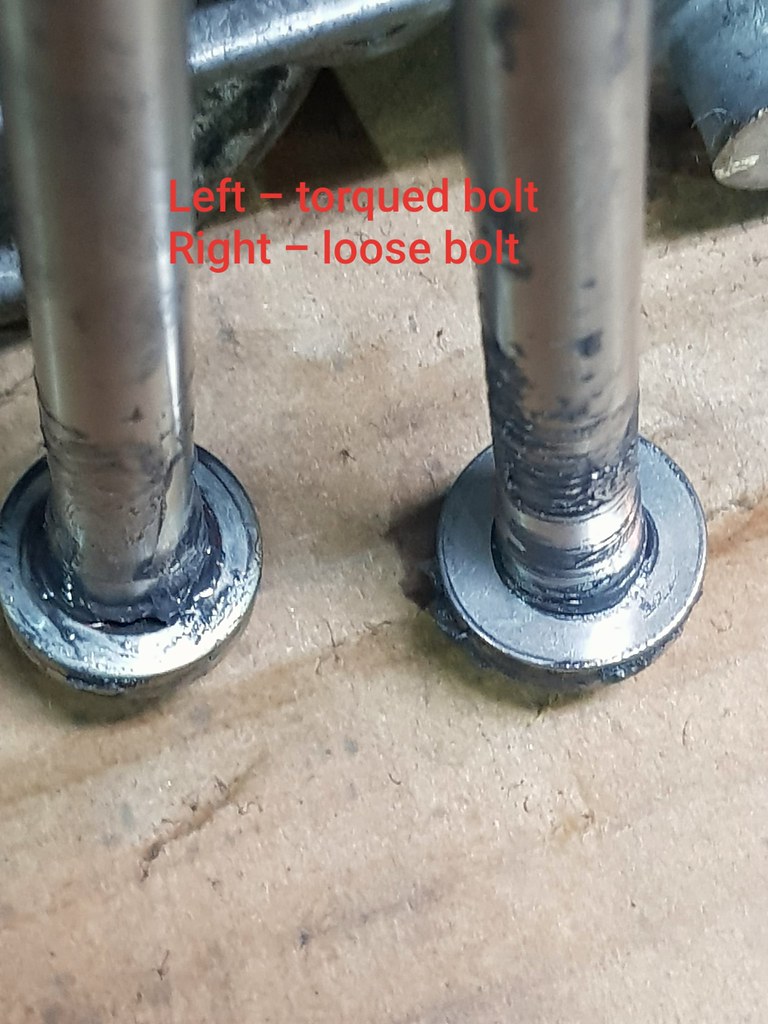 2018-10-13_11-17-30 by bram biesiekierski, on Flickr
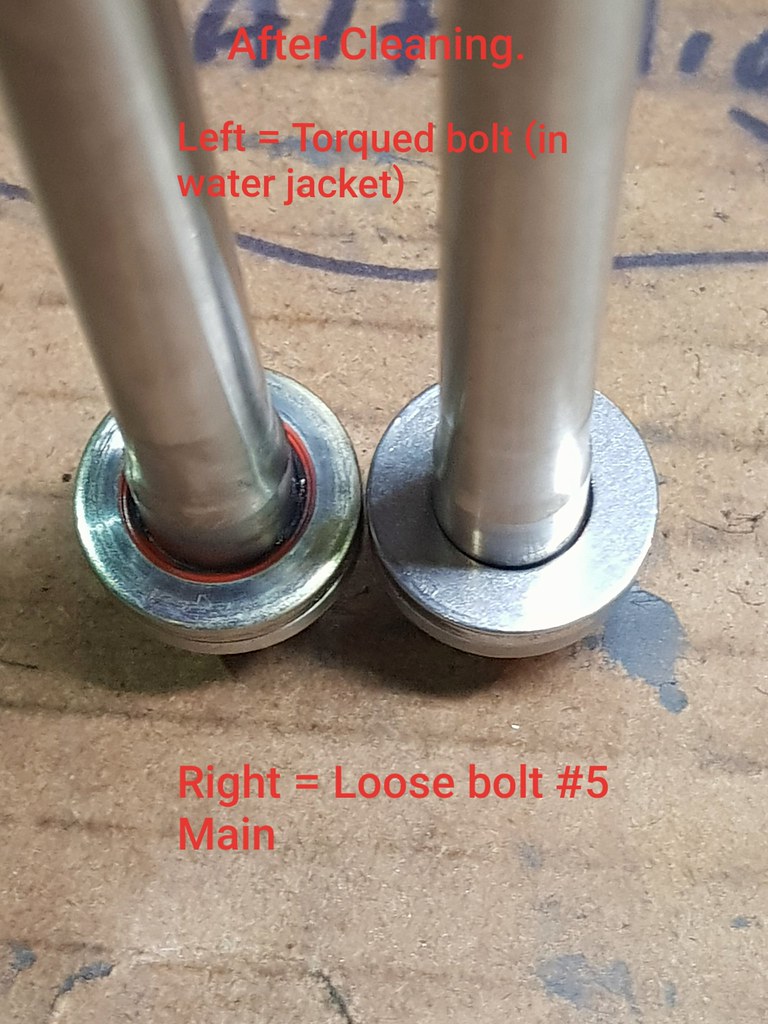 2018-10-13_11-17-45 by bram biesiekierski, on Flickr
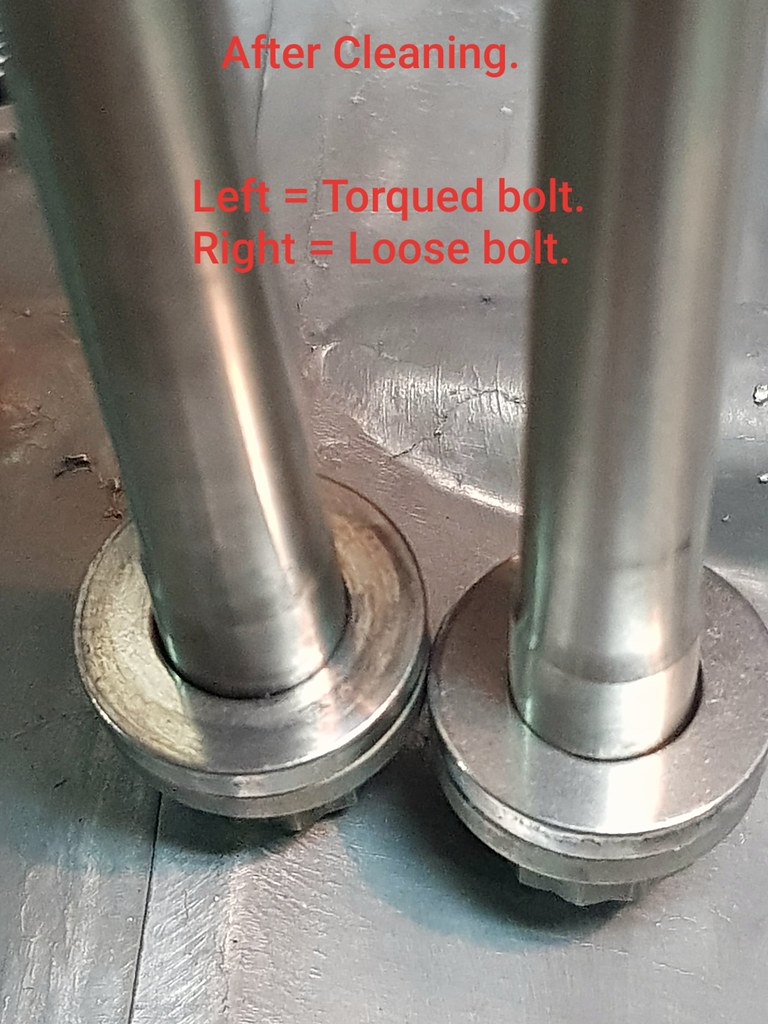 2018-10-13_11-17-57 by bram biesiekierski, on Flickr
 2018-10-13_11-18-08 by bram biesiekierski, on Flickr
 2018-10-13_11-18-42 by bram biesiekierski, on Flickr
Got the block back after line honing. Went to seperate the case.
The 2 bolts on #5 main werent tight !!!!! How fucking hard is it to read instructions and do the bolts up like the instructions say.
The motor industry is fucked. No cunt gives any shits.
It can't hurt to fit torque plates, however this obviously necessitates two torque plates. An easy alternative would be to torque the heads in place for the line honing process.