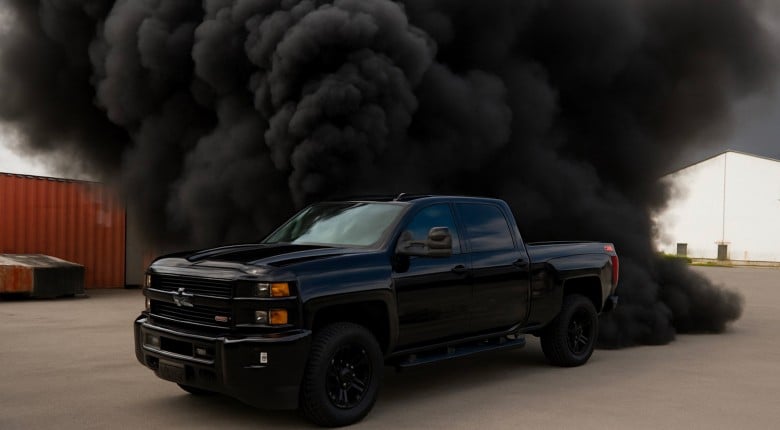
Rolling coal is one of the most talked-about and controversial elements of diesel engine tuning. Anyone who's watched diesel tractor pulling, drag racing, or modified street trucks will be familiar with the sight of thick black smoke pouring from the exhaust as the boost piles on. While the visual spectacle is either loved or hated, there's more to the story than aesthetics and anti-social behaviour alone when it comes to doing the same thing in your own street-legal vehicle day to day.
In this article: What Is Rolling Coal? | Pros and Cons Of Excessive Exhaust Smoke | Environmental and Legal Considerations | What Happens To Your DPF When You Roll Coal
What Is Rolling Coal?
At its core, 'rolling coal' refers to the intentional production of heavy black exhaust smoke from a diesel engine. This occurs through adding more fuel to the combustion process.
Power in a diesel engine is closely linked to fuelling, and adding more fuel generally increases power. There's a limit to how much fuel you can add, or how late it can be injected in the combustion process, before you get to a point where unburned fuel makes its way out the exhaust in the form of soot particles, AKA black smoke.
It may look like this is an inefficient use of fuel, and to a degree there’s truth to that, however, the engine will generally produce more power under these conditions than it can with no visible smoke output.
Pros and Cons
Rolling coal will produce more power than a smoke-free calibration under certain conditions, but there are some substantial downsides, mostly in a significant drop in efficiency and an increase in emissions. While some enthusiasts see rolling coal as a statement or a byproduct of chasing 'maximum power', it is important to acknowledge the costs.
As a tuner, finding the balance between extracting performance and maintaining clean operation for a street legal vehicle becomes a personal and legal choice. It is 100% possible to produce reliable and impressive power figures without resorting to excessive smoke. It will be less than if you were to throw more fuel at the tune and create black soot clouds, but it might not even be enough to notice without a dyno, depending on your setup. With this in mind, it's really about what you, or your customer, find acceptable.
Here's a breakdown of the pros and cons of rolling coal, some of which we'll discuss in more detail next.
Pros:
- Higher potential power and torque production
- The look (if you're into that very unfounded 'soot gets the moot' kind of thing, we guess)
Cons:
- Significantly increased emissions
- Inefficient fuel use
- Legal and compliance problems
- DPF damage
- Negative public perception
Environmental and Legal Considerations
Rolling coal is almost always associated with emissions non-compliance. Depending on your location, producing visible smoke on the road can result in fines or vehicle inspection failures, whether it's intentional or not. While we generally don't pass judgment on personal tuning preferences here at HPA, it is essential to understand the consequences of this practice.
Heavy soot output isn't only environmentally damaging but also makes your vehicle a clear target for enforcement, with no realistic/needle-moving performance impact on a street-legal vehicle. Due to this, it's not something we advocate for.
DPF Implications
If your diesel vehicle is equipped with a diesel particulate filter (DPF), rolling coal will quickly overwhelm it. A DPF is specifically designed to trap soot, and intentionally producing excess soot will cause rapid loading. In most cases, regeneration won't restore normal function, and the filter will need replacement, which is an expensive repair. Enthusiasts who pursue rolling coal often remove the DPF entirely, but this requires the ability to disable DPF-related functions within the ECU which brings its own legal risks in many countries.
Understanding rolling coal comes down to acknowledging the trade-off between maximum fuelling, power output, and the environmental and mechanical implications. While the sight of heavy black smoke might be familiar in certain motorsport settings, it's not without consequences and should be approached with full awareness of its impacts, especially if you have a DPF fitted.