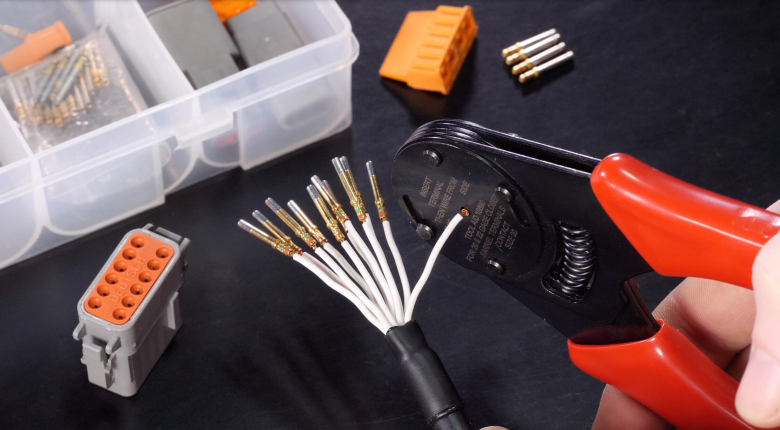
For over 25 years, Deutsch DT connectors have been a go-to choice for sealing sensor, actuator and harness-to-harness connections in many performance automotive and motorsport wiring harnesses. They're reliable, straightforward to work with, and, compared to higher-end options, easy on the budget, which is why you'll find them throughout club-level and professional builds alike.
Commonly just called 'Deutsch Connectors', there are four Deutsch DT variants you'll come across: DT, DTM, DTP and DTHD. Each is built around a different contact size and current rating, so picking the right one comes down to how much current a given circuit needs to carry. This article breaks down what each series offers, where it fits in a harness, and what to keep in mind when specifying connectors for your build.
In this article: What Are Deutsch Connectors? | Why Use Them? | History of the DT Connector | DT Series | DTM Series | DTP Series | DTHD Series | Which Connector Should You Use? | Sealing, Boots and Weatherproofing | Keying and Limitations | Tools You'll Need | Where to Buy | How To Read Deutsch Part Numbers | Conclusion
What Are Deutsch Connectors?
Deutsch DT series connectors are environmentally sealed electrical connectors built around a rugged thermoplastic housing, silicone rubber seals and corrosion-resistant terminals. That combination makes them a common choice anywhere a connection needs to survive vibration, moisture, dust and temperature swings, which covers most of the connections in a car. They're rated to operate across a wide temperature range, from -55°C to 125°C, so heat soak in an engine bay isn't a concern, but you shouldn't be placing them next to your exhaust manifold.
Rather than one single connector, Deutsch produces several options sized around different pin counts and current capacities. The variants you'll run into most in motorsport wiring are DT, DTM and DTP for multi-pin sensor and actuator connections. Less common and somewhat detached from the others, despite the product name, is the DTHD variant for single, high-current circuits. We rarely use a DTHD as most high current circuits in an automotive application are generally hardwired to a stud or Radlok connector, but occasionally they can be useful around fuel, electric power steering or alternator setups.
The right connector for a given circuit comes down to how much current it needs to carry and how many wires you're terminating into it, all things we always want to plan and work out before spending any money.
Why Use Deutsch Connectors in your Wiring Harness?
At the top end of the market, autosport style connectors are extremely compact and come with a high mating cycle count, but a single connector body pair can run $200 to $300 USD, and you need dedicated crimp tooling and positioners to work with them which can cost $1,000-$1,500 on top. Deutsch connectors sit at a much more accessible price point, generally around $10 USD for a small connector body, and the crimp tools needed to terminate them are generic; inexpensive, quality ones can be had for a few hundred. From there, no specialised knowledge is required to get a great result and a reliable connection.
"My go-to for affordable quality option is the Deutsch range of DT, DTM and DTP connectors." - Andre Simon, HPA
Deutsch DT family connectors are also well suited to thin wall wire types such as Tefzel, which is commonly used in high performance and motorsport wiring harnesses due to its resistance to heat and abrasion as well as its thin insulation and reduced overall wire diameter. This is worth knowing because factory OE connectors are usually sealed for automotive-grade wire like TXL, which has a noticeably thicker jacket. Fit a factory seal over a thinner Tefzel conductor and there often isn't enough insulation for the seal to grip properly, which can leave a path for moisture straight through the back of the connector. Deutsch's DT, DTM and DTP ranges are designed with generally thinner wire in mind, so the seals grip correctly on the gauges commonly used in a motorsport harness and you also always have the option of sealing the connector when required, just to be sure. We'll get into that soon.
History of the Deutsch DT Connector
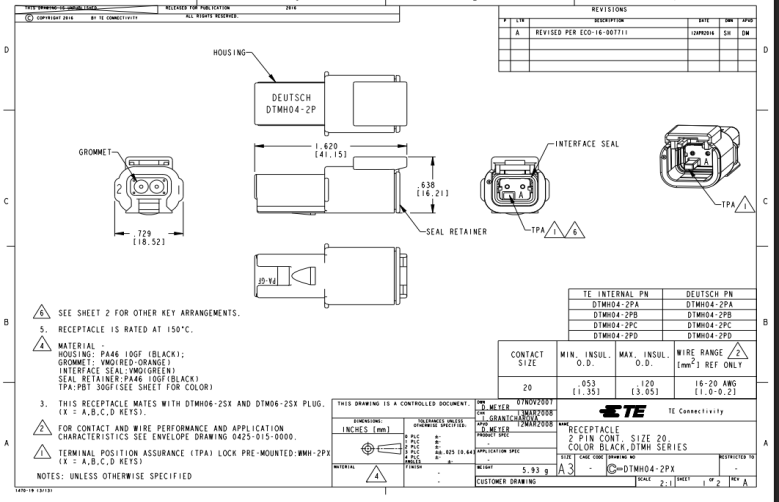
Deutsch as a company was founded in 1938 by Alex Deutsch in California, and for its first few decades the business was focused on connectors for aerospace and military programmes rather than automotive with a clever 'push-pull' connector design being created for the Douglas DC-8 around 1957. Throughout the 1950s, Deutsch was among a handful of connector manufacturers developing a design that would go on to define the modern DT family in 1959: a panel-mountable connector using individually removable contacts, crimped onto the wire first, then inserted from the rear of the housing and mechanically retained. That was a BIG step up from earlier connectors, which were often moulded or soldered in place and difficult to service.

Deutsch operated independently for decades, gradually expanding from military and aerospace use into industrial, automotive and motorsport applications, before being acquired by TE Connectivity (TE). The acquisition agreement was announced in December 2011 and the deal closed on 3 April 2012, for a total transaction value of around $2 billion USD (that's approximately 700,000 Turbosmart turbochargers in today's money). Deutsch continues to operate as a brand within TE today, and the DT, DTM and DTP part numbering and mating interfaces have carried through that transition unchanged, so a DT06-4S plug bought today will still mate with a DT04-4P receptacle from years earlier.
TE has continued to develop the platform since the acquisition rather than leaving it static. In 2023, for example, TE added a new approved raw material source across the 2 to 12-way DT range. Around the same time, TE also added new colour options, green, brown and blue, to the 2, 3, 4 and 6-way DT housings, along with expanded wedge lock choices. Both are documented as running production changes rather than a new model line, so parts made before and after remain fully interchangeable. We wouldn't complain if more things these days took that approach.
You may occasionally see older and newer DT housings described online as different "series" or "generations" based on visual differences, such as a moulded rear cap, different lettering, or a different logo. As far as we can establish, there's no official (public) generational naming system behind this, but every connector will have coding for batches and location of manufacturing and we recommend you record these in your documentation. That way, if TE advises of an issue with a specific batch, you know exactly what you used where for easy replacement. An unlikely scenario, but it is commonly done all the same.
What's actually changed over the years are things like drawing revisions, approved material sources, manufacturing locations, keying, and added variants like enhanced seal retention or extra colour options, all documented as modifications within the same DT family rather than as distinct new series.
DT Series: Specifications and Uses
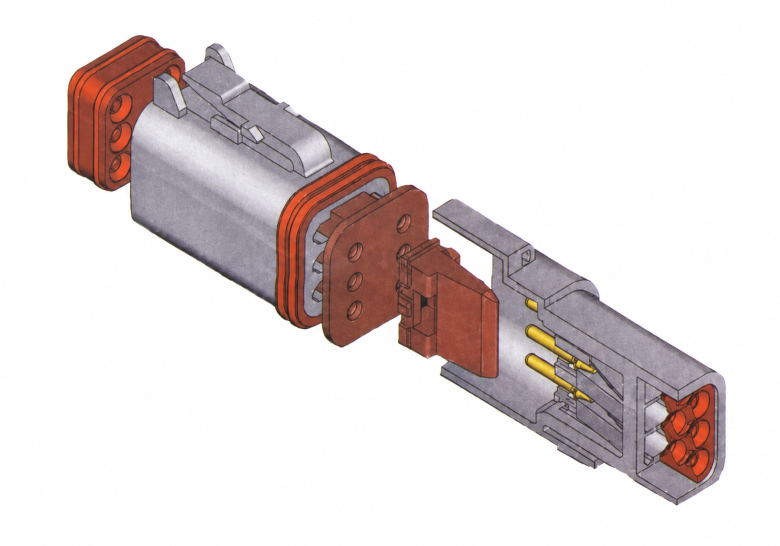
The DT series uses a size 16 contact (Deutsch's own contact numbering, not to be confused with wire AWG) and is the mid-range option of the three families.
- Current rating: up to 13 amps per contact
- Wire compatibility: 14 to 20 AWG (American Wire Gauge)
- Cavity configurations: 2, 3, 4, 6, 8 and 12 position
DT connectors are a good option once a circuit's current draw goes beyond what the DTM series can handle.
DTM Series: Specifications and Uses
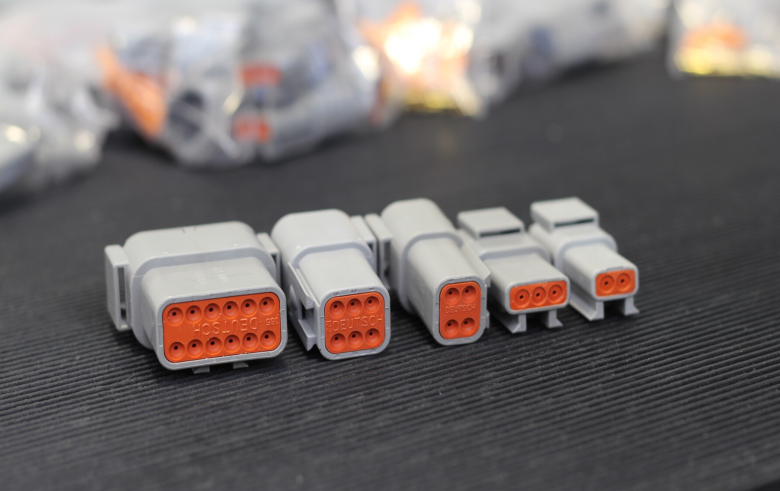
The DTM series uses a size 20 contact and is the smallest and most common of the three families for general sensor and low current wiring.
- Current rating: up to 7.5 amps per contact
- Wire compatibility: 14 to 22 AWG
- Cavity configurations: 2, 3, 4, 6, 8 and 12 position
Because most sensors and low-current actuators around an engine don't draw more than a few amps, DTM connectors cover the bulk of the connector needs on a typical motorsport harness in a smaller physical size than the DT, DTP or DTHD variants. We're talking EMAP, ECT, REF, IAT, wheelspeed, MAP or CAN wiring etc.
DTP Series: Specifications and Uses
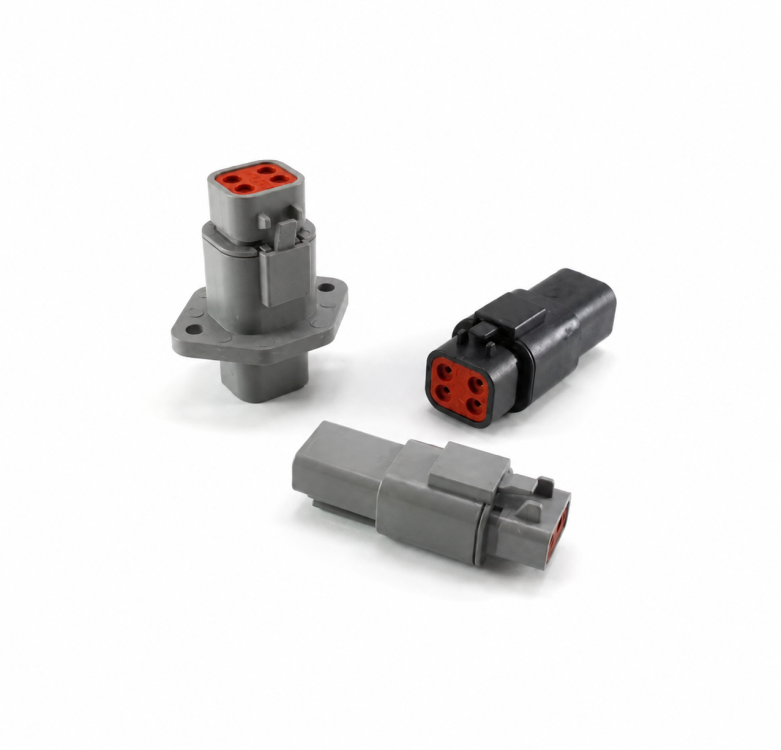
The DTP series uses a size 12 contact and is the highest current option of the three, intended for circuits that exceed what the DT series can handle.
- Current rating: up to 25 amps per contact
- Wire compatibility: 12 to 14 AWG with the standard solid contact; a dedicated stamped and formed contact extends this down to 10 AWG
- Cavity configurations: 2 and 4 position only
Because the DTP series is only available in 2- and 4-position housings, it's typically reserved for higher-draw circuits or main relays.
DTHD Series: Specifications and Uses
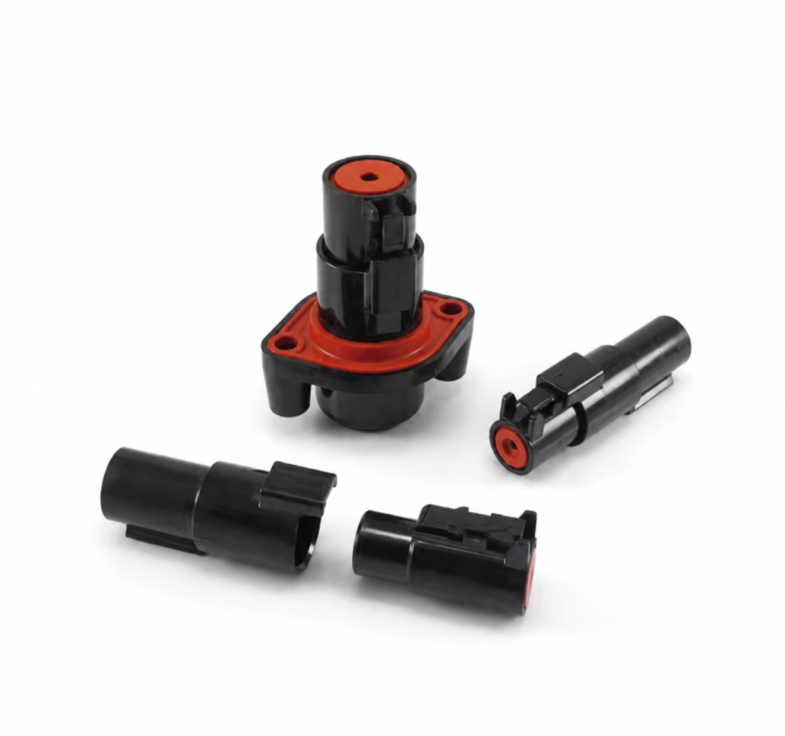
The DTHD series is a different shape of connector to the other three. Rather than a multi-pin rectangular housing, it's a circular, single terminal connector, essentially a heavy duty environmentally sealed alternative to splicing two power cables together. It's commonly used for high current, single-circuit connections such as electric power steering or alternator disconnects etc.
- Contact sizes: size 4 (100 amps), size 8 (60 amps) and size 12 (25 amps)
- Wire compatibility: 6 to 14 AWG
- Cavity configuration: single position only
The size 12 contact used in a DTHD connector is the same contact used in the DTP series. DTHD housings can be used in-line or panel mounted, and are available with optional end cap and flange mount modifications for different installation needs.
Which Deutsch Connector Should You Use?
| Series | Contact Size | Current Rating | Wire Compatibility | Cavity Options |
| DTM | Size 20 | Up to 7.5A | Up to 22 AWG | 2, 3, 4, 6, 8, 12 |
| DT | Size 16 | Up to 13A | 14 to 20 AWG | 2, 3, 4, 6, 8, 12 |
| DTP | Size 12 | Up to 25A | 12 to 14 AWG (10 AWG with S&F) | 2, 4 |
| DTHD | Size 4, 8 or 12 | 25A to 100A (size dependent) | 6 to 14 AWG | 1 (single terminal) |
As a rule of thumb, start with DTM for sensor wiring and low current circuits, move up to DT once you're past 7.5 amps, reserve DTP for the small number of multi-pin circuits on a car that draw serious current, and use DTHD if you need a single, heavy duty power connection, perhaps for ease of servicing.
Here's the same current ratings at a glance, laid out by amperage rather than by series:
| Connector Series | 7.5 amps | 13 amps | 25 amps | 60 amps | 100 amps |
| DTM Series | ✓ | ||||
| DT Series | ✓ | ||||
| DTP Series | ✓ | ||||
| DTHD Series | ✓ | ✓ | ✓ |
There are also some bussed (joiner), header and panel mount versions that use the same contacts and tooling; we're just going to stay focused on the inline connector versions today.
Sealing, Boots and Weatherproofing
All 4 options carry an IP68 (Ingress Protection) rating. Properly wired and mated connections will withstand immersion under 90cm or three feet of water (depending on your shoe size) without loss of electronic qualities or leakage. That rating depends on the connector being fully and correctly assembled, and on two separate seals both doing their job. A rear wire seal, or grommet, grips each individual wire where it enters the back of the housing, while a separate interfacial seal on the mating face seals the plug against the receptacle once the two halves are connected. The wedge lock needs to be seated behind the terminals for the connector to be considered properly mated, and any cavity you're not using needs to be filled with the correct size cavity plug. In a pinch, a short piece of filler wire with the same insulation diameter as the other wires can also seal the cavity, provided it is inserted correctly. An open, unplugged cavity gives moisture a direct path into the connector, even if every other pin is sealed and wired correctly, and while this is really quite an obvious and simple thing to state, it is still one of the most common things we see overlooked.
"Properly wired and mated connections will withstand immersion under three feet of water without loss of electronic qualities or leakage."
That durability isn't just environmental either. Deutsch rates DT, DTM and DTP connectors for a minimum of 100 mate and unmate cycles, more than enough for a harness you'll be plugging and unplugging repeatedly across a race season.
Once the contacts are crimped and inserted into the housing, the wedge lock fits behind them to confirm their position and provide secondary retention, stopping the contacts from backing out. On DT, DTM and DTP connectors, this also doubles as an alignment dowel, a moulded protrusion on the front of the wedge lock that the mating connector slides against, helping keep the two halves lined up before the pins make contact and reducing the risk of bent pins on mating.
"They are rated at 100 engagement cycles minimum... and even in a motorsport application, 100 engagement cycles is quite a lot." - Andre Simon, HPA
On the socket half of the connector, the housing includes a moulded recess designed to accept a heat shrink boot, so you can build a fully sealed transition from the connector back onto the harness. A section of SCL, semi rigid heat shrink, is a common and cost effective way to do this, and a proper Hellermann or Raychem heat moulded boot will also fit if you want a more finished result. The pin half of these connectors doesn't accept a boot in the same way, so that side of the connection typically stays on the sensor or actuator end of the harness, where it's less exposed.
Keying and Other Considerations
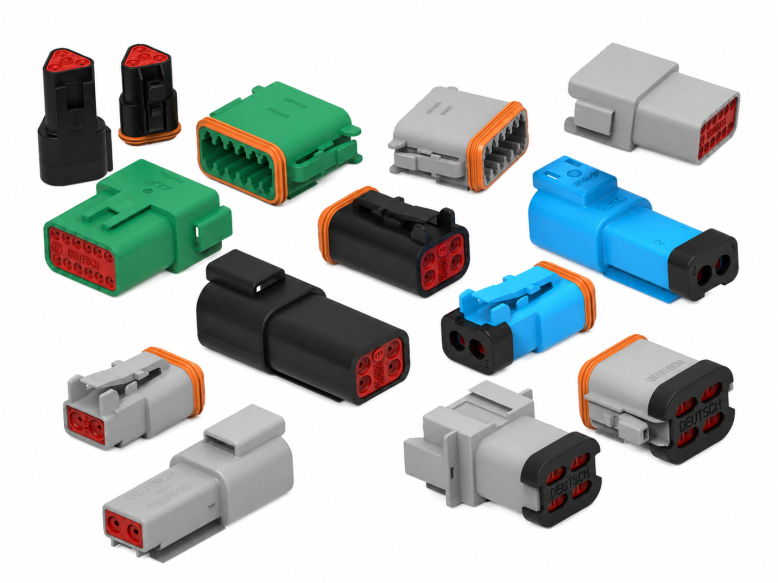
Thanks to continual product updates over the years, the 8-way and 12-way DT and DTM connectors are available in four keyed variants, A, B, C or D, which physically prevent a connector from mating with the wrong key. Connector body colour is sometimes used as a visual shorthand for this in supplier listings, but it isn't a reliable general indicator, grey and black bodies in particular can turn up across more than one keying, so don't assume colour alone tells you the key. Where black is actually worth noting is that it's commonly associated with an enhanced seal retention variant, better suited to smaller gauge wire, rather than being tied to a specific key.
On DTM specifically, keying is implemented through the wedge lock rather than the housing itself, different keyed wedge locks are available for the same DTM housing. In practice this isn't something you need to think about day to day, standard, non-keyed wedge locks cover the vast majority of builds.
The 2, 3, 4 and 6-way DT and DTM connectors don't offer keying at all, and neither does the DTP series across its 2 and 4-way options. On those non-keyed configurations, there's nothing stopping two identical connectors from being physically mated to the wrong mating half, especially where several sit close together, for example around an engine bay. Clear, consistent labelling is still the best safeguard on any non-keyed connector.
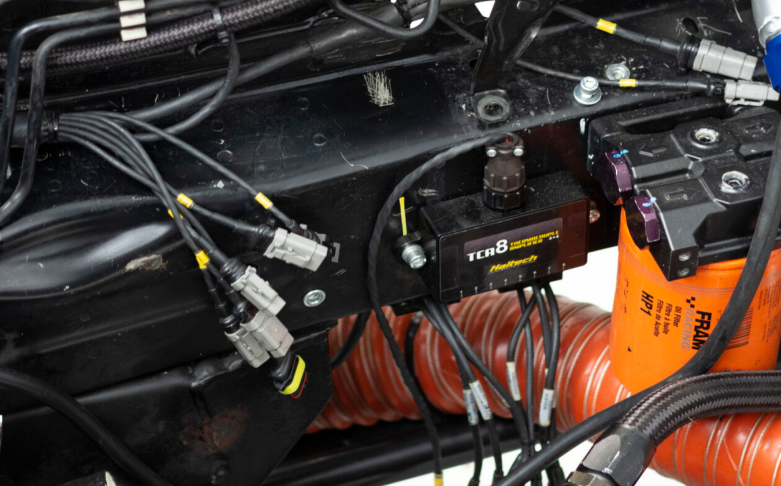
Another consideration to keep in mind is bulk. These connectors don't have the compact profile of some more expensive connector options, so a harness with a lot of Deutsch connectors positioned close together can end up adding noticeable bulk, potentially making routing and mating difficult. It's worth factoring that into your loom routing and mounting plan, with a simple staggered solution often being the easiest fix (much like what you should do with your splices!).
Tools You'll Need
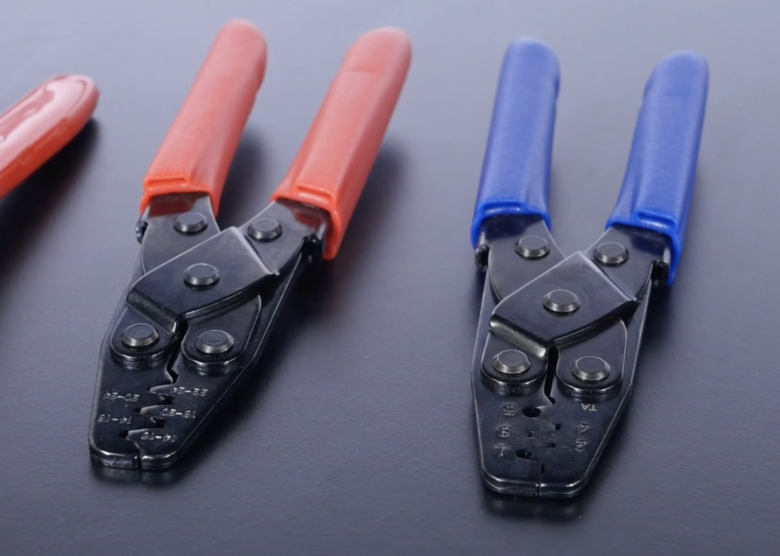
Terminating Deutsch connectors doesn't require the same specialised, expensive tooling that autosport-style (aka 'Race Spec' or 'Mil Spec') connectors need, although they certainly exist. Suitable tools are widely available at varying quality levels (you get what you pay for).
We're going to focus on the Deutsch/TE part numbers to start with and add some cross-references to a few (but not all) cheaper but reliable options out there from brands like Rennsteig, Sargent and Tool Aid. Some brands, like Tool Aid, replace one adjustable tool with multiple non-adjustable options that ultimately get the same job done for you.
Deutsch refers to its common machined contacts as solid contacts. They use a closed wire barrel, so they're also commonly described as closed-barrel contacts. The alternative construction is called stamped and formed, or S&F, also commonly described as open-barrel, with separate conductor and insulation-support crimp sections. The two constructions require different, non-interchangeable crimp tools.
In our case DT, DTM, DTP and DTHD connectors are typically used with solid, closed-barrel contacts. DT, DTM, and DTP housings can also accept stamped and formed open-barrel contacts; however, when done correctly, both are going to be perfectly functional connections that contain all that magical electrical smoke in the same way. You can even use both in the same connector in the case of a repair if it doesn't trigger your OCD too hard.
In our opinion, it is a personal choice that is mainly influenced by 2 factors.
- Closed barrel contacts are easier to work with and the tooling is cheaper | It's easier to keep them positioned while crimping, and there is only one crimp cycle with one tool doing many sizes.
- Open barrel contacts are cheaper (per contact) | They are a bit more fiddly to work with, the tooling is not as 'universal'. Both the conductor and insulation support need to be crimped, and general purpose tooling usually does that in 2 crimp cycles rather than a single one. A dedicated terminal-specific die can form both during one cycle, but they're not cheap!
TOOLING: Solid Contacts | Closed Barrel
The correct tool depends on contact size:
- Size 16 (DT) and size 20 (DTM): HDT-48-00 (12 to 22 AWG) or HDT-50-00 (12 to 20 AWG)
- Size 12 (DTP, and the largest DTHD contact): HDT-48-00 (12 to 22 AWG) or HDT-50-00 (12 to 20 AWG)
- Size 4 and size 8 (DTHD only): HDT-04-08 (4 to 10 AWG, per deutschconnector.com's crimp guide)
You may also come across the HDT-1561 listed for these same sizes, particularly through resellers. TE removed it from their current solid-contact tooling documentation, so treat it as a superseded part number.
HDT-48-00 is the more versatile of the two main tools. It covers a wider range of wire sizes and will work with DT, DTM, DTP connectors along with some DTHD, Jiffy Splice and some of Deutsch's round series connector options. It's also an adjustable tool rather than a fixed crimp, so you do need to set it to the correct position for your specific contact and wire gauge before crimping and Deutsch's solid contact documentation gives a specific dial setting for every contact and wire combination.
Other Brands and Cross-References
| Brand | Tool | Closest TE Reference | Documented Coverage |
| Rennsteig | 8782 0009 6 SelectorCrimp HDT-48 | HDT-48-00 | Deutsch solid contacts across 12 to 22 AWG |
| Sargent | 3107DTCT | Partial alternative to HDT-48-00 | Selected size 20, 16 and 12 Deutsch solid contact part numbers |
| Tool Aid | 18890 | Partial alternative to HDT-48-00 | Size 20 closed-barrel contacts using 20 and 22 AWG wire |
| Tool Aid | 18880 | Partial alternative to HDT-48-00 | Size 16 closed-barrel contacts using 14, 16 and 18 AWG wire |
| Tool Aid | 18860 | Partial alternative to HDT-48-00 | Size 12 closed-barrel contacts using 12 AWG wire |
| Tool Aid | 18870 | Partial alternative to HDT-04-08 | Larger Deutsch closed-barrel contacts using 6, 8 and 10 AWG wire |
These are cross-references rather than universal replacements. Always check the exact contact part number and wire size against the tool manufacturer's compatibility information before crimping.
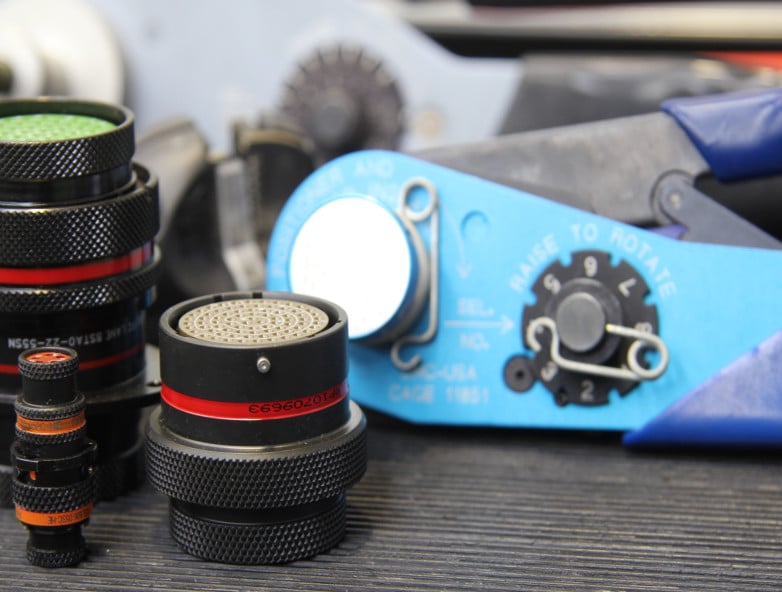
At the professional motorsport level, some builders use a different tool architecture entirely. A single tool frame fitted with interchangeable positioner heads, aka turrets or dies, with one per terminal size rather than one tool with a built-in adjustable dial. The DMC AFM8 or AF8 are the most popular versions of this you will probably see.
It's a genuinely different setup, not just a pricier version of the same thing and it comes at a real cost difference that only really benefits people wiring for a living, or large companies that need tools which can be calibrated and have routine calibration checks for quality control etc.
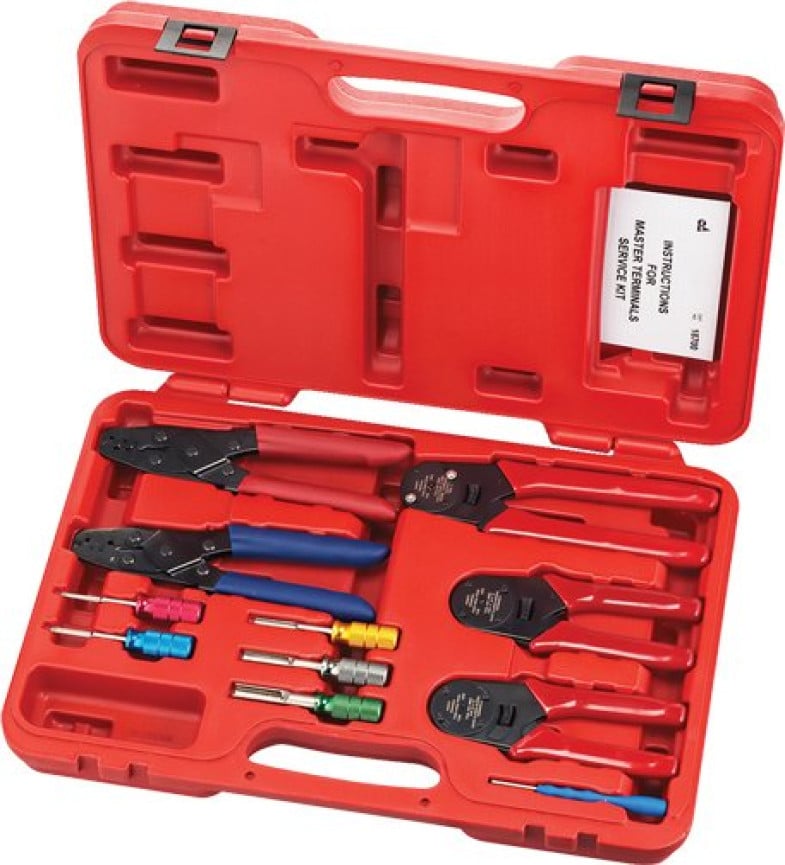
Where a club-level DTM crimp tool runs around USD$50-$250+, the professional-grade frame alone can run USD$700-1000, with positioners adding another USD$50-80+ each on top. Useful if you're working across several connector families professionally, but not something the standard size 12, 16 or 20 Deutsch solid contact needs. Beyond that again, TE also produces genuine production line equipment, power crimp presses and applicators designed for high volume manufacturing, well beyond what even a professional motorsport harness builder would typically need.
TOOLING: Stamped and Formed Contacts | Open Barrel
DT, DTM and DTP connectors can also be fitted with stamped and formed contacts, and so can DTHD's size 12 contact, though not its size 4 or size 8 contacts, which are closed only. Stamped and formed contacts have separate conductor and insulation-support crimp sections, formed using open-barrel tooling matched to the contact part number, wire size and insulation diameter, rather than the HDT range above. With the correct dedicated die, both sections are typically formed in one crimp cycle, though if you're working with general-purpose tooling rather than a terminal-specific die, it's common to crimp the conductor and insulation sections as two separate operations. Always confirm the contact construction before buying tooling, since solid and stamped and formed contacts aren't interchangeable on the same crimp tool.
Unlike the solid contact tools above, open barrel tooling is split further within each contact size by wire gauge, so there isn't one tool that covers a whole contact size the way HDT-48-00 does. Here's how TE's own DTT tools break down:
| Contact Size | DTT Tool | Wire Range |
| Size 16 (DT) | DTT-16-00 | 14 to 16 AWG |
| Size 16 (DT) | DTT-16-01 | 18 to 20 AWG |
| Size 16 (DT) | DTT-16-02 | 12 AWG (heavy-duty size 16 variant) |
| Size 20 (DTM) | DTT-20-00 | 16 to 20 AWG |
| Size 20 (DTM) | DTT-20-02 | 18 to 22 AWG |
| Size 12 (DTP / DTHD) | DTT-12-00 | 12 to 14 AWG |
| Size 12 (DTP / DTHD) | DTT-12-01 | 10 AWG |
TE's documentation also lists a DTT-16-03 for the 12 AWG size 16 variant, but we don't have its exact wire sub-range confirmed from the material on hand, so it's left off the table rather than guessed at. There's no open barrel option for DTHD's size 4 or 8 contacts, since those are solid only to begin with.
| Brand | Tool | Closest TE Reference | Documented Coverage |
| Rennsteig | PEW12 crimp frame (624 000 3 RT) + Deutsch DTM S&F die set (624 1599 3 01 RT), sold separately | DTT-20-00 / DTT-20-02 | DTM size 20 stamped and formed contacts, 0.35 to 1.00 mm² (roughly 22 to 18 AWG) |
The PEW12 is a general-purpose modular frame, not Deutsch-specific, so the frame alone won't crimp anything, you need the matching die set as well, and possibly a separate locator too, that part isn't fully clear from what we've sourced, so it's worth confirming directly with the supplier before buying. We haven't found an equivalent Rennsteig die set for DT size 16 or DTP/DTHD size 12 stamped and formed contacts, that may just be a gap in what's publicly listed rather than confirmation one doesn't exist.
You can find the documentation for 1.00 to 2.50 mm², roughly 16 to 12 AWG here, and 0.50 to 2.00 mm², roughly 20 to 14 AWG here.
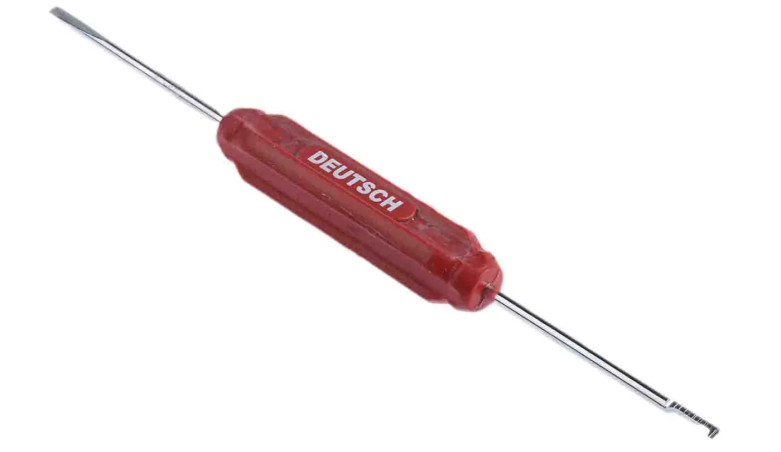
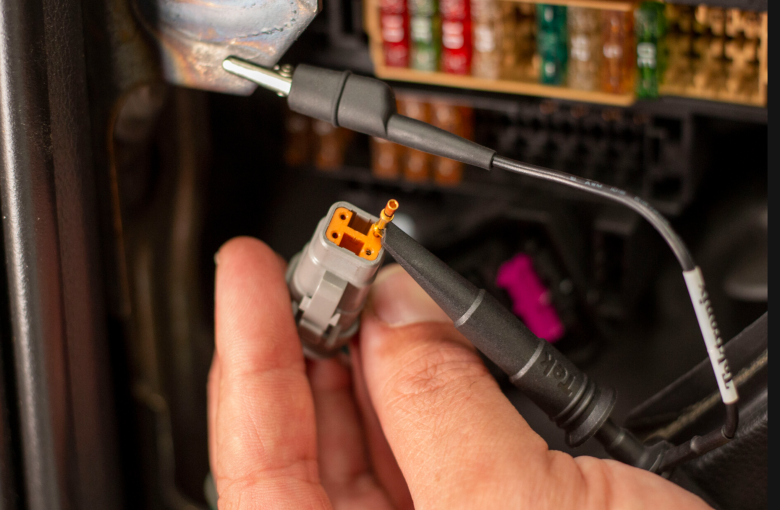
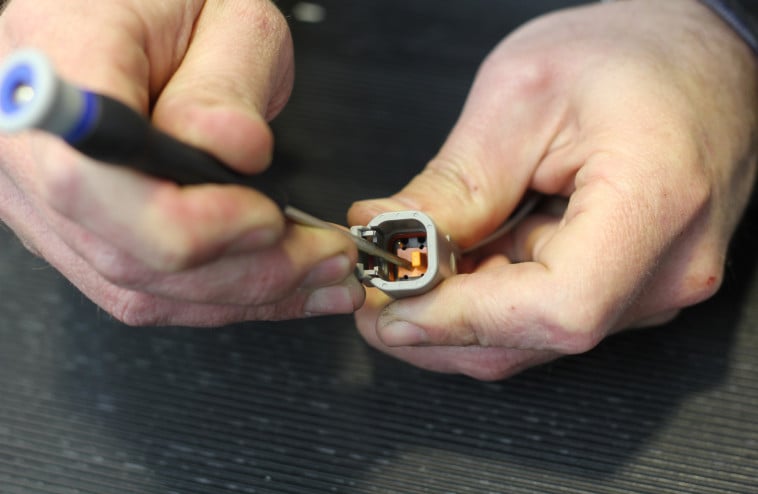
How a connector is assembled is important to understand in order to work out how to depin a connector too (unless you love just cutting perfectly fine connectors off your harness!). Many tools will get the job done, but a dedicated Deutsch removal tool (DT-RT1) makes the job really straightforward on DT and DTM connectors. It's hook-ended on one side for lifting the wedge lock out, with a flat, screwdriver-style tip on the other for releasing the locking finger inside the cavity. For a full walkthrough of the process, see HPA members' webinar 195 | Pinning and Depinning Common Connectors.
Where to Buy Deutsch Connectors
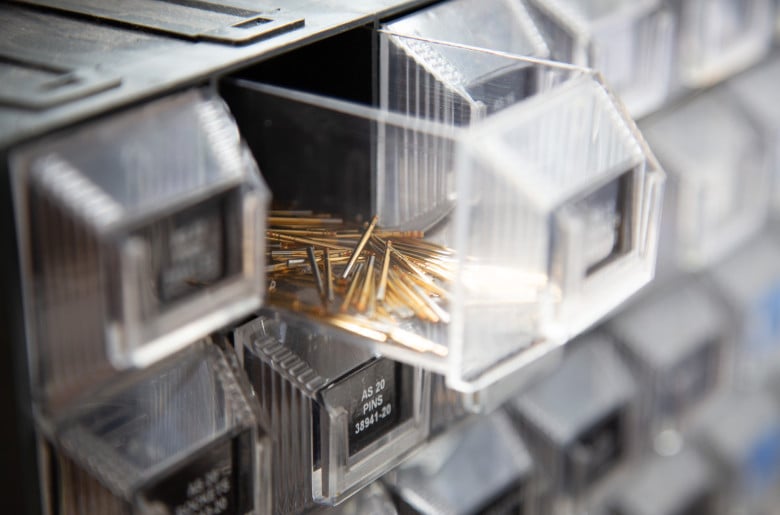
Deutsch connectors are widely stocked, and the right supplier for you usually comes down to your location, your timeframe, and whatever else you need for the same build. Rather than list specific suppliers here, which change over time, the HPA forum maintains a wiring and accessories suppliers list covering different regions, a good place to start.
How To Read Deutsch Part Numbers?
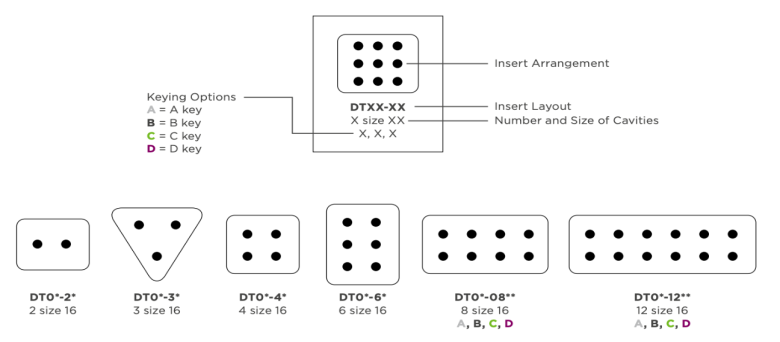
Deutsch part numbers look cryptic at first, but they follow a consistent, logical structure once you know what to look for. Take DT06-4S as an example:
- DT identifies the connector family (DT, DTM or DTP)
- 06 identifies the housing style, 06 is a plug, 04 is a receptacle
- 4 is the number of cavities, or positions, in that housing
- S identifies the housing as accepting socket contacts (P is used for pin contacts)
So DT06-4S is a 4-way DT plug that takes socket contacts, and its mating half, DT04-4P, is the corresponding 4-way receptacle that takes pin contacts. Where a connector is available with keying, a letter for the key, A, B, C or D, is added after the position number. The same logic carries across to DTM and DTP part numbers, just with M or P inserted into the family code. Note that contact size isn't spelt out in the DT, DTM or DTP part number itself, it doesn't need to be, since each of those three families only ever uses one contact size (DT is always size 16, DTM always size 20, DTP always size 12).
One thing worth calling out clearly: Deutsch's "plug" and "receptacle" terms don't map the way you might expect. The plug is the half that holds the socket (female) contacts, what most people would casually call the "socket side." The receptacle is the half that holds the pin (male) contacts, the "pin side." So a plug takes sockets, and a receptacle takes pins, the opposite of what the word "plug" might suggest.
DTHD part numbers work a little differently, because a single DTHD housing is offered in three different contact sizes rather than just one. Take DTHD06-1-4S as an example: DTHD identifies the family, 06 is the plug style (04 for receptacle), 1 indicates it's a single terminal connector, 4 is the contact size, and S indicates it accepts socket contacts. That extra digit for contact size is there specifically because, unlike DT, DTM and DTP, the same DTHD housing style comes in three sizes: 4 (100 amps), 8 (60 amps) and 12 (25 amps).
Conclusion
DT, DTM, DTP and DTHD between them cover the vast majority of the wiring requirements in a motorsport harness, from a low-current sensor through to serious fuel pumps, fans and other auxiliary systems without the cost or tooling investment of an autosport connector, yet are still robust and reliable. Picking the right series comes down to matching current draw and pin count to the job at hand, the physical room you have to work with, then sealing, keying where available, and labelling the harness properly once it's built.
If you want to go deeper on planning and building a fully sealed motorsport harness from the ground up, this free lesson series is a great next step.