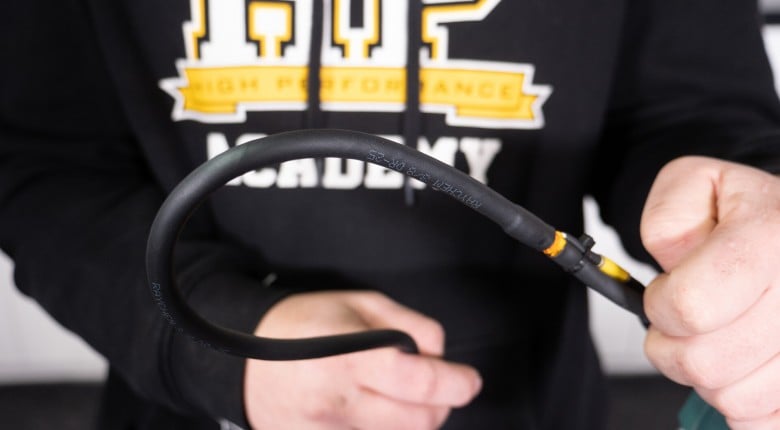
Building a motorsport wiring harness? Selecting the right wire is only part of the equation.
The sheathing used to protect the harness is just as important for long-term reliability, abrasion resistance, and overall appearance.
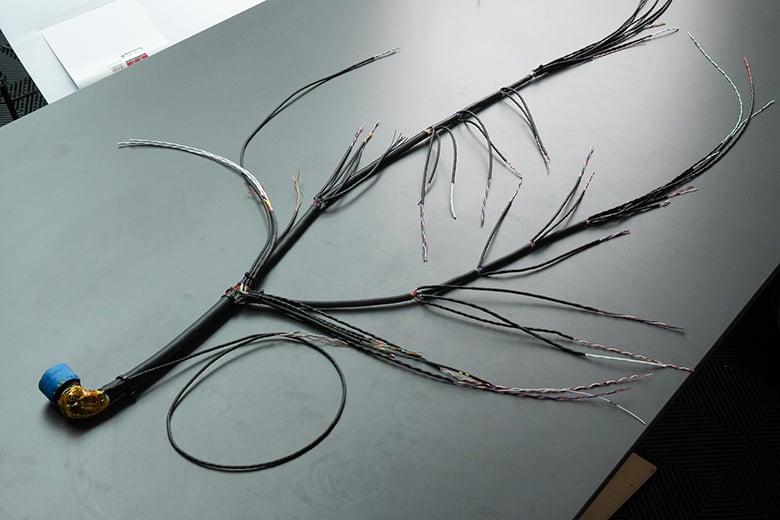
Harness sheathing protects the wiring from abrasion and heat while keeping the loom bundled neatly together, and plays a major role in the finished look of the harness. Look at any high-end motorsport wiring, and you'll always find a properly sheathed loom with clean branch points and transitions.
The two most common sheathing options used in EFI and motorsport harness construction are expandable braid and DR-25 heatshrink, so let's look into both of these and discuss what's going to work the best for our application.
In this article: What Is Wiring Sheathing? | Expandable Braid Sheathing | DR-25 Heatshrink | Dual Wall Heatshrink | Choosing the Correct Sheathing Size | Additional Heat Protection | Which Sheathing Should You Use? | Where Can I Buy Heatshrink? | Summary
What Is Wiring Sheathing?
Let's start with the very basics. Sheathing is the outer protective covering installed over the wires in a harness.
Its primary jobs are to:
- Protect the wires from abrasion
- Provide additional heat resistance
- Keep the harness organised and tidy
- Improve long-term reliability
- Create a professional appearance
While wire insulation already provides electrical protection, the additional sheathing protects the harness from harsh conditions found in the engine bay, especially in motorsport.
Expandable Braid Sheathing
Expandable braid is one of the most commonly used harness sheathing materials for modified street cars and club-level motorsport builds.
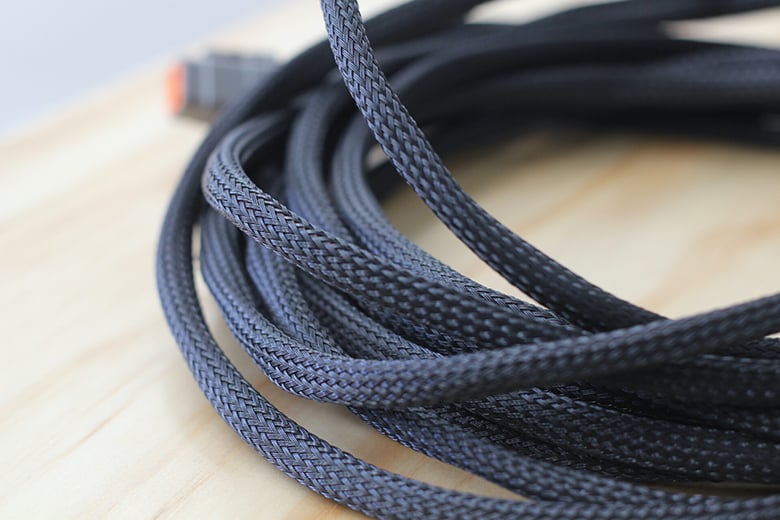
It consists of a woven plastic sleeve that expands in diameter when compressed lengthwise. This allows the braid to be slipped over the wiring harness before relaxing back into a tighter fit.
One of the biggest advantages of expandable braid is its serviceability. Because the braid can be re-expanded after installation, it can be removed relatively easily if the harness needs to be modified or repaired later.
Expandable braid is also appreciated for its:
- Ease of installation
- Excellent abrasion resistance
- Lower cost
- Flexible and lightweight construction
The main downside, however, is that expandable braid can't create a fully sealed harness due to its woven construction. This makes it less suitable for professional motorsport applications where complete environmental sealing becomes crucial.
One challenge when working with expandable braid is that the cut ends tend to fray very quickly. Ideally, expandable braid should be cut using a hot knife, which melts the plastic fibres together during cutting, preventing the material from unravelling.
Since most of us don't have access to a dedicated hot knife, many fabricators develop their own techniques for working with braid using standard hand tools. Taking the time to properly prepare and finish expandable braid makes a major difference to the final appearance and durability of the harness.
When selecting expandable braid for engine bay use, it's important to choose a product with a temperature rating of at least 125°C to ensure long-term reliability.
DR-25 Heatshrink
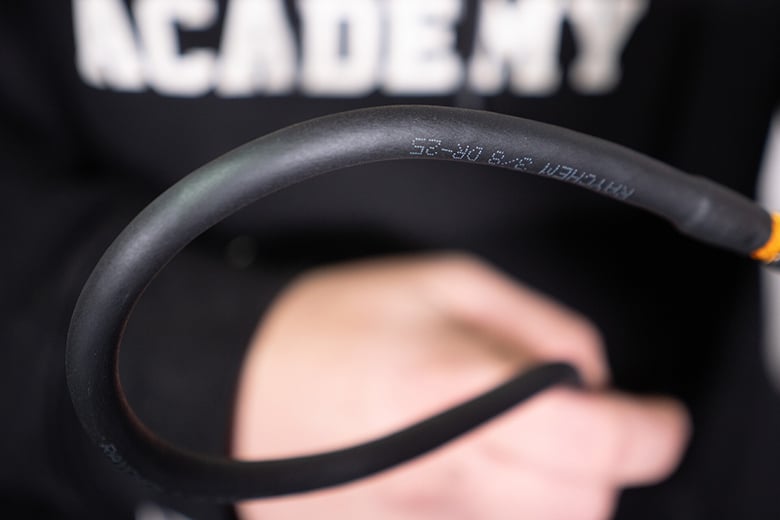
For professional motorsport harness construction, the industry-standard sheathing material is Raychem DR-25 heatshrink, and this differs significantly from the standard heatshrink commonly used in electronics.
Once recovered, DR-25 has a much thicker wall, which allows it to remain flexible while providing great abrasion resistance and environmental sealing.
Let's run through a list of the main advantages of DR-25 heatshrink:
- Excellent abrasion resistance
- Can create a fully sealed wiring harness
- Resistant to heat, aviation and diesel fuels, hydraulic fluids, and lubricating oils
- Professional motorsport-standard appearance
- Retains flexibility after recovery
- Provides excellent long-term durability in harsh environments
- Compact finished harness size
- Improved strain relief when used with moulded boots
All these advantages do come with a major trade-off. If changes are required later, the DR-25 must be carefully cut off and replaced, and because of this, DR-25 harness construction is often considered a "one-chance" process.
Because DR-25 creates a sealed harness once recovered, it's critical that every wire, branch, and connector must be correctly positioned before any heat is applied. This means that, compared to expandable braid, working with DR-25 heatshrink requires significantly more planning and precision.
DR-25 has a 2:1 shrink ratio and an operating temperature range of -75°C to 150°C, making it well suited to the demands of the engine bay. So, for example, 1/2-inch DR-25 shrinks down to approximately 1/4-inch when fully recovered.
When shrinking DR-25, a minimum temperature of 175°C is required for full recovery. A quality heat gun is generally preferred over an open flame to achieve even heat application and avoid overheating or damaging the material. When using a heat gun, some minor surface wrinkling is normal due to non-uniform heating and has no effect on the performance of the tubing.
As the DR-25 shrinks down, it forms a tough outer shell that still retains flexibility while dramatically improving abrasion resistance and environmental sealing.
It's also important to understand that DR-25 should be allowed to fully recover to its intended diameter. Using oversized sheathing that only partially shrinks can reduce abrasion resistance and leave the harness looking loose or unfinished. Avoid recovering DR-25 over sharp edges, as these can puncture the tubing and cause it to split during installation.
Professional motorsport harnesses will also commonly use heatshrink moulded boots at branch transitions to improve sealing and strain relief, further increasing durability in harsh racing environments.
You can download the DR-25 datasheet for more specific details here.
Dual Wall Heatshrink (Glue Shrink)
Another important material commonly used in motorsport harness construction is dual-wall heatshrink, commonly referred to as glue shrink.
Unlike standard heatshrink, dual-wall heatshrink features an internal adhesive lining that melts as heat is applied during recovery.
As it shrinks down onto the harness or connector, the adhesive flows into gaps and around surfaces. Once cooled, the adhesive solidifies again, creating a sealed and mechanically supported connection.
Dual-wall heatshrink is most commonly used for:
- Sealing harness branch points
- Supporting connector terminations
- Providing strain relief
- Preventing expandable braid from fraying
- Creating sealed connector boots
Two of the most common motorsport-grade dual-wall heatshrink products are Raychem ATUM and Raychem SCL, with SCL being more commonly used on many wiring projects here at HPA.
ATUM features a 4:1 shrink ratio, making it particularly useful when the heatshrink needs to fit over large connector bodies or branched sections before shrinking tightly into place.
The adhesive lining inside ATUM also remains relatively flexible once cooled, similar to traditional hot glue. This makes it a good option for applications where some flexibility in the finished harness is desirable.
Raychem SCL behaves quite differently from ATUM.
SCL has a 3:1 shrink ratio and a continuous operating temperature range of -55°C to 110°C. Once cooled, it becomes significantly more rigid than ATUM, which provides excellent strain relief and creates an extremely robust branch or connector transition.
The adhesive lining used in SCL is a black potting compound that generally provides a stronger and more durable seal than the softer adhesive found in ATUM.
This makes it especially useful for creating professional motorsport connector boots because it can be shaped while still hot to permanently set the angle at which the harness exits the connector.
Regardless of which dual wall heatshrink product is used, proper surface preparation is critical for achieving a reliable bond. Before installing this sheathing, the surface it will recover onto should be thoroughly abraded using something like 150-grit emery paper. This roughened surface dramatically improves adhesive bonding and helps ensure long-term reliability in harsh automotive environments.
You can find the SCL datasheet here, and the ATUM datasheet here for more details.
Choosing the Correct Sheathing Size
The sizing process for expandable braid and DR-25 heatshrink is essentially the same.
First, measure the outside diameter of the harness section you want to sheath. From there, select the largest size of braid or DR-25 that will still tighten down firmly around that diameter once relaxed or recovered. For DR-25, always aim for the tubing to shrink by at least 20% of its supplied diameter, while leaving at least 10% of recovery potential unrealised. This ensures the tubing conforms properly to the harness and achieves its full recovered wall thickness.
It's also worth accounting for length shrinkage. DR-25 will shorten slightly during recovery, so always cut lengths a little longer than the distance you need to cover.
Correct sizing is important because:
- Oversized sheathing can look loose and untidy
- Undersized sheathing becomes difficult to install
- DR-25 needs proper recovery to achieve full wall thickness and abrasion resistance
- Tubing that fully reaches its maximum recovered diameter may not conform as reliably to surface irregularities
Proper sizing also helps maintain flexibility while keeping the harness compact and professional-looking.
For more information, TE Connectivity have a detailed explanation here.
Additional Heat Protection
Even with careful harness routing, some sections of a motorsport loom may still need extra heat protection due to proximity to exhaust systems, turbochargers, or other high-temperature components.
In these situations, additional high-temperature silicone sheathing can be installed over the existing harness sheathing. This extra layer helps shield the harness from radiant heat while maintaining flexibility.
Unlike expandable braid or DR-25, silicone heat sheathing is neither shrinkable nor expandable. This means it must be installed before the harness connectors are pinned and terminated, otherwise it won't fit over the connectors later.
The silicone sleeve is typically secured at both ends to prevent it moving along the harness during operation.
Which Sheathing Should You Use?
For most modified street cars and enthusiast-level motorsport projects, expandable braid is usually a perfectly good choice thanks to its affordability, ease of installation, and ability to be modified later.
For professional motorsport applications where environmental sealing, weight reduction, and maximum durability are priorities, DR-25 is generally considered the gold standard.
Neither option is universally better, and the right choice depends on your budget, application, and long-term serviceability requirements.
Where Can I Buy Heatshrink?
There are a range of wiring suppliers listed in the HPA forum, covering expandable braid, DR-25, ATUM, SCL, and silicone sleeving sources alongside wiring crimp and strip tools, connectors, terminals and wire like Tefzel or Spec 44. The best supplier for you will depend on your location, timeframe, and what other materials you need to source at the same time.
Summary
Harness sheathing plays a critical role in protecting motorsport wiring from abrasion, heat and environmental damage while also creating a clean professional appearance.
Expandable braid offers flexibility, affordability and easy future modifications, making it ideal for many enthusiast builds.
DR-25 heatshrink provides superior sealing and durability for professional motorsport applications, although it requires much more planning because the harness can't easily be modified once recovered.
Regardless of which option we choose, proper sizing, careful installation, and appropriate heat protection are essential for building a reliable motorsport wiring harness.
Are you interested in building your own wiring harness from scratch? It might seem daunting at first, but this is all very much learnable from home. Get started with High Performance Academy's Wiring Fundamentals course.